
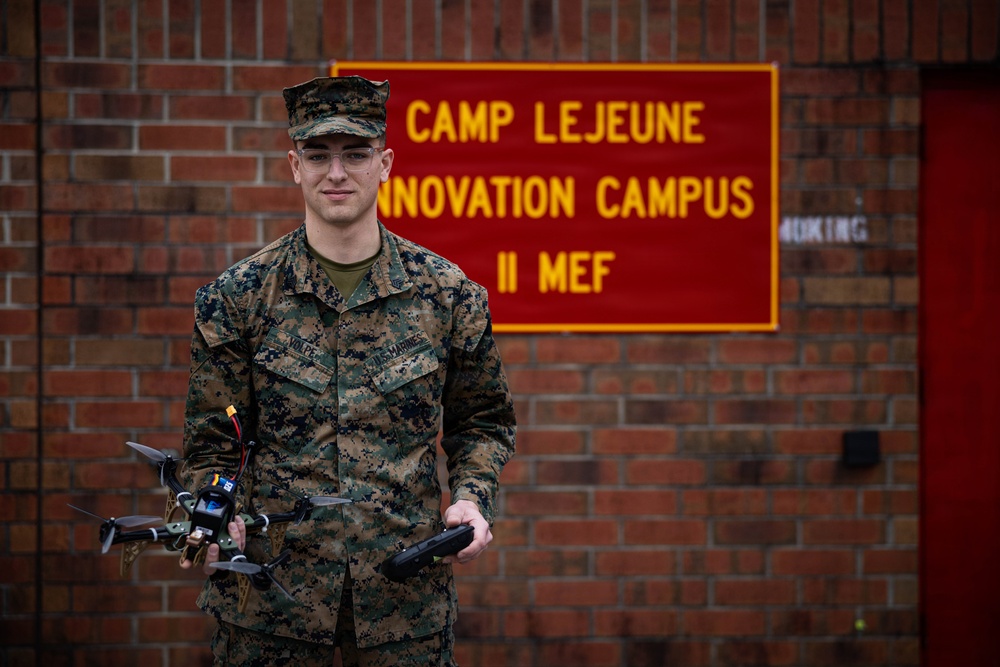
The Marine Corps has written field-manufactured drones into its logistics policy. A Canadian defense firm is now marketing a containerized factory aimed at that kind of work.
The policy is Marine Corps Order 4700.4A, dated May 8, 2026, and filed under Standard Subject Identification Code 04000, Logistics. It reissues the service's advanced manufacturing (AdvM) policy and contains a short, blunt instruction: "Commanders at all levels shall develop and employ AdvM technologies to the fullest extent possible in order to enhance lethality and survivability."
The hardware pitch comes from Sentinel Advanced Military Solutions of Chateauguay, Quebec, a subsidiary of CMP Advanced Mechanical Solutions. Military & Aerospace Electronics reports that Sentinel has picked Phillips Federal as its authorized US federal resale and service partner for three deployable manufacturing systems: Forge-X, Forge-Extreme and Forge-Expedition. Sentinel says it printed drone frames inside a Forge-X container, assembled them on site and flew them during an August 2026 exercise with I Marine Expeditionary Force (I MEF) at Camp Pendleton.
The two developments line up neatly, but they are not the same thing. One is binding Marine Corps policy. The other is a vendor announcement that, by DroneXL's reading, names no contract, no Marine Corps order, no price, no drone count, no print times and no flight results.
What the order actually covers
MCO 4700.4A is listed as current in the Marine Corps Electronic Library. It defines roles for the "immediate integration" of advanced manufacturing across ground equipment, unmanned vehicles and systems, additive and expeditionary construction, and ground-based ammunition.
For the drone community, the important clause is its scope. The order applies to "all Group 1 and 2 advanced manufactured sUAS and components." It does not apply to Group 3 through 5 unmanned aircraft or to manned aviation. Those remain under the Naval Aviation Maintenance Program (NAMP) and Naval Air Systems Command (NAVAIR). DroneXL notes that Groups 1 and 2 top out at 55 pounds (25 kg). Anything heavier stays inside the established naval aviation process.
The order also states its threat case directly. DroneXL quotes it: "The enemy is now capable of targeting our supply chains and the industrial base." The order's stated goal is to manage risk, not eliminate it. Per DroneXL, commanders may field printed items unless they judge that a failure would likely cost a life, a limb, eyesight or a major piece of equipment.
The order also deals with intellectual property, which may matter more than the printers. According to DroneXL, it authorizes manufacturing equipment where the Marine Corps holds the technical data rights, and it calls for acquiring technical data packages (TDPs). A container is only as useful as the data rights behind what it prints.
The Forge-X pitch
Sentinel describes Forge-X as more than a printer in a box. According to Military & Aerospace Electronics, the system makes drone components, assembles and repairs aircraft in the field, and adapts designs from digital files stored on site. That last capability is the core of the pitch. A forward unit holding a library of designs could change an airframe to suit a mission, or replace a damaged part, without waiting on a supply chain the order itself says is under threat.
Forge-X is part of what Sentinel calls its StarForge ecosystem. The company groups edge manufacturing, digital stockpiles, modular infrastructure, power, uncrewed aircraft and counter-UAS under that name. Sentinel names Lockheed Martin Skunk Works as the contributor of command-and-control software and sensor fusion.
The Camp Pendleton demonstration is the company's main evidence. As Military & Aerospace Electronics recounts it, frames were printed inside the container during the August tactical exercise with I MEF, assembled on site, and flight-tested in a simulated mission. Sentinel CTO Edward Zimmermann is quoted in the company's announcement.
Phillips Federal is a division of Phillips Corporation. As the authorized federal reseller and service partner, it gives Sentinel a US channel for selling to government buyers. Sentinel's parent CMP has more than 700 employees, DroneXL reports.
What hasn't been disclosed
The announcement leaves several questions unanswered. DroneXL reports that the release does not name:
- a contract or contract value;
- any Marine Corps order for Forge-X systems;
- a unit price;
- how many drones were printed or flown at Camp Pendleton;
- print times per frame;
- flight-test results;
- who owns the design files the container would print from.
The last gap connects most directly to the order. MCO 4700.4A ties field manufacturing to the government holding technical data rights. A container that "adapts designs from digital files stored on site" is only as useful to the Marine Corps as the rights to those files. If the designs belong to the vendor, the Corps would be buying a factory that only makes what its supplier licenses. If the Corps owns the TDPs, the container becomes a commodity production cell. Sentinel's announcement doesn't say which model it is selling.
The Marines are already printing drones
Field-built drones are not a new idea for the Corps. DroneXL points to HANX, a 3D-printed drone that the 2nd Maintenance Battalion built in 90 days. That example suggests the binding constraint is not whether Marines can print and fly a small UAS. It is whether the service can do it at scale, near the front, with designs it controls and a risk framework commanders can apply without escalating every decision. The new order addresses the policy and risk side. Vendors like Sentinel are pitching the hardware.
Why It Matters
MCO 4700.4A moves field manufacturing of small drones from experimentation to expectation. The word "shall" in the commander's guidance, the explicit inclusion of Group 1 and 2 sUAS, and a risk threshold that tolerates failure short of life, limb, eyesight or major equipment together give units policy cover to print, assemble and fly their own aircraft. The carve-out for Group 3 through 5 systems leaves larger aircraft under NAMP and NAVAIR.
That creates potential demand for containerized manufacturing systems like Forge-X, and a US federal reseller gives Sentinel a sales channel to government buyers. Until Sentinel or the Marine Corps discloses a contract, cost data or test results, though, the Camp Pendleton exercise is a demonstration, not a program of record. Buyers should also look past the container to data rights. Under the Corps' own policy, the right to print a design matters as much as the machine that prints it.
