
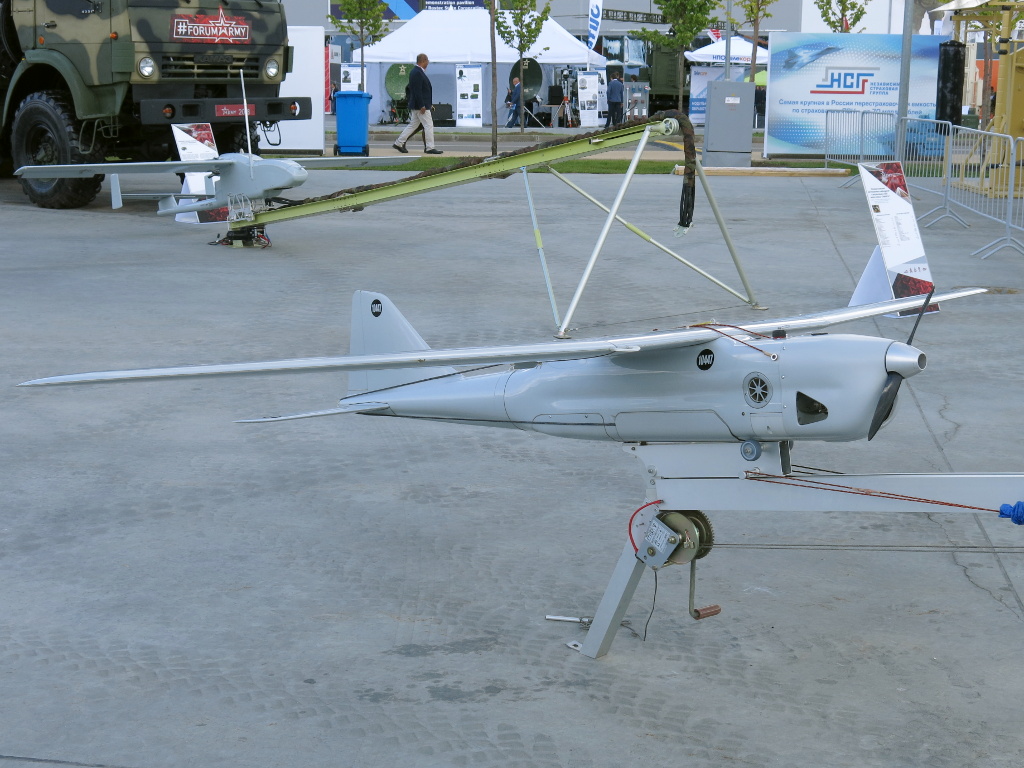
Before a Russian Msta-SM self-propelled howitzer fires, something has to find the target. For the past decade, that something has usually been an Orlan-10. Russia's most widely deployed tactical drone entered combat in the Donbas in 2014, served in Syria between 2015 and 2018, appeared in Libya in 2019, and has been a near-constant feature over eastern Ukraine since February 2022. Its function is deceptively simple: locate targets, relay coordinates to artillery, confirm the strike. That loop — sensor to gun to correction — is why Ukrainian forces have made shooting down Orlan-10s a persistent priority.
A Dining-Room Table That Runs on Car Fuel
Physically, the Orlan-10 is modest. Wingspan 3.1 meters, fuselage 2 meters, empty weight 12.5 kg. Its single-cylinder piston engine runs on AI-95 automotive gasoline. Cruising speed is 110 km/h, maximum 150 km/h, ceiling 5,000 meters. Endurance of 16–18 hours gives it loiter time that covers most of the tactical depth a brigade formation needs to observe.
Launch requires no runway — a portable collapsible catapult handles that — and recovery is via parachute with pneumatic shock absorbers that inflate just before impact. The system has been operational since 2010. The sensor suite rides in interchangeable gyro-stabilized pods: a Canon DSLR and Phase One IXA 180 camera for optical work, and a Lynred PICO-640-046 infrared thermal camera (640×480, 120 Hz) for night operations. Navigation uses dual GPS/GLONASS waypoint autopilot; one ground station can control up to four vehicles simultaneously, with a data link rated to 120–600 km (practical reception peaks around 180–200 km). If satellite signals are jammed, an optical recognition fallback keeps the drone functional.
Three Aircraft, Three Jobs
Russia does not deploy Orlan-10s alone. The standard packet is two or three aircraft in coordinated roles: one at 1,000–1,500 meters for persistent ISR, one as an electronic warfare or data-relay node, one dedicated to artillery spotting and correction. The fire-control aircraft transmits target coordinates directly to gun crews and can assess battle damage without returning to base.
The EW node has become a system in its own right. The Leer-3 complex pairs three Orlan-10 variants with a six-wheel command-and-control truck to form a mobile cellular intercept and suppression unit. It suppresses cellular networks, intercepts calls and texts, and determines subscriber IMSI locations. U.S. military sources cited by Newsweek described the capability to disable cellular networks, and allow the [Russian military] to send fake messages to subscribers
while preserving service for Russian-operated devices. On April 9, 2024, Ukraine's 129th Territorial Defense Brigade destroyed a Leer-3 system in Zaporizhzhia with HIMARS rockets, illustrating the system's vulnerability once located.
Built From Russia's Adversaries' Parts
Analysts examining captured Orlan-10 wreckage reached a pointed conclusion: the drone defining Russian tactical reconnaissance is built almost entirely from components manufactured by Russia's adversaries. The component list confirms that assessment. Processing and communications hardware includes chips from Texas Instruments, Analog Devices, and Xilinx (now AMD). GPS modules are Swiss. Infrared matrices come from France's Lynred. Communications equipment is German. Phase One IXA-180 cameras are Danish. FLIR systems are American. Navigation chips use Israeli licenses. Chinese suppliers T-Motor and Radiolink Electronic Limited provide propellers, engines, flight controllers, and GPS modules; Sony cameras and Lenovo laptops appear in captured airframes.
SMT-iLogic3, a St. Petersburg procurement intermediary for STC, has been under U.S. sanctions since December 2016. The U.S. Department of Commerce placed STC itself on the Entity List in June 2022, citing an international network
of intermediaries in China, Hong Kong, Macau, and Canada. The EU, UK, Canada, and Japan added sanctions against STC in 2022; Ukraine and Switzerland followed in 2023. None of it halted procurement. From January through October 2022 — the invasion's first year and the first wave of new sanctions — STC acquired $25.75 million in Western products through intermediary firms in China, Serbia, the UAE, and Turkey. Two identified nodes: SMT-iLogic3 and US-Russian dual citizen Igor Kazhdan, both named as conduits for controlled components.
Ukraine's Main Intelligence Directorate struck from a different angle in 2023, acquiring 100 gigabytes of classified STC data covering 194 items — technical drawings, specifications, patents, software. Officials valued the cache at approximately $1.5 billion, crediting cooperation with patriotic representatives of civil society and the media community.
Output, Exports, and What Comes After
Production has scaled regardless. STC moved into a former Yulmart warehouse — 25,100 square meters — in January 2023. Russian Defense Minister Sergey Shoigu stated in July 2023 that Orlan-10 and Orlan-30 supplies had risen by 53 times since early 2022.
The baseline was already above 1,000 units delivered pre-war; unit cost runs $87,000–$120,000. Rosoboronexport displayed the Orlan-10E export variant at Defence Services Asia 2026 in Kuala Lumpur, marketing it as combat-proven
for artillery targeting.
The heavier Orlan-30 extends the family with a 3.9-meter wingspan, 300 km range, and — critically — an integrated laser target designator capable of designating targets for laser-guided munitions. Orlan-30 production has scaled up to 25 times compared to 2021 levels, per Rosoboronexport. No verified open-source specifications for an Orlan-50 exist; the designation appears in reporting as a rumored next-generation platform without confirmed public documentation.
The Orlan-10's weaknesses are catalogued: EW susceptibility, small-arms-range operating altitude, GPS spoofing exposure. They have not prevented it from serving as the connective tissue between Russian sensors and fires across a decade of conflict on three continents. The drone is cheap, proliferating, and sanctioned in ways that demonstrably have not stopped its manufacture. Until Russian artillery is denied the ability to see what it is shooting at, the Orlan-10 — and whatever follows it — remains a defining problem for any force operating against Russian ground units.
Sources
- GlobalSecurity.org — Orlan-10 UAV specifications and operational history
- Airforce Technology — Orlan-10 Unmanned Aerial Vehicle
- Euromaidan Press / Inform Napalm — Orlan-10 production ramp despite sanctions (2024)
- Army Recognition — Ukrainian intelligence breach of STC classified data
- Army Recognition — Russia exports Orlan-10E at DSA 2026
- Newsweek — Russian Leer-3 EW system destroyed by HIMARS in Zaporizhzhia (2024)
- MissileStrikes.com — Orlan-10 specifications and combat record
- United24 Media / RUSI / Istories / Reuters — Western components in the Orlan-10
- EDR Magazine — Rosoboronexport showcases Orlan-30 UAV
- Congressional Research Service — Russia's War in Ukraine: Military and Intelligence Aspects (R47068)
