
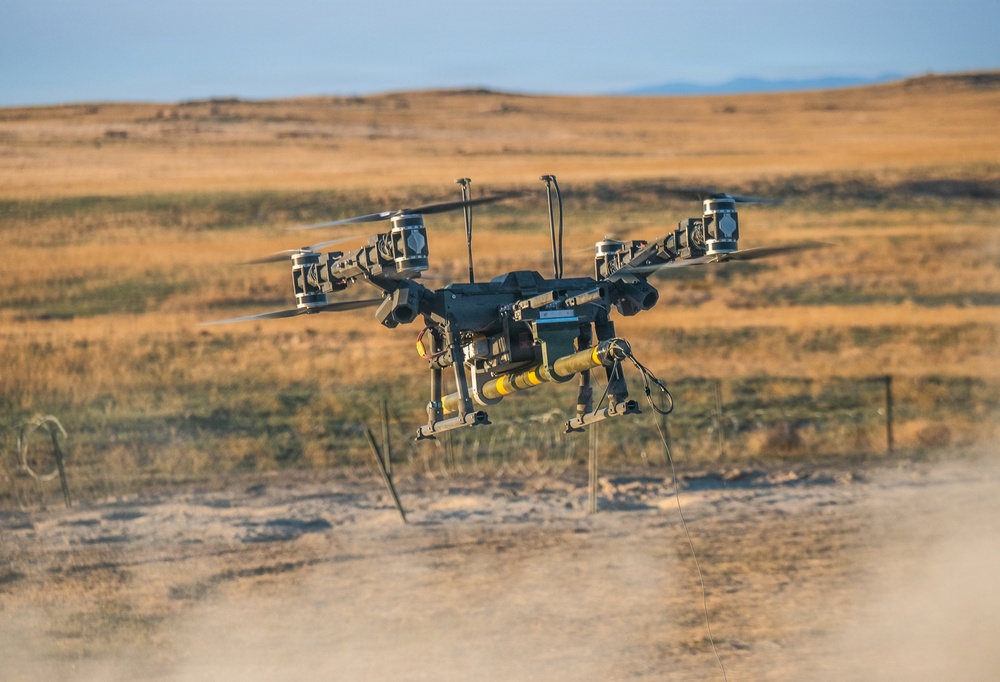
Breaching a wire obstacle is one of the oldest and most lethal problems in ground combat, and until now the solution has always demanded that a soldier crawl forward into the killing zone with an explosive charge in hand. On June 22, 2026, combat engineers from the Oregon Army National Guard tried something different: they let a drone do the crawling.
At Range 22 of the Orchard Combat Training Center in Idaho, soldiers from Bravo Company, 741st Brigade Engineer Battalion, part of the 41st Infantry Brigade Combat Team, flew a heavy-lift drone to carry, place, and remotely detonate a live two-section M1A3 Bangalore torpedo through a concertina-wire obstacle. The charge blew a lane through the wire while the engineers stayed under cover. The demonstration, which the National Guard described as a proof-of-concept, was reported by the Army Times on June 30 under a headline that captured the point precisely: the U.S. Army going into the breach without soldiers.
An old munition, a new delivery method
The Bangalore torpedo is not a new weapon. It is a length of pipe packed with explosive, screwed together in sections and shoved under or through a wire entanglement to clear a path — a design that has been a staple of combat engineering since the First and Second World Wars. What is new is the delivery. Instead of a soldier pushing the charge into place by hand, the Oregon Guard used a drone built by Lorica Technologies in Ashland, Oregon, a heavy-lift platform the company calls the "Mule 28."
That marriage of a WWII-vintage munition to a modern unmanned lift is the whole idea. The Bangalore still does the work of tearing open the obstacle; the drone simply removes the human being from the most dangerous part of the operation. According to the National Guard's own account, the drone delivered the explosive to clear concertina wire so that soldiers could remain covered, and personnel triggered the detonation remotely.
How they got to a live charge
Detonating a live Bangalore torpedo carried by a drone is not the sort of thing an engineering unit does on the first attempt. According to KPIC, Bravo Company worked through a graduated safety build-up before the final shot. The sequence started with an inert training aid, moved to an inert Bangalore fitted with a blasting cap, progressed to detonating cord, and only then culminated in the live charge that cut the lane through the wire.
That deliberate escalation is what turned a concept into a capability. "The Soldiers of Bravo Company took an idea from the battalion staff and applied their expertise to make that idea functional and effective," said Lt. Col. Eric Zimmerman, the battalion commander.
Why Ukraine is in the room
The inspiration for the effort is explicit, and Zimmerman named it. "Watching what was going on in Ukraine, and how innovative they are, it inspires you to get better and think bigger," he said in the National Guard's account of the test. The war in Ukraine has become a live laboratory for cheap unmanned systems reshaping battlefield tasks that used to require crewed vehicles or exposed infantry, and the Oregon Guard's breach demonstration reads as a direct application of that lesson to the assured-mobility mission of combat engineers.
What actually happened, in plain terms
What was the objective? To breach a concertina-wire obstacle — the tangled coils of razor wire used to channel and slow an attacking force — without sending a soldier forward to place the charge.
What did the drone do? The heavy-lift Mule 28 carried the demolition charge to the obstacle and maneuvered it into position to open a lane through the wire. Army Times reported that the drone maneuvered the charge while personnel detonated the explosive remotely.
Why does the Bangalore matter here? It is a proven, purpose-built wire-breaching munition. Pairing it with a drone means engineers do not have to invent a new explosive; they only have to change how it gets to the target.
Who documented it? The demonstration was covered by the National Guard's own newsroom as a primary source, by the Defense Visual Information Distribution Service (DVIDS) with official imagery and video, and by regional and defense-trade outlets including KPIC and Army Times.
Why It Matters
Obstacle breaching is, by long consensus among ground forces, among the deadliest phases of any assault. An attacking unit is at its most exposed when it stops at a wire or minefield and must clear a path under fire. Every technique that keeps a soldier out of that moment is worth a hard look, and a drone that flies a standard Bangalore torpedo into the obstacle does exactly that — it substitutes an inexpensive, expendable machine for a human being in the killing zone.
The Oregon Guard's demonstration is significant precisely because it is not exotic. It takes a munition the Army has fielded for generations and a commercially built heavy-lift drone, and combines them into a capability that a brigade engineer battalion could plausibly practice and refine on its own. Army Times framed the demonstration within the Army's broader push to reduce risk in obstacle-breaching operations, and the fact that it emerged from a National Guard unit rather than a major program office underscores how accessible the underlying pieces have become.
It is still a proof-of-concept, not a fielded system, and the graduated safety process the unit followed is a reminder that flying live explosives is unforgiving work. But the trajectory is clear: the tools that are rewriting the war in Ukraine are now being tested against one of the ground soldier's oldest and most lethal tasks, and a wire obstacle in the Idaho desert just got breached with nobody in the open.
Sources
- Oregon Guard Engineers Test Drone-Delivered Breach Capability (National Guard)
- The US Army goes into the breach — without soldiers (Army Times)
- Oregon National Guard tests drone to remotely deliver explosive during training (KPIC)
- Oregon engineers breach wire obstacle with drone-delivered Bangalore (DVIDS)