
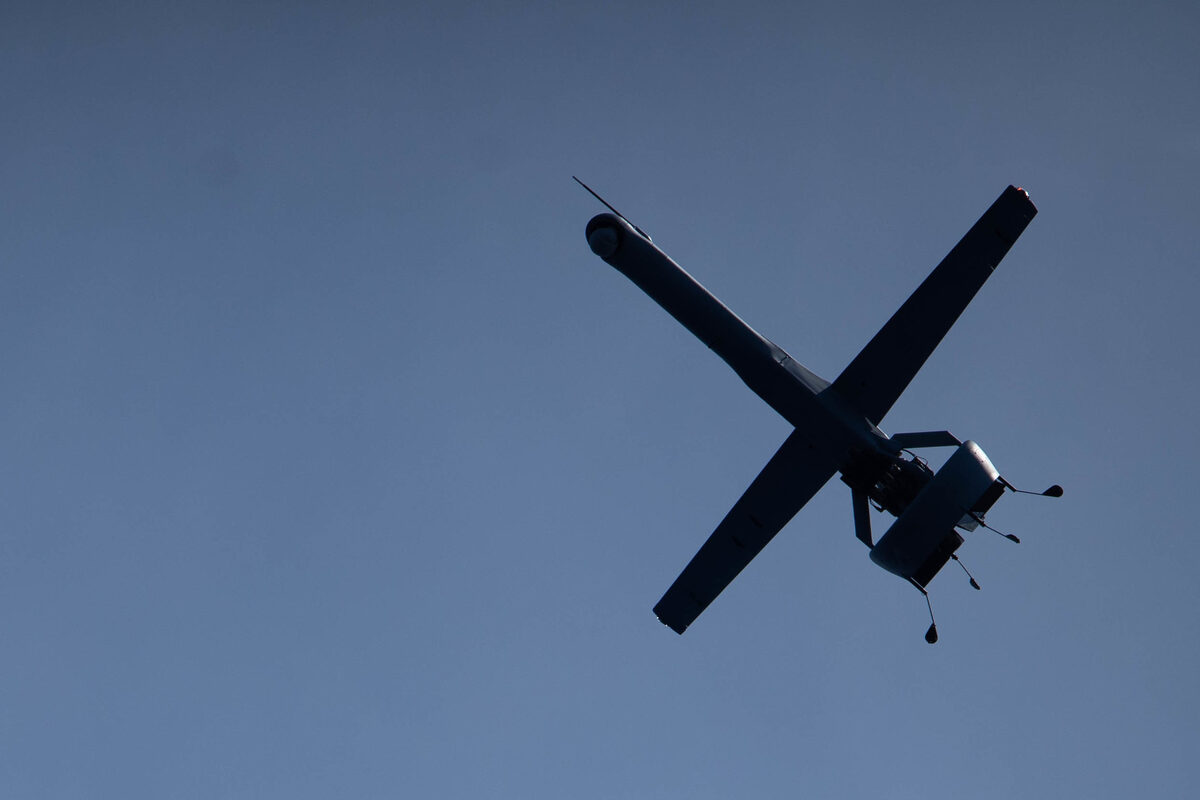
Greece is getting more V-BATs. Two details are missing, though: how many, and for how much.
Shield AI announced on Nov. 11 that the NATO Support and Procurement Agency (NSPA) had ordered additional V-BAT vertical take-off and landing (VTOL) uncrewed aircraft for the Hellenic Army and Hellenic Navy. NSPA placed the contract through its UAS Support Partnership. On Nov. 13, Janes reported that the company release gives neither a quantity nor a contract value. Janes also added a date: the first aircraft from the order are due in January 2027, according to Shield AI's James Lythgoe.
Here is what the public record does and does not show, why Greece went through a NATO agency instead of buying the aircraft directly, and how the order fits Shield AI's growing presence in the Greek defense market.
What Is Actually Known
Greece already flies a small V-BAT fleet. Janes puts the existing inventory at six aircraft, with two delivered in March. The Greek forces use them for intelligence, surveillance and reconnaissance (ISR) over both land and sea.
The paper trail for expanding that fleet goes back several months:
- June 2: The Hellenic Army signed a procurement agreement with Shield AI, according to Janes.
- July 23: A Greek Ministry of National Defence statement said the government had approved buying 10 more V-BATs.
- Nov. 11: Shield AI announced the NSPA order for additional V-BATs for the Army and Navy.
- January 2027: First deliveries from the new order are expected, per Lythgoe as quoted by Janes.
A reader might assume the NSPA order covers the 10 aircraft the Greek government approved in July. That may well be the case, but none of the sources say so. Shield AI's release refers only to "additional" aircraft, and Janes explicitly notes the missing quantity and value. Until NSPA, the Greek MoD or Shield AI gives a number, it is best treated as unconfirmed.
The Aircraft
The V-BAT is built around a single enclosed ducted fan. It launches and lands vertically without assistance or dedicated launch equipment, according to Defence Industry Europe. Shield AI describes it as able to operate from ship decks, islands, remote coastlines and other austere sites without runways. For a navy that matters: an aircraft that needs no dedicated launch equipment is easier to base on a ship than one that does.
Janes lists these specifications:
- Wingspan: 3.8 m
- Maximum take-off weight: 75 kg
- Payload: 18.1 kg
- Propulsion: heavy fuel engine (JP5)
- Endurance: 12-plus hours with an EO/IR payload
- Range: 130–180 km, depending on data link
The heavy-fuel engine counts for more than it might seem. Militaries try to run their equipment on common fuel supplies, and a drone that burns a fuel already in the military logistics chain, such as JP5, can ease that burden.
Shield AI also says the V-BAT has shown resilience in GPS-denied and communications-denied conditions. That is a company claim. The sources contain no independent test data on it, and it should be read that way.
Why Buy Through NSPA?
The procurement route is the more interesting part of the story. NSPA's UAS Support Partnership lets participating nations buy and support uncrewed aircraft through a shared legal framework, while each country keeps ownership and control of its own capabilities, Defence Industry Europe notes.
According to the Shield AI release carried by ASDNews, NSPA's AGS and UAS Programme provides life-cycle support spanning acquisition, spares, maintenance, training, upgrades and technical assistance. The release says that by consolidating national requirements, NSPA can reduce contracting timelines, create common support solutions and provide access to shared logistics and economies of scale. Shortening the time from a budget decision to aircraft on the flight line is the main appeal of pooled procurement.
The release does not explain why no quantity or value was published, and the sources do not say who decided that. The lack of a number does not by itself suggest anything unusual, but it does mean outside observers cannot yet judge the scale of Greece's commitment.
The release also points to a doctrinal benefit. Operating a common V-BAT fleet across the Armed Forces supports interoperability and standardized training and maintenance. Two services flying the same aircraft can share training and logistics instead of duplicating them.
The Aegean Problem
Lythgoe called the V-BAT "exceptionally well suited to the Aegean," where, he said, forces need long-endurance ISR from islands, coastlines, ships and austere sites without dependence on runways. An aircraft with 12-plus hours of endurance that does not need a runway fits that description on paper, provided it performs as advertised.
The existing six-aircraft fleet already flies ISR missions over land and sea, so the new order expands a capability Greece has been using rather than introducing a new one.
Shield AI's Widening Greek Footprint
The V-BAT order is one piece of a larger Shield AI push into Greece, set out in the company's release:
- Athens office: Shield AI has opened a regional office in Athens.
- X-BAT MoU with GEK TERNA: In October, Shield AI signed a memorandum of understanding with GEK TERNA to pursue X-BAT opportunities in Greece, including a Greek industrial participation strategy and potential local production and sustainment.
- KMB Hunter with ALTUS LSA: In July, Shield AI partnered with ALTUS LSA to arm the V-BAT with the Greek-built KMB Hunter interceptor. The pairing suggests the V-BAT could carry an effector, not just sensors.
- Hivemind with EFA GROUP: Shield AI also works with EFA GROUP on sovereign autonomous pilots powered by Hivemind.
Taken together, these deals look like a localization strategy: a local office, industrial partners, and Greek-built content integrated into the platform. That is this article's reading of the deals, not a claim made in the sources.
Why It Matters
The order is a modest piece of news, but it shows a few things about how European militaries are buying drones.
First, it shows pooled NATO procurement being used for a tactical UAS, not only large strategic programs. If the January 2027 delivery date holds, first aircraft would arrive roughly six months after the Greek government's July 23 approval, though the sources do not confirm that the order matches that approval. Other mid-sized allies weighing similar purchases have an existing route to look at.
Second, Greece is committing to a single ISR platform across two services, with the training and maintenance benefits Shield AI describes.
Third, the opacity is a real gap. Without a quantity or contract value, there is no way to tell whether this is a token follow-on buy or a substantial expansion of a six-aircraft fleet. The July approval for 10 aircraft gives a plausible upper reference point, but no source ties the two together. The January 2027 delivery should eventually answer the question. Until then, Greece's V-BAT fleet is growing by an undisclosed amount at an undisclosed price.
Sources
- NSPA orders more V-BAT UAVs for Greece, delivery in January 2027 (Janes, Nov. 13, 2026)
- Shield Receives NSPA Order for Additional V-BATs for Hellenic Army and Navy (Shield AI release via ASDNews, Nov. 11, 2026)
- Shield receives NATO agency order to supply more V-BAT drones to Greece's Army and Navy (Defence Industry Europe, Nov. 11, 2026)
