
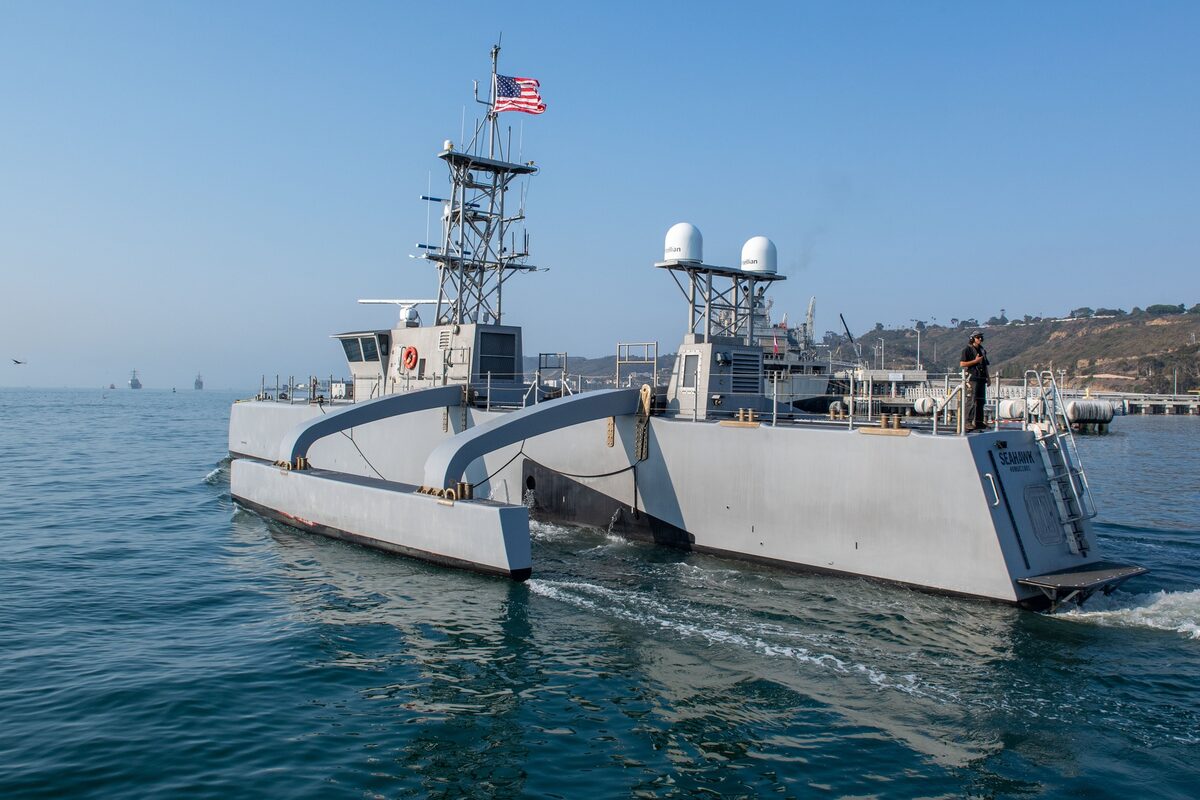
The Navy's Medium Unmanned Surface Vessel (MUSV) program has moved from published requirements in March to a production order in September. On Sept. 29, Navy officials confirmed production Other Transaction agreements (OTAs) for 30 medium-sized robotic ships. Galliano Marine Services, HII and Saronic each get an agreement for 10 vessels. The average price is about $40 million per vessel, which puts the combined order at roughly $1.2 billion.
The awards follow a Phase I at-sea test campaign. According to a Navy Program Executive Office press release reported by DefenseScoop, the agreements went to the three companies "after successful at-sea testing." Janes reports that Chris Miller, acting direct reporting portfolio manager for Robotic and Autonomous Systems, said production begins immediately. He said deliveries could start as early as the fourth quarter of fiscal 2027. DefenseScoop's account of the release puts initial deliveries before the end of fiscal 2027.
What the Navy Bought
The three winners are Galliano Marine Services, which does business as Edison Chouest, along with HII, which is offering a design called Romulus, and Saronic, offering Marauder. Each agreement covers 10 MUSVs. The $40 million figure is an average per vessel, as reported by both Janes and The War Zone, so the final cost of each hull may differ from it. The $1.2 billion total is simple arithmetic on that average (30 vessels at $40 million each), not a separate contract ceiling stated in the sources.
The War Zone reports that production will take place at shipyards in Loreauville, Houma and Franklin, Louisiana. The sources reviewed here do not say which company will build at which yard.
The Phase I Test
Seven companies competed in Phase I, according to The War Zone. Janes and The War Zone describe the test as about 26 hours and more than 360 nautical miles, run from a single command-and-control input. Miller said the format showed a vessel could run more than 24 hours at extended range with minimal operator input.
The Navy's March threshold requirements were demanding for an unmanned vessel. They called for a range of 2,500 nautical miles at 25 knots, carrying a 25 metric ton payload in Sea State 4. The vessels also had to carry forty-foot-equivalent-unit containerized payloads. The test above was a demonstration run, not a full trial against every one of those thresholds, and the sources do not say how each vessel performed against them.
Who Didn't Get a Production Order
Not every company that cleared Phase I gets hulls. Janes reports that Leidos, PacMar and Sea Machines also met the Phase I requirements but did not receive production OTAs. Each of the six Phase I companies receives $15 million and a place on the Maritime Marketplace hosted on Drones.mil. The marketplace gives the Navy a pool of vetted vendors to draw on later, and keeps the companies without production orders eligible for follow-on production agreements from authorized acquisition authorities across the Defense Department.
Relation to the Phase II Call
This production award is separate from the Phase II call for solutions the Navy issued less than a week earlier, per DefenseScoop and The War Zone. The Phase II notice, as described by The War Zone, set different design limits: no more than 295 feet or 5,000 metric tons of displacement, at least 10 days of unmanned operation, and a design ready for an operational demonstration at the time of submission. In other words, the Navy is buying the first 30 vessels from Phase I while opening a second competition for what comes next.
DefenseScoop also notes that the award came less than a week after the Navy established a new Robotic and Autonomous Systems Warfighting Development Center at Joint Expeditionary Base Little Creek. DefenseScoop says the center is expected to play a major role in shaping how the Navy fights with uncrewed systems.
Why It Matters
The MUSV has been a long-running ambition, and The War Zone's headline says the Navy has "finally" advanced it. Converting a test campaign into a 30-vessel production order is a notable step: The War Zone says the Navy has tried and failed to field larger drone boat fleets before, and its capability today is a small force of largely experimental, optionally crewed designs.
The choice of OTAs is part of the story. The War Zone describes OTAs as a contracting mechanism designed to support rapid prototyping and research work without more traditional and often lengthy processes, though the sources do not detail these agreements' terms. DefenseScoop frames the buy as part of a broader effort to ramp up robotic capabilities. DefenseScoop reports that Chief of Naval Operations Adm. Daryl Caudle ties MUSVs to what he calls the "Hedge Strategy" and a "Tailored Offset."
The order also spreads risk. Three different companies will build 10 vessels each, which would likely limit the effect of a flaw in any single design. Leidos, PacMar and Sea Machines remain on the marketplace and are eligible for follow-on production agreements.
Open questions remain. The sources do not describe the payload configurations of the first 30 vessels, how they will be crewed for maintenance, or how the Navy will measure performance against the March thresholds, which the Phase II notice relaxes on speed and at-sea refueling. With deliveries starting no earlier than the fourth quarter of fiscal 2027, the first real data on how these ships work at scale is still to come.
