
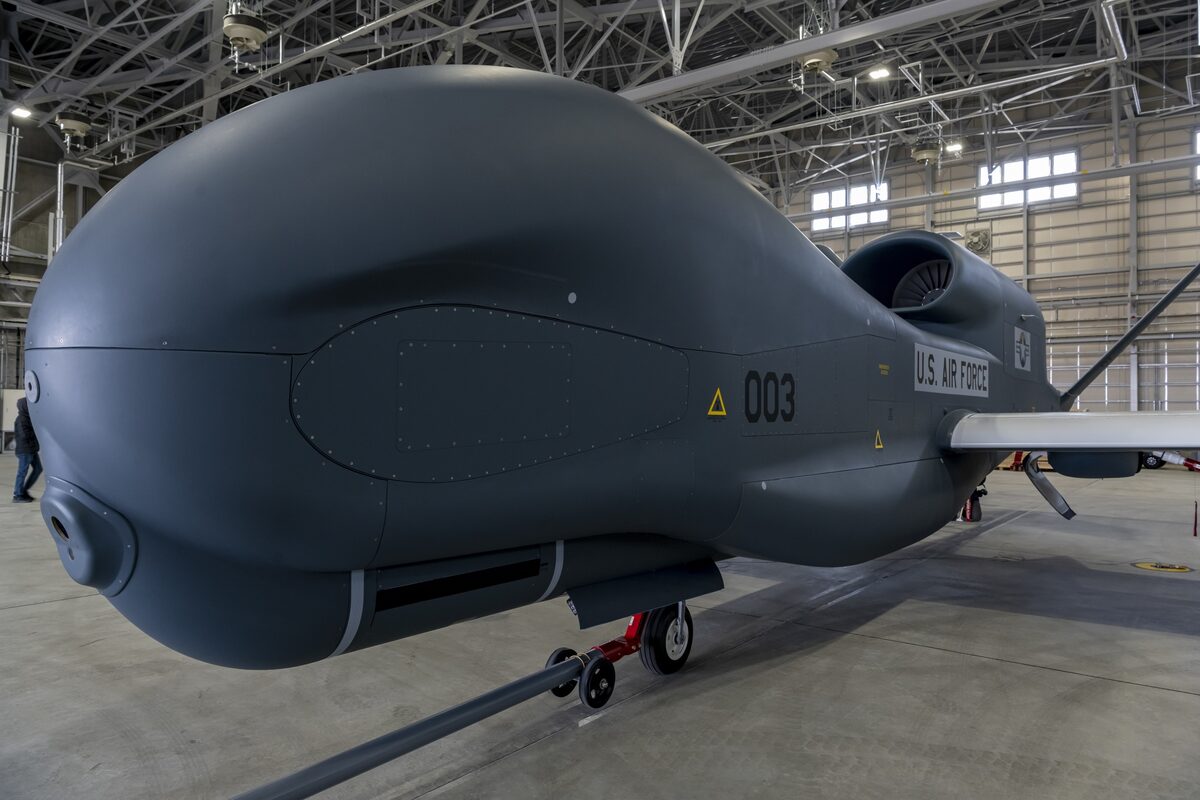
Japan lost one of its three RQ-4B Global Hawk surveillance drones on September 15, 2026, when the aircraft went down in the Sea of Japan roughly 50 kilometers (about 30 miles) off the coast of Tottori Prefecture. It is the first crash of a Global Hawk in Japan Air Self-Defense Force (JASDF) service, and it removes a third of the country's entire high-altitude, long-endurance surveillance drone inventory in a single incident.
The aircraft, an RQ-4B Block 30i assigned to the 502nd Squadron of the Airborne Warning and Control Wing at Misawa Air Base, took off at 10:20 a.m. local time. According to Janes, ground controllers lost contact with the drone at 12:55 p.m. and lost its radar return three minutes later, at 12:58 p.m. The Japan Coast Guard dispatched a helicopter that spotted floating debris at 2:19 p.m., and a JASDF F-15J fighter sent to search the area located additional wreckage six minutes later, at 2:25 p.m.
JASDF Chief of Staff Gen. Takehiro Morita confirmed the loss at a press conference, telling reporters the flight was not a training exercise. Stars and Stripes reported the crash site was about 30 miles north of Tottori Prefecture, consistent with Janes' roughly 50-kilometer figure, and that the cause remains under investigation. Defense Ministry spokesman Kimihito Aguin said the incident would not halt Japan's surveillance operations: "The Self-Defense Forces are maintaining the necessary operational posture," he said, adding that missions would continue while the investigation proceeds.
A Small Fleet Gets Smaller
Japan's Global Hawk fleet was never large to begin with. The JASDF received its three RQ-4B Block 30i aircraft between March 2022 and June 2023, according to Stars and Stripes, at a combined acquisition cost of roughly $450 million. c4isrnet separately reported a per-airframe price of about $163 million. That price tag buys an aircraft with a 32-hour endurance, a 60,000-foot operating ceiling, and a sensor suite combining electro-optical/infrared (EO/IR) cameras, synthetic aperture radar (SAR), and ground moving target indicator (GMTI) capability, per c4isrnet's reporting. With Friday's crash, the fleet drops from three to two aircraft — an instant one-third reduction in Japan's dedicated high-altitude surveillance drone capacity, and the kind of loss that is difficult to absorb quickly given the aircraft's cost and the years-long lead times typical of RQ-4 production and delivery.
What We Know — and Don't — About the Cause
None of the reporting so far identifies a mechanical, weather, or operational cause for the loss of contact. What is established is the timeline: a normal takeoff from Misawa at 10:20 a.m., contact lost at 12:55 p.m., radar contact lost three minutes later, and debris confirmed on the surface of the Sea of Japan by early afternoon. Gen. Morita's confirmation that the flight was operational rather than a training sortie indicates the drone was flying a real surveillance mission at the time of the incident, though none of the available reporting specifies the mission's target or purpose. Stars and Stripes noted the investigation into the cause is ongoing, and no source reviewed here has reported a preliminary finding.
Why It Matters
Global Hawk is central to Japan's ability to watch its own airspace and surrounding waters continuously and from altitudes and standoff ranges manned aircraft cannot easily match. With only three aircraft to begin with, Japan's Global Hawk fleet had essentially no depth: any single loss was always going to be proportionally severe, and a one-third cut hits exactly that vulnerability. The Defense Ministry's insistence that surveillance missions will continue suggests Tokyo intends to keep flying the remaining two aircraft at or near the same operational tempo, which means less redundancy and less margin for maintenance downtime or a second unplanned loss. The incident also lands amid a broader regional context in which Japan has leaned on persistent, high-altitude ISR (intelligence, surveillance, and reconnaissance) to track activity near its coastlines. A fleet reduced to two aircraft has less capacity to sustain overlapping or back-to-back long-endurance missions, and any extended grounding pending the investigation's outcome would compound the gap further. Given the roughly $163 million unit cost and the fleet's age — the oldest aircraft delivered only in March 2022 — replacing the lost airframe, if Japan chooses to do so, would be a slow and expensive undertaking rather than a quick fix.