
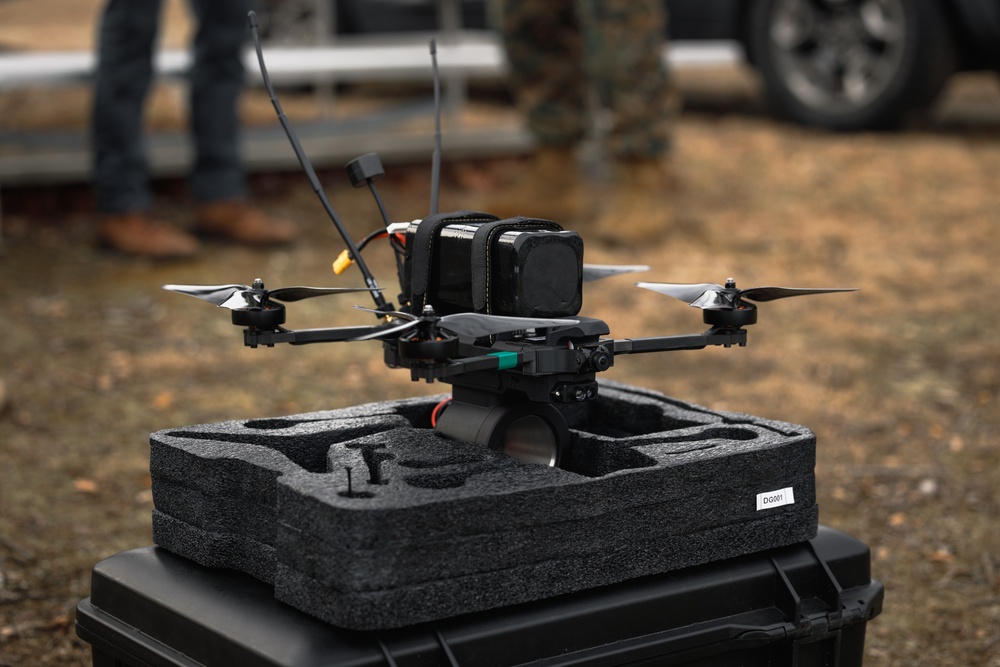
The Drone Dominance Program (DDP) has opened its third buying round, and the terms are tougher than the last. A Sept. 28 announcement titled "DDP RFS 3 is Open" puts $450 million toward roughly 60,000 drones. Any company that wants to reach the next evaluation event, Gauntlet III, must first deliver a 400-drone production order in about two months.
The announcement, published on the program's site as announcement data, says the DDP will award $1.1 billion in prototype orders across multiple independent phases. Phase 3 puts $450 million of that toward roughly 60,000 drones.
What Phase 3 Buys
The $450 million is split evenly across two mission sets, Deep Strike and Close Quarter Battle (CQB). Deep Strike covers finding and striking targets from stand-off positions out to about 20 km. Both categories will be tested in GNSS-denied and communications-denied environments.
The announcement also includes an option to buy up to 40,000 more drones, for a potential total of 100,000. Those extra units would be bought at company-determined pricing. The stated reason is to "better understand the pricing in the marketplace."
Price Points Move in Opposite Directions
- Deep Strike: the drone price, excluding weaponization, rises to $5,000 from $4,500.
- CQB: the price falls to $3,000 from $3,500.
The two moves point different ways. The announcement says the Deep Strike increase is meant to let companies add capability, particularly better compute, communications or sensing. It says the CQB cut reflects scaling purchases and improving supply chains.
The Math Does Not Fully Close
DroneXL ran the numbers and found a gap. At the listed prices, 60,000 drones cost $180 million if all are CQB and $300 million if all are Deep Strike. Either way, the $450 million headline is not fully accounted for by airframe prices alone.
The announcement is also ambiguous about whether "split evenly" refers to dollars or to drone counts, DroneXL notes. By our own arithmetic, an even split by count (30,000 of each) would come to $240 million at the listed prices. An even split by dollars ($225 million per mission set) would imply different unit counts in each category.
The Deep Strike price excludes weaponization, but the announcement does not say how the remaining budget is meant to be used. The answer matters for bidders sizing their production plans.
The plan has shifted over time, too. According to DroneXL, citing Washington Technology, the December 2025 plan called for Phase 3 to buy 100,000 drones at $3,000 each. The 100,000 figure survives as the ceiling with the option, and the $3,000 price survives only for CQB.
The 400-Drone Gate
The most consequential change is the entry requirement. Each firm that reaches Gauntlet III must first deliver a 400-drone production order in about two months.
That is a step up from Gauntlet II. According to Soldier Systems Daily, Gauntlet II qualifiers had to fill a 120-drone order with lethality payloads in about five weeks. DroneXL puts the new gate at more than three times the quantity, over about two months. Production capacity, not only flight performance, looks set to be a filter.
Gauntlet II scoring already reflected that emphasis. Soldier Systems Daily reports that companies were scored on performance in the event, evaluations by military operators, and demonstrated production and supply chain capabilities. The 400-unit order makes production a hard pass/fail test before a company is allowed to compete.
Who Gets In
The announcement lays out two routes into Gauntlet III:
- The ten Gauntlet II awardees are invited directly to Gauntlet III in the mission they won.
- About eight additional companies are to be invited to a "Pitch & Fly" event in November. Companies start by submitting a pitch deck on NSTXL.
Up to 14 companies in total will go on to Gauntlet III. Ten direct entrants plus about eight invitees exceeds 14, so the field will be trimmed somewhere along the way. DroneXL notes that the announcement does not say whether the cap counts companies or awards.
Where Gauntlet II Left Things
Phase 3 builds on results published in mid-September. DefenseScoop reported that Gauntlet II at Fort Carson logged 1,858 sorties across 23 platforms from 19 companies. All 11 platforms evaluated at long distance reached 15 km. In Gauntlet I, only 24 percent of drones reached 10 km.
The Deep Strike leaderboard was Perennial Autonomy, Hyperscale, Neros, Skycutter and Swarm Defense Technologies. In CQB it was Neros, ORQA US, XTEND Reality, Vector and ModalAI. Neros appears on both lists.
Soldier Systems Daily adds that the qualifier ran June 8-19 at Camp Grayling, Michigan, with 49 companies. Gauntlet II followed in August. Test lanes included controlled kinetic engagement and electronic warfare, with drones flown against counter-UAS systems. DefenseScoop also reported that Gauntlet 2.5, focused on "bomber" drones, was planned to start in October.
Orders already placed give a sense of scale. DroneXL reports that Swarm Defense received a prototype order valued at a minimum of $25 million for 4,000 Kiwi drones, plus munitions and control software. It also reports that Gauntlet I bought about 30,000 drones for up to $150 million. Phase 3 is roughly double that volume, with a stiffer entry requirement than Gauntlet II.
Why It Matters
First, the program is being used as a price-discovery tool as much as a procurement vehicle. The company-set pricing on the 40,000-drone option is explicitly meant to show the Pentagon what the market will bear. The $5,000 and $3,000 price points are likewise a signal to industry about what the program will pay.
Second, the 400-drone gate favors firms that can manufacture at rate. Small developers with strong flight results but thin supply chains now face a production test before they reach the next evaluation. That could narrow the field toward vendors already delivering at scale, which aligns with the program's stated goal of acquiring more than 200,000 UAS by 2027, as reported by DefenseScoop.
Third, the unexplained gap between the listed prices and the $450 million budget is a question bidders will want answered. Until the Pentagon clarifies whether the split is by dollars or by drones, and what the remaining funds cover, the real size of each lane remains uncertain.
Sources
- Drone Dominance Program announcement "DDP RFS 3 is Open," Sept. 28, 2026 (dronedominance.mil)
- Pentagon Opens $450M Attack-Drone Round With A 400-Drone Deadline (DroneXL)
- Pentagon unveils top performers in latest 'Gauntlet' for Drone Dominance Program (DefenseScoop)
- Drone Dominance Program Announces Gauntlet II Results (Soldier Systems Daily)
