
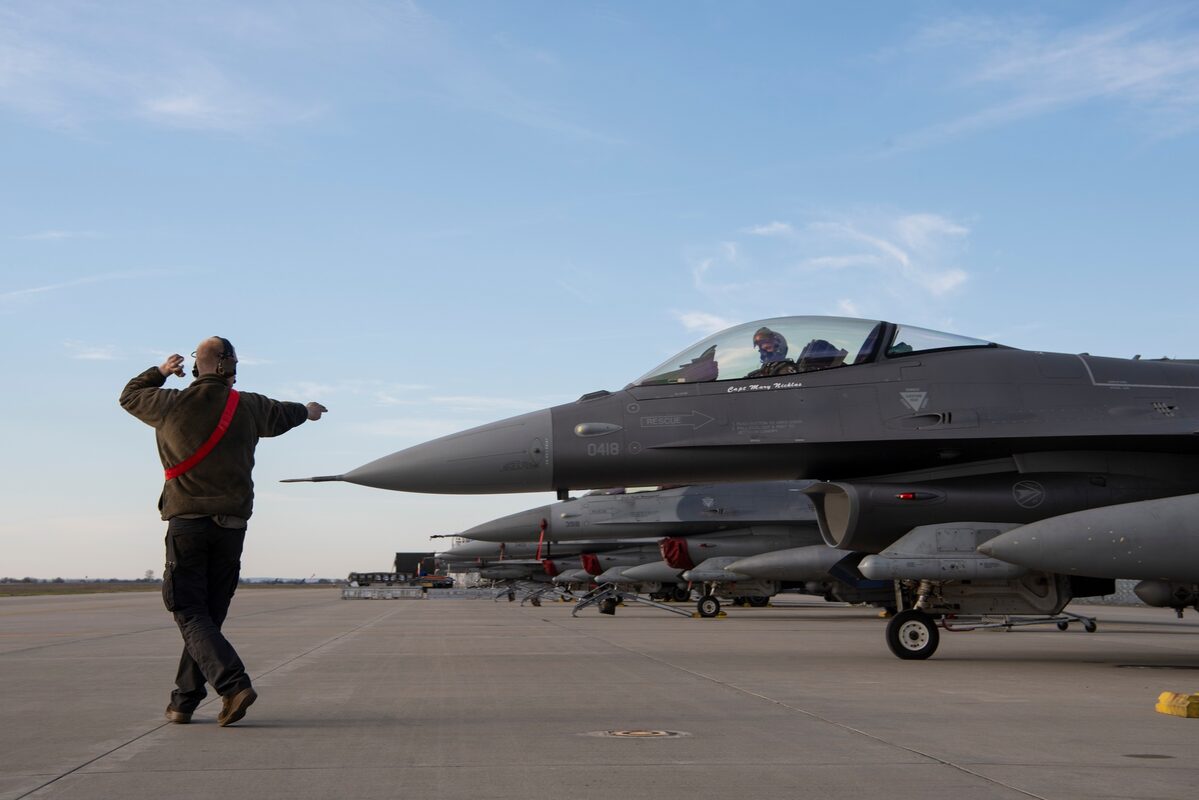
NATO Air Policing aircraft shot down two unidentified drones in two separate NATO member states within a 48-hour window this week, underscoring how routine — and how unresolved — airspace incursions along the alliance's eastern and southeastern flanks have become. The first interception happened before dawn on Aug. 14 over northeastern Latvia, near the border with Russia. The second came in the predawn hours of Aug. 16 over eastern Romania, near the border with Moldova. In both cases, fighter jets flying NATO's standing Baltic and Black Sea air-policing missions engaged and destroyed the intruding aircraft after positive identification. Latvian officials have not publicly attributed the Aug. 14 drone's origin, and Romanian authorities likewise said the Aug. 16 drone's origin was unconfirmed — though a NATO spokesperson offered a preliminary, hedged assessment on the Romanian drone, described below.
The back-to-back shootdowns mark the latest entries in a pattern that has been building for more than a year: unidentified drones crossing into NATO airspace from the direction of Russia or Russian-adjacent territory, prompting scrambles, brief evacuations of nearby villages, and — increasingly — live intercepts rather than passive tracking.
Latvia: Eurofighters and F-16s Scrambled Near Rugaji
According to Stars and Stripes, the Latvia incident began before sunrise on Aug. 14, when a drone was detected approaching the country's northeastern border region. NATO scrambled two Italian Eurofighter Typhoons flying out of Šiauliai Air Base in Lithuania, along with two Turkish F-16s based at Ämari, Estonia — both aircraft types assigned to NATO's Baltic Air Policing rotation. One of the Italian Eurofighters engaged the drone near the village of Rugaji and shot it down over an unpopulated area.
NATO's statement on the incident was terse: "After positive identification, one of the Italian Eurofighters neutralized the potential threat over an unpopulated area." Four municipalities in the area were told to shelter in place while the intercept was underway; the threat was declared over at roughly 4:50 a.m. local time.
Latvian Prime Minister Andris Kulbergs framed the shootdown as evidence the country's air defenses are functioning as intended, telling reporters it confirmed "Latvian airspace is protected," while also pressing for further investment in counter-drone capability. The Rugaji incident follows a similar episode in June, when a French Rafale downed a drone over Latvian territory — meaning this is at least the second confirmed intercept over Latvia in roughly two months.
Romania: Fourth Drone Downed in 2026, Near Galați
Just under 48 hours later, a nearly identical scenario played out roughly 1,300 kilometers to the south. Per Euronews and NATO's own Allied Air Command archive, two Spanish F-18 Hornets flying out of Mihail Kogălniceanu Air Base were authorized to intervene at 04:44 local time on Aug. 16 and intercepted a drone approximately 24 kilometers north of the city of Galați, close to Romania's border with Moldova. The drone was shot down, with wreckage falling between the villages of Baleni and Cudalbi. Romanian Defence Minister Radu Miruta characterized the response as proof Romania "is defending its airspace" with the backing of allied air power. NATO's Allied Air Command listed the incident in its official archive, consistent with Euronews's independently reported details of the interception.
Per a Reuters wire report carried by US News, this was the fourth drone Romanian forces have shot down in 2026 alone — a tally that reflects how routine incursions along the Moldovan and Black Sea frontier have become for Romanian and allied air policing units this year. Romanian authorities said they could not confirm the drone's origin based on the evidence available immediately after the intercept, though a NATO spokesperson, U.S. Army Col. Martin O'Donnell, told Reuters that "the drone appears to be Russian," while cautioning that additional details remained under investigation. The Galați area has been a recurring flashpoint: Euronews noted a Russian drone strike in the same district injured two people on May 29, 2026.
What's Different — and What Isn't
Neither incident represents a first for its respective country. Latvia's Aug. 14 shootdown follows the June Rafale intercept, suggesting NATO's Baltic Air Policing detachments are now treating drone incursions as a recurring operational reality rather than an anomaly requiring case-by-case escalation review. Romania's fourth downing of the year points to the same trend along its own frontier, where Black Sea drone traffic tied to the war in Ukraine has repeatedly spilled into Romanian and Moldovan airspace. What both incidents share is an attribution gap, though it isn't identical in each case. In Latvia, NATO's public statement described the drone only as a "potential threat," with no nationality or origin claimed. In Romania, Romanian authorities said the drone's origin had not been confirmed, even as a NATO spokesperson gave Reuters a preliminary, hedged assessment that it "appears to be" Russian — the basis for US News's "suspected Russian drone" headline, which reflects an on-the-record NATO comment rather than unsupported editorializing. Still, a hedged, preliminary read from a spokesperson is not the same as a confirmed, forensic determination of launch point and operator, and that gap is becoming a defining feature of these incidents: the intercepts are fast and decisive, but the investigative and political follow-through lags well behind.
Why It Matters
Two live shootdowns in two different NATO countries within 48 hours is a meaningful data point for anyone tracking how the alliance's counter-drone posture is evolving. It shows that intercepting small, low-cost, hard-to-identify drones with manned fighter aircraft — an expensive and resource-intensive tool for the job — has become a standing part of NATO's eastern-flank air policing routine rather than an emergency escalation. Italian Eurofighters, Turkish F-16s, and Spanish F-18s were all pulled from their standard rotational deployments to run these intercepts, in two separate theaters, within two days of each other. It also highlights a persistent capability and attribution gap. Both Latvia and Romania could physically stop the drones once detected, but neither government could offer a confirmed determination of where the drones launched from or who was responsible — even in Romania's case, where this was the fourth such incident of the year, where a nearby Russian drone strike had already caused injuries in May, and where a NATO spokesperson's preliminary comment pointed toward Russia without amounting to an official determination. For a defense-and-policy audience, the pattern raises the practical question NATO planners are increasingly wrestling with: whether relying on fourth- and fifth-generation fighters to shoot down cheap, attritable drones is a sustainable long-term posture, or a stopgap while cheaper ground-based and directed counter-UAS systems are fielded along the alliance's most exposed borders.
Sources
- NATO fighter jets scramble, shot down drone after it enters Romania airspace — NATO Allied Air Command
- NATO jets shoot down drone over Latvia — Stars and Stripes
- NATO fighter jets shoot down drone over Romania near Moldova border — Euronews
- Suspected Russian Drone Shot Down in Romanian Airspace — US News/Reuters