
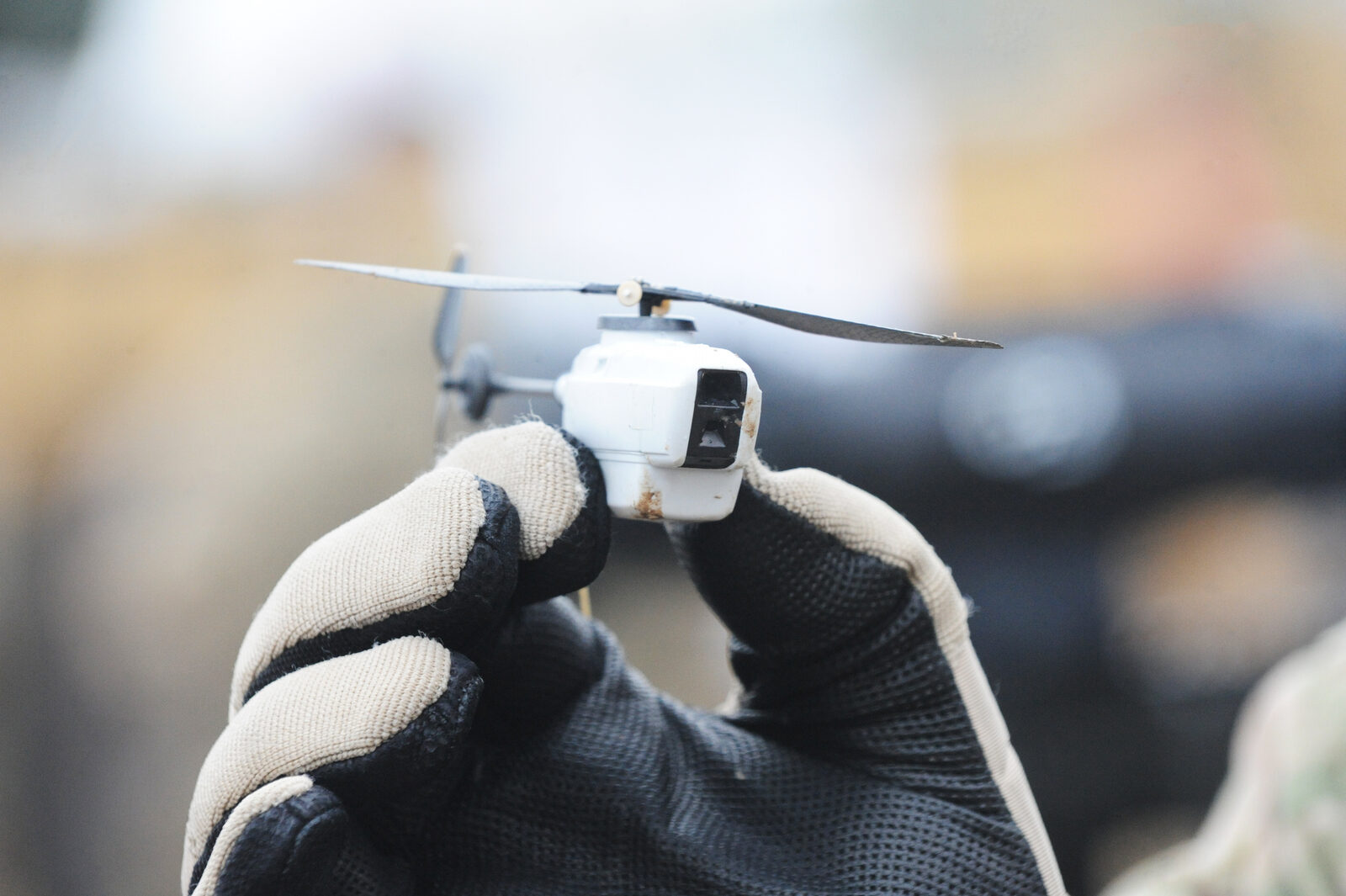
In 2012, British soldiers in Helmand Province began slipping a drone smaller than a paperback novel out of their cargo pockets before clearing compounds. The device — roughly the size of a human hand, weighing 16 grams including its camera — could peer around corners, over walls, and into courtyards the troops were about to enter. It flew for 25 minutes, transmitted live video, and was nearly silent. It was called the Black Hornet, and its deployment under Operation Herrick marked a quiet inflection point in infantry ISR doctrine.
That 2012 contract — £20 million for 160 units from the UK Ministry of Defence — planted a flag. By 2025, more than 33,000 Black Hornets had been delivered to nearly 50 countries. The platform had spawned three generations, passed through two acquisitions, and accumulated more than $125 million in prior US Army orders plus a July 2023 contract worth up to $94 million. What began as an experimental capability for tier-one dismounted operations had become standard kit for infantry platoons across NATO and beyond.
Taxonomy: Why Size Class Is a Tactical Variable
The defense industry draws the nano/micro line at weight. Nano-UAVs are defined at a maximum of roughly 250 grams; micro-UAVs extend up to 2 kilograms with correspondingly superior range, endurance, and service ceiling. The distinction is not arbitrary. At nano scale, a soldier carries the system in a cargo pocket or ammunition pouch rather than a dedicated pack. The acoustic and visual cross-section drops to near-zero at modest distances. The system can enter spaces — hallways, stairwells, rubble fields — where any larger platform is physically excluded.
This separates nano-UAS from the proliferating class of tactical FPV drones, which are optimized for speed and payload (including warheads) rather than covert persistence. It also separates them from loitering munitions, which trade ISR precision for terminal effect. Nano-UAS in current doctrine are pure ISR platforms — no onboard weapons, encrypted datalink, real-time video and stills returned to an operator who acts immediately on what they see.
Sensor options in the broader micro-UAS category have expanded substantially: optical and thermal imaging are baseline; more advanced configurations carry CBRN detection, SIGINT for communications interception, and SLAM-based 3D mapping for autonomous navigation in GPS-denied environments. The Black Hornet 4, Teledyne FLIR's current generation unveiled at the Association of the U.S. Army conference in October 2023, carries a 12-megapixel daytime EO camera with low-light performance and a new high-resolution thermal imager — notable for a platform that fits in a shirt pocket and weighs 70 grams.
The Black Hornet Arc: Three Generations, One Design Philosophy
The Black Hornet originated at Prox Dynamics AS, a Norwegian firm that began development in April 2008 and commenced serial production in early 2012. The PD-100 — Black Hornet 1 — was a single-main-rotor helicopter configuration: 100mm long, 120mm rotor span, 16 grams total weight including camera, capable of 10 meters per second and 25 minutes of endurance at a control range of 1,000 meters. Three cameras provided both still imagery and live video with zoom. The original two-unit system package weighed under 1 kilogram excluding the display.
FLIR Systems acquired Prox Dynamics in November 2016 for $134 million, integrating the platform into a broader electro-optical product line. FLIR was itself subsequently acquired by Teledyne, forming Teledyne FLIR Defense — the current developer and manufacturer. The Black Hornet 3, launched in June 2018, pushed weight to 32 grams while adding GPS-independent flight capability, a critical upgrade for operations in environments where GPS jamming or denial is expected.
The Black Hornet 4, announced at AUSA 2023, represents the most significant generational leap. At 70 grams and 255mm length (10 inches), it is heavier than its predecessors but carries substantially more capability: 30-plus minutes of endurance, operational range exceeding 2 kilometers, obstacle avoidance, an advanced battery system, and the dual EO/thermal sensor payload. It deploys in under 20 seconds from carry to airborne and operates in winds up to 25 knots and rain, across a temperature range of -20°C to 43°C. The single-rotor configuration is retained specifically for its acoustic and visual signature advantage over quad-rotor designs.
“Black Hornet 4 takes the features and capabilities that made Black Hornet 3 world renowned to the next level.” — Dr. JihFen Lei, EVP, Teledyne FLIR Defense
Advertisement
The Soldier Borne Sensor Program and NATO Fielding
The US Army began formally acquiring the Black Hornet 3 in 2018 under the Soldier Borne Sensor (SBS) program, which is specifically described as providing “squad and small unit-level surveillance and reconnaissance capabilities.” Prior US Army orders exceeded $125 million before the AUSA 2023 announcement. In July 2023, the Army awarded a five-year contract worth up to $94 million for additional systems.
The SBS program's design philosophy is deliberately non-specialist. Teledyne FLIR specifies the system for “non-specialist dismounted soldiers,” and the operator training requirement is as little as 20 minutes — low enough that the capability can be embedded at squad level without dedicated UAV operators pulling from other functions.
Allied adoption has been extensive. Germany announced a Black Hornet 4 contract for the Bundeswehr in February 2025. Ukraine received 150–240 sets donated jointly by the UK and Norway in August 2022. France, Switzerland, the Netherlands, Greece, Spain, Turkey, Australia, and New Zealand are among the roughly 50 countries operating the platform.
The competitive landscape at nano and micro scale has diversified around the Black Hornet's success. The RQ-28A Short-Range Reconnaissance (based on the Skydio X2D) weighs 1.3 kilograms — well above the nano threshold — with a 10-kilometer range and 35-minute endurance, and is fielded at platoon level. The Parrot ANAFI USA MIL (500 grams, 32x zoom, 32-minute endurance) is broadly adopted by allied forces including the British RAF, Finnish Army, and Spanish Navy; France ordered 300 to 400 units in 2021. The Bug 4.1, under 350 grams, offers a 3-kilometer range with an integrated GPS follow-the-leader kit positioned for swarm deployment. What distinguishes the Black Hornet from these platforms is categorical: true cargo-pocket carry at operational weight. The others are pack-carried assets; the Black Hornet is personal kit.
Swarms, Lethality Convergence, and the Battery Wall
The long-term trajectory of nano-UAS points toward networked autonomy, though current doctrine keeps the Black Hornet as a single-operator, single-vehicle ISR tool. Adjacent platforms show where the technology is heading. The Bug 4.1's GPS follow-the-leader kit provides a rudimentary swarm formation capability. The Ninox 40 MT combines mesh networking with collaborative multi-sensor reconnaissance at tactical range.
Elbit's Lanius loitering munition represents the furthest current step toward nano-scale lethality: SLAM-based 3D mapping, fully autonomous flight over most of its mission profile, and an armed 150-gram explosive payload. Human-in-the-loop authorization is required for lethal activation — for now. At the research edge, the French Defence Innovation Agency's BioFly project targets a flapping-wing architecture under 50 grams, mimicking bird or insect flight to further reduce the already-minimal acoustic and visual signature of rotary-wing nano platforms.
Cutting across all of it is the battery constraint. Lithium cell energy density is the governing variable for nano-UAS performance — “a major weight factor” in the words of the European Security and Defence survey — and it has not improved fast enough to break the 25-to-35-minute endurance ceiling that has characterized the class since 2012. The Black Hornet 4's 30-plus minutes represents marginal progress over the original PD-100's 25 minutes. Swarm multiplication is power-divided, not power-multiplied: deploying ten nano-drones means ten simultaneous 30-minute clocks, not a single sustained 300-minute ISR umbrella.
Other hard limits remain fixed. Line-of-sight datalink means urban canyons and terrain features disrupt communications unless relay nodes are deployed. The 25-knot wind ceiling grounds the system in conditions common to many operational environments. And cost — originally $40,000 to $60,000 per two-unit system, with some configurations reaching $200,000 — positions the Black Hornet as a precision asset, not a disposable one. These constraints define the partition between nano-ISR's irreplaceable capabilities and the roles where micro-class or tactical FPV platforms are more appropriate.
What nano-UAS does — at weights measured in tens of grams, in terrain inaccessible to any larger platform, with an operator who trained for 20 minutes — it does in a way nothing else replicates. As one analysis put it, by shrinking reconnaissance to something carried in a cargo pocket, the category “has fundamentally changed how small units see — and survive — in complex environments.” The battery wall will eventually move. Until it does, the doctrine adapts around the physics.
Sources
- Teledyne FLIR Defense — Black Hornet 4 PRS product page
- BusinessWire / AUSA 2023 — Teledyne FLIR Defense unveils Black Hornet 4
- Army Technology — PD-100 Black Hornet Nano project profile
- The Defense Post — Black Hornet drone guide (2026)
- The Defense Post — Germany acquires Black Hornet drones (2025)
- Military Embedded Systems — Nano-UAS contract for US Army Soldier Borne Sensor program extended
- European Security and Defence — Nano-UAV and micro-UAV developments (2024)
- European Security and Defence — Micro drones: miniature reconnaissance assets for the modern battlefield (2023)
- New Atlas — Black Hornet nano-UAV (2013)
- War History Online — Black Hornet Nano
- U.S. Army — Army to Purchase Additional Soldier Borne Sensor Systems
