
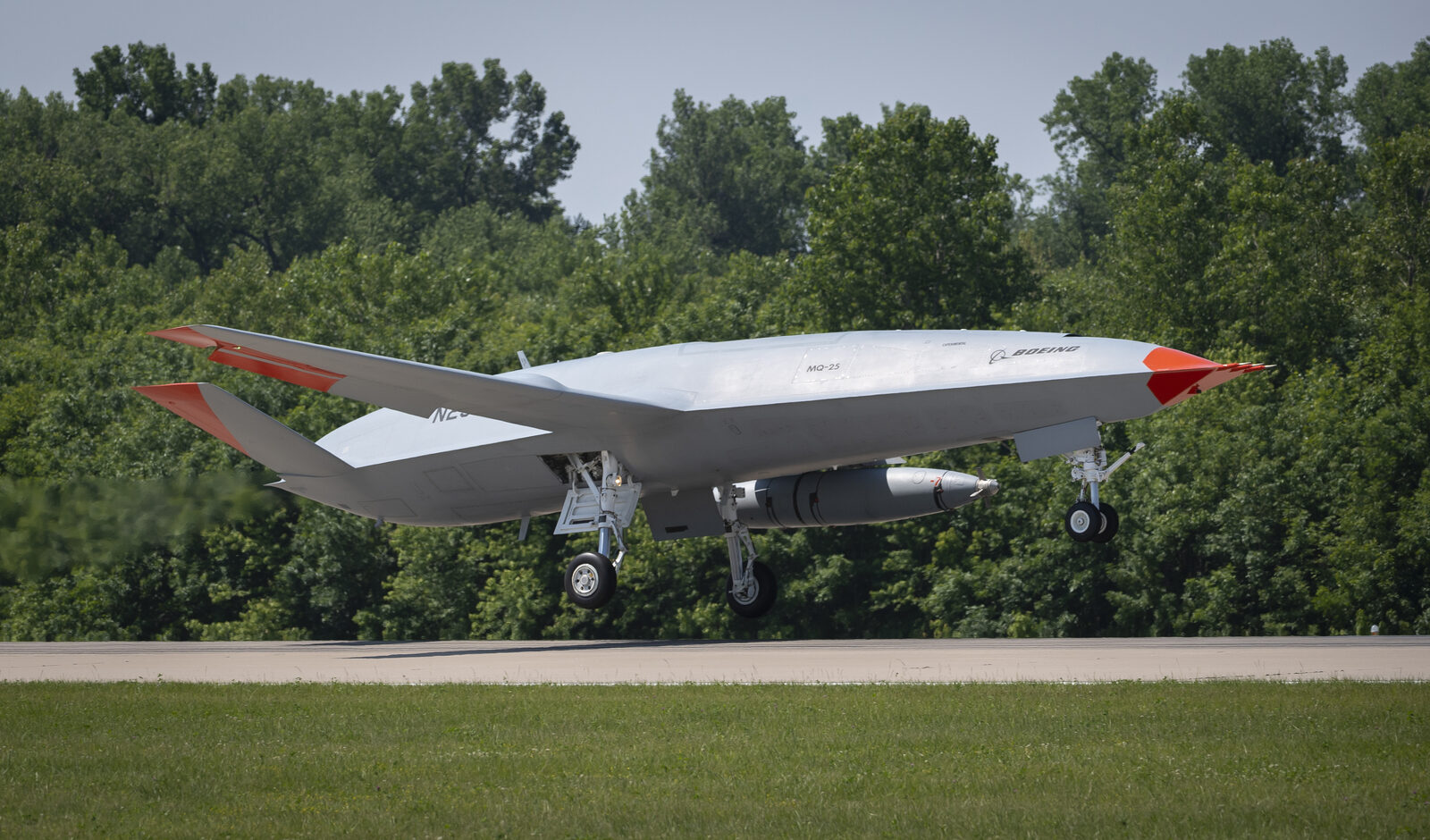
For the better part of two decades, the U.S. Navy has burned combat fighters on a logistics problem. Super Hornets — aircraft designed and procured to fly strike missions — have routinely been tasked as "buddy tankers," hauling fuel bags rather than weapons so the rest of the carrier air wing could reach its targets. Depending on the mission, multiple F/A-18s per carrier air wing spent sorties doing the work of a tanker rather than a strike jet. The MQ-25A Stingray exists to end that arrangement.
From Strike Drone to Tanker: A Program That Changed Its Mind
The MQ-25 did not begin life as a tanker. Its lineage runs through the Unmanned Carrier-Launched Airborne Surveillance and Strike (UCLASS) program, an earlier Navy effort focused on giving carriers an autonomous platform capable of deep ISR and strike missions. The logic of UCLASS made sense in an era when the threat environment still allowed carrier aircraft to range relatively freely. That calculus changed as adversary anti-ship missile ranges expanded, pushing the contested perimeter outward until the strike drone concept lost its operational basis — a drone with insufficient combat radius to reach defended targets offered limited value as a strike platform.
In February 2016, the Navy formally restructured UCLASS into the Carrier-Based Aerial-Refueling System (CBARS), pivoting the primary objective to unmanned aerial refueling. The mission requirements shrank from strike complexity to a more tractable problem: fly out, offload fuel, return. Five months later, in July 2016, the program received its current designation — MQ-25A Stingray. Boeing won the Engineering and Manufacturing Development contract in August 2018 — a fixed-price-incentive-firm-target award worth $805.3 million to design, develop, fabricate, test, and deliver four aircraft, beating out General Atomics and Northrop Grumman. A subsequent $84.7 million contract modification in April 2020 added three more aircraft, bringing the EMD fleet to seven.
What the Stingray Actually Is
The MQ-25A is a purpose-built carrier aircraft in every physical sense. Its wingspan stretches 75 feet (22.9 m) when spread — but folds to 31.3 feet (9.5 m) for carrier stowage, the same constraint that has shaped naval aviation since World War II. Length runs 51 feet (15.5 m); folded height is approximately 16 feet. Maximum takeoff weight is roughly 44,000 pounds. A single Rolls-Royce AE 3007N turbofan provides approximately 8,000 to 10,000 pounds of thrust.
The key performance number is fuel offload: up to 15,000 pounds (6,800 kg) per sortie, delivered via probe-and-drogue refueling to the aircraft types that matter most on a carrier deck — the F/A-18 Super Hornet, EA-18G Growler, and F-35C Lightning II. The range extension those numbers produce is substantial. A Super Hornet's combat radius grows from roughly 725 kilometers to over 1,300 kilometers; the F-35C's stretches from approximately 1,100 kilometers to around 1,800 kilometers. Each MQ-25 sortie can service four to six fighters.
Boeing describes the design as a clean-sheet aircraft drawing on over 90 years of company experience building carrier aircraft. Low-observable features are incorporated — a flush top-mounted air inlet and inset engine exhaust — reflecting design decisions carried forward from Boeing's earlier UCLASS program submission.
The T-1 Milestone Run
Before the first operational aircraft flew, Boeing built and flew the T-1 test asset — a prototype used to de-risk the program's core capabilities. T-1 achieved its first flight on September 19, 2019. What followed was a compressed sequence of aviation firsts:
- Early June 2021: T-1 completed the first unmanned aerial refueling of another aircraft in history, offloading fuel to an F/A-18 Super Hornet.
- August 19, 2021: T-1 refueled an E-2D Hawkeye — demonstrating compatibility with the carrier's airborne early warning aircraft.
- September 14, 2021: T-1 refueled an F-35C Lightning II, completing the trifecta of primary receiver types.
- December 20, 2021: T-1 conducted its first carrier deck maneuvers aboard USS George H.W. Bush, validating handling qualities and functionality in the actual carrier environment.
By the time T-1 was retired, it had accumulated approximately 125 flight hours — a prototype that did the job it was built to do.
"Today's successful flight builds on years of learning from our MQ-25A T1 prototype and represents a major maturation of the program." — Dan Gillian, VP/GM, Boeing Air Dominance
From Prototype to Production: The Mascoutah Facility and the April 2026 Flight
In September 2021, Boeing announced a 300,000-square-foot manufacturing facility at MidAmerica St. Louis Airport in Mascoutah, Illinois — the dedicated production home for MQ-25A. The first Navy Engineering Development Model (EDM) aircraft arrived there in March 2025. On January 29, 2026, that aircraft completed an autonomous taxi test, executing a series of ground maneuvers at MidAmerica Airport in response to commands from Air Vehicle Pilots — the Navy's designation for the operators who control the system.
The program's most significant recent milestone came on April 25, 2026, when the first operational U.S. Navy MQ-25A Stingray completed its first test flight — a two-hour sortie at Mascoutah. The flight validated the aircraft's ability to autonomously taxi, take off, execute assigned flight profiles, and land. The next phase involves additional testing at MidAmerica before the aircraft transitions to Naval Air Station Patuxent River, Maryland for carrier qualifications.
"The MQ-25A is not just an aircraft: it's the first step in integrating unmanned aerial refueling onto the carrier deck," said Rear Adm. Tony Rossi, Program Executive Office for Unmanned Aviation and Strike Weapons, after the April flight.
Dan Gillian, Boeing's VP/GM for Air Dominance, called it "the most complex autonomous system ever developed for the carrier environment."
The MD-5: Controlling a Carrier UAV
The MQ-25A is designed to operate autonomously through all mission phases — taxi, takeoff, assigned mission execution, and landing — at the push of a button. The human interface is the Unmanned Carrier Aviation Mission Control System (UCAMS) MD-5 Ground Control Station (GCS), operated by Air Vehicle Pilots who can manage the aircraft from either ship or shore. The January 2026 taxi tests were the first public demonstration of the MD-5 directing an operational airframe through real ground maneuvers, a prerequisite to the April flight.
Schedule, Cost, and the Long Road to IOC
The MQ-25 program has not been cheap or fast. The original EMD contract totaled $805.3 million; with modifications, seven development aircraft were contracted for approximately $890 million.
In May 2026, the Navy confirmed MQ-25A achieved Milestone C, authorizing the program to enter Low-Rate Initial Production. LRIP Lot 1 covering three aircraft was anticipated to be placed in summer 2026, with priced options for Lot 2 (three aircraft) and Lot 3 (five aircraft). The FY2027 budget request included three MQ-25s.
The schedule has slipped. Initial Operating Capability, originally targeted for 2024, has moved to approximately FY2029. Full Operational Capability is projected around FY2031. Navy officials had publicly committed to flying the MQ-25 in 2025 — a target narrowly missed, with the first production aircraft flying in April 2026.
What Milestone C unlocks, however, is real. The MQ-25A is the U.S. Navy's first carrier-based unmanned aircraft to reach production authorization. When the aircraft reaches the fleet and Air Vehicle Pilots begin controlling sorties from the ship's combat information center rather than a buddy-tanker cockpit, it will mark a structural change in how carrier air wings are composed and employed — one that has been building since the UCLASS concept was first sketched out nearly two decades ago.
Sources
- Boeing — MQ-25 Stingray manufacturer page
- Boeing Features — First U.S. Navy MQ-25A Stingray Completes Test Flight (2026-04-27)
- Boeing Media Room — Boeing, U.S. Navy Achieve Successful MQ-25A Test Flight (2026-04-27)
- Naval Technology — MQ-25 Stingray Unmanned Aerial Refuelling Aircraft
- GlobalSecurity.org — MQ-25 Stingray
- Breaking Defense — Navy's MQ-25 Stingray Carrier Drone Completes First Test Flight (2026-04-27)
- The War Zone — MQ-25 Stingray Has Begun Taxi Tests (2026-01)
- The Defense Post — MQ-25A Stingray Guide (2026-03-15)