
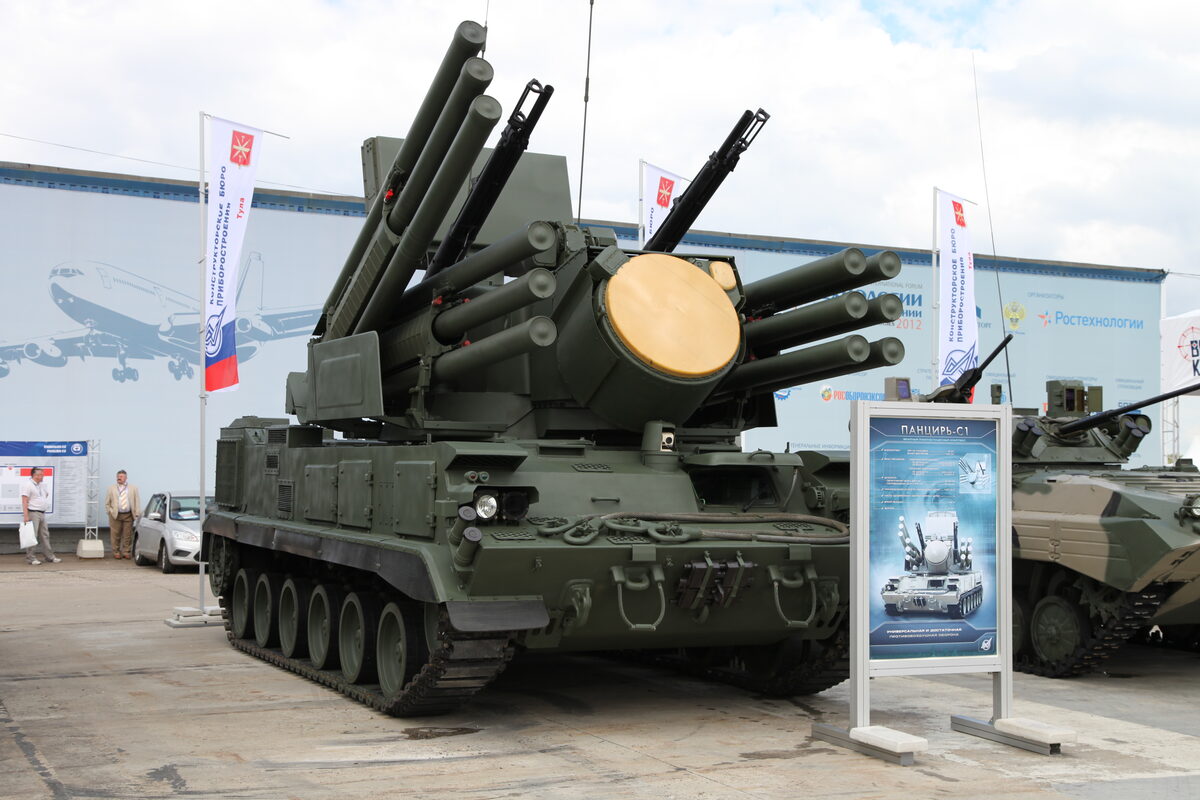
The image that crystallized Moscow's predicament arrived on June 5, 2026: a Mi-26 heavy-lift helicopter lowering a Pantsir air-defense system — almost certainly the new SMD-E variant — onto the roof of the Dom v Sokolnikakh residential complex. Agentstvo first reported it; Meduza published it two days later. It was not the first such installation — a Pantsir had already been lifted onto the Nordstar Tower, a 42-story, 171.5-meter business center, in late May — but the image of a surface-to-air missile system being planted atop an inhabited apartment block compressed years of gradual escalation into a single frame. The work proceeded despite bad weather. That detail alone signals how little optionality Moscow believes it has left.
The Documented Installations and the Seven New Towers
Russia has been layering air-defense assets around its capital since 2023, ultimately deploying more than 100 units in the metropolitan zone. In 2025 alone, roughly 40 additional Pantsir-S1s were added. That pace was a response to the steady escalation of Ukrainian deep-strike drone operations — but the geometry of the problem kept shifting. Placing systems on the ground around the city's perimeter addresses threats arriving at moderate altitude. It does not adequately address threats that hug terrain, thread between buildings, or come in low enough to exploit the radar shadows that urban mass creates.
The rooftop program is a direct answer to that gap. By elevating fire-control radars and interceptor rails to the tops of high-rises, operators gain unobstructed line-of-sight downward into the urban canyons that would otherwise defeat a ground-level installation. The Nordstar Tower placement — on a 171.5-meter structure in a dense commercial corridor — is a textbook application of that logic.
The rooftop deployments were followed, between May 19 and 21, by the construction of seven new dedicated Pantsir towers north and east of Moscow, positioned near populated settlements. These are not improvised mounts; they are purpose-built structures, which means the program had enough lead time to involve engineering and site preparation even as helicopter deliveries to existing buildings were happening simultaneously. Taken together — documented rooftop sites, new tower infrastructure, and the existing 100-plus-unit perimeter — Moscow is assembling what amounts to a stratified, multi-altitude intercept cordon. The question is whether the inventory can sustain it.
The SMD-E Variant and the Problem of Urban Radar Blind Spots
The Pantsir-SMD-E, unveiled at the Armiya-2024 exhibition, is the system specifically suited for what Moscow is attempting. Unlike the Pantsir-S1 series, it carries no autocannons — it is missile-only, which substantially reduces the weight and structural load imposed on a rooftop mount. Its engagement envelope spans two tiers: up to 48 TKB-1055 mini interceptors covering 0.5 to 7 kilometers, optimized explicitly for small UAS threats, and up to 12 standard 57E6-E missiles reaching out to 20 kilometers. The fire-control radar detects targets at 24 kilometers and can track up to 40 simultaneously.
That dual-tier intercept capability matters because the drone threat Moscow faces is not monolithic. Ukraine fields everything from slow FPV machines operating at low altitude to larger strike drones capable of sustained flight over hundreds of kilometers. A single engagement solution does not address both ends of that spectrum adequately. The mini-interceptor tier — 48 rounds versus the S1's 12 standard missiles — provides the magazine depth needed against saturation attacks, while the longer-range tier handles faster, higher-flying platforms. Compactness and reduced weight are what put the SMD-E on rooftops rather than in a field; the engagement envelope is what makes the placement operationally meaningful rather than merely symbolic.
Urban radar blind spots are the structural vulnerability the entire program is trying to address. Ground-based radars in a dense city face horizon masking: buildings occlude low-altitude approach corridors, and a drone flying below roofline level for much of its approach will not enter a ground-station's detection cone until it is close enough that engagement timelines collapse. Elevating the radar to rooftop height does not eliminate the problem — a sufficiently low, maneuvering drone in a street canyon still presents detection challenges — but it substantially extends the detection range against most threat profiles and, crucially, opens engagement geometry against targets that a ground-mounted system physically cannot see in time.
The May 17, 2026 attack on Moscow — one of the largest Ukrainian drone strikes on Moscow to date, killing three and wounding seventeen in the Moscow region — demonstrated in hard terms what an undersaturated defense looks like against a coordinated swarm. The rooftop and tower program is the structural response. Its adequacy against the next iteration of the threat remains an open question.
The Attrition Math Working Against Moscow
Ukraine's Unmanned Systems Forces destroyed 174 Russian air-defense assets in the first five months of 2026 alone, at a combined assessed value of approximately $5.4 billion. That figure encompasses systems across the theater — not just around Moscow — but it captures the exchange dynamic that shapes everything happening on those rooftops.
The SMD-E is compact, but it is not cheap. Each installation represents an asset that can be targeted — by a drone designed to suppress air defenses, by a strike that forces the system to expend interceptors at a rate that exhausts its magazine, or by a follow-on attack timed to the reload cycle. Placing these systems on civilian high-rises creates a secondary problem that Russia has not publicly addressed: the legal, structural, and civilian-safety implications of operating live SAM systems above inhabited apartment buildings in a major metropolitan area. The Dom v Sokolnikakh is a residential complex, not a government facility. The tenants did not relocate when the helicopter arrived.
The Defence Security Asia analysis characterized the rooftop deployments as "one of the clearest visual indicators yet that the war's drone dimension has fundamentally altered Russia's homeland defense calculations." That is a careful way of saying that the operational perimeter of the war now runs through Moscow's skyline. Seven new towers, helicopter-delivered SAMs on apartment blocks, 100-plus units already in theater — and still the math of attrition runs in Ukraine's favor. At $5.4 billion in destroyed assets in five months, the cost of maintaining the cordon is not a rounding error. It is a strategic liability that compounds with every successful Ukrainian strike, and every new Pantsir bolted to a rooftop is simultaneously a defensive asset and a target.
Sources
- ArmyInform (official Ukrainian Army outlet) — Ukraine's Unmanned Systems Forces: one year of a branch the world had never seen
- Meduza — Pantsir air-defense system installed on roof of residential high-rise in Moscow
- UNITED24 Media — Russia builds seven new Pantsir air-defense towers around Moscow after drone attack
- Defense Express — Russia is rapidly placing Pantsir-SMD-E air-defense systems on civilian building rooftops in Moscow
- Defence Security Asia — Russia: Moscow Fortress — Pantsir-SMD-E, Mi-26, Ukraine drone war
- Kyiv Independent — Russia deploys new Pantsir air-defense systems on Moscow rooftops amid fears of Ukrainian drone strikes