
Many police drone programs describe their launch as a success story. Montgomery County, Maryland, describes its own as a correction. Speaking at AUVSI's Drone and AAM Policy Symposium, held Nov. 9-10 at Nationals Park in Washington, Tony Galladora of the Montgomery County Police Department's Operational Intelligence Division told attendees that the department's first attempt to fund a Drone as First Responder (DFR) program failed with county legislators. In his account, the department had not done the community groundwork first.
"We got our hands slapped and got put on a proper path to fix that," Galladora said, according to DroneXL.
Three years later, the program he described runs 12 drones from six dock sites and assists with about 750 calls for service a month. The way it got there is what other agencies are paying attention to.
The First Ask
The department first tried to get money through the normal budget process. County Executive Marc Elrich's recommended FY2024 budget included a $250,000 DFR pilot, which appeared in an April 20, 2023 council staff packet cited by DroneXL. The County Council did not fund it that spring.
Galladora said the department had asked for the money without community engagement. Councilmembers asked the police department to do more outreach and public engagement before they would bring the program to a vote, Bethesda Magazine reported, and the department went back to the community.
Summer of Town Halls
The department held town halls over the summer of 2023. It also changed the rules the program would operate under. The department's drone directive was revised in September 2023 and took effect Sept. 19, 2023, DroneXL reported.
The changes made the second request look very different from the first. On Nov. 7, 2023, the County Council voted unanimously to approve a $350,000 Drone As First Responder pilot. Under that pilot, the department would buy two drones: one for downtown Silver Spring and one for downtown Wheaton, Bethesda Magazine reported at the time. The approved amount was $100,000 more than the original request.
During the council debate, the discussion focused on what the drones would not do. Earl Stoddard of the county's Office of Emergency Management & Homeland Security told members the drones would not have face recognition and would not be permitted for surveillance under the legislation. That included surveillance of First Amendment events unless there was an immediate safety threat. Councilmember Natali Fani-Gonzalez put it bluntly: "This is not surveillance."
The first flight took place on Nov. 20, 2023, less than two weeks after the vote.
What the Rules Actually Say
The limits promised in 2023 are now written into the program's public description. The department's DFR program page limits the program to calls for service generated by 911 or police. A drone is launched from an autonomous dock and flies to the scene of a qualifying call.
The county's published operating limits include:
- No facial recognition and no audio recording.
- The camera stays at the horizon until the aircraft gets on scene of the call.
- Responds only to 911 calls and officer requests. The department says it does not proactively patrol and does not use drones for random surveillance.
- No "occurred earlier" calls. The department will not fly to incidents where the crime occurred earlier and there is no suspect on scene or safety concern.
- Video is handled like body-worn camera footage. It is stored as evidence under the same retention periods as body-worn and in-car camera video.
Several of these rules limit how the aircraft operate in practice, not only what the department is allowed to do. Keeping the camera at the horizon until arrival means the drone is not pointed down at the neighborhoods it passes over on the way to a call. The council's concerns centered on surveillance, and the appropriation language was tightened by two council committees to address them. The department chose to keep the aircraft for calls where something is still happening or officers need support.
The Hardware
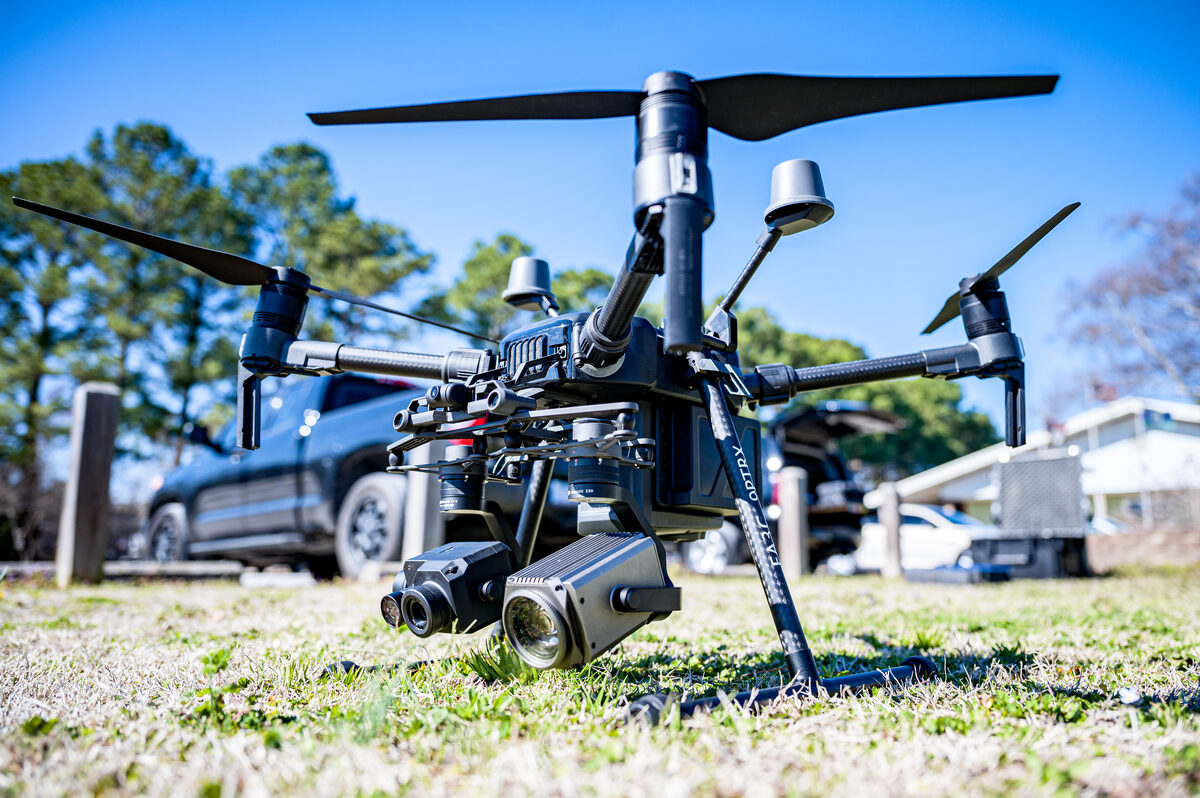
According to the county, the current aircraft is the Skydio X10, launched from an autonomous dock and carrying a VT300Z EO/IR gimbal, which the county describes as a mission-grade, stabilized camera for law enforcement and public safety. The county says its program uses small, unmanned aircraft that weigh under 55 pounds. DroneXL reported that the department replaced its earlier DJI drones and rooftop pilots with docked Skydio X10s.
Docks change how the program operates. A drone stationed at a dock site can launch when a call comes in, and DroneXL reported that pilots now fly beyond visual line of sight from the county's Joint Operations Center. Moving from two drones in Silver Spring and Wheaton to 12 aircraft at six sites is a substantial expansion from the original downtown pilot.
The department also publishes flight data. When DroneXL checked the program's public flight dashboard on Nov. 13, it showed 345 flights since Nov. 1.
The Staffing Pressure
Galladora also described a practical reason for the program's growth. The department is down about 200 officers, he said, and it is looking heavily to technology to offset that. An aircraft that reaches a scene first can give dispatchers and responding officers information before a patrol unit arrives, which is a plausible benefit when fewer officers are available to send.
This is also where the program's original promises may face the most pressure. A department short on officers has a clear reason to ask its drones to do more. The county's published rules, including no patrols, no random surveillance, and no flights to earlier incidents with no suspect present, are what constrain that. Because those rules are public, residents and council members can check the department against them as the fleet grows.
Why It Matters
Montgomery County's experience is turning into a common reference point for state and local governments planning drone programs. Route Fifty reported from a recent event that speakers named community acceptance and trust as a top priority for agencies launching drone programs. The outlet used Montgomery County police as an example of an agency that quickly discovered how important community acceptance was to getting a program off the ground.
The sequence is the main lesson. The department asked for money first and did not get it that spring. It then held public meetings, revised its directive, and the council wrote specific limits into the appropriation. After that, it received more money than it had originally been recommended, with a unanimous vote. A tighter policy turned out to be the condition for moving the program forward, not an obstacle to it.
For agencies considering docked DFR systems, Galladora's comments suggest the hardest part of the effort may not be the aircraft but getting approval. Agencies that start with the procurement request may end up where Montgomery County was in spring 2023: sent back to do the public engagement they skipped.
Sources
- Montgomery Police Drone Director: 'We Got Our Hands Slapped' (DroneXL)
- Drone as First Responder Program (Montgomery County Police Department)
- Montgomery County Council approves new police drone program (Bethesda Magazine)
- Governments need community trust to get drone programs off the ground, experts say (Route Fifty)
