
The Coast Guard has pulled its uncrewed surface vessels off the Great Lakes for the winter. It plans to send them back in the spring. Between those two points, the service has done something unusual for a technology evaluation: it wrote the program's data-handling terms into a press release.
The Nov. 9 release says the service is wrapping up its 2026 evaluation of six Saildrone Voyager USVs ahead of winter icing. It also says the Coast Guard plans "an additional test and evaluation period" in spring 2027 as part of a service-wide look at autonomy. Rear Adm. Russell Dash, Commander of the Great Lakes District, said the seasonal deployment "provided valuable insight into how autonomous platforms support Coast Guard missions in a freshwater environment."
The release reads as a season wrap-up. It also works as a draft privacy policy, published as a public statement and not as a formal rule. The commitments it makes are real, and so are the questions it leaves open. Both matter more now that the boats are coming back.
What Was Out There
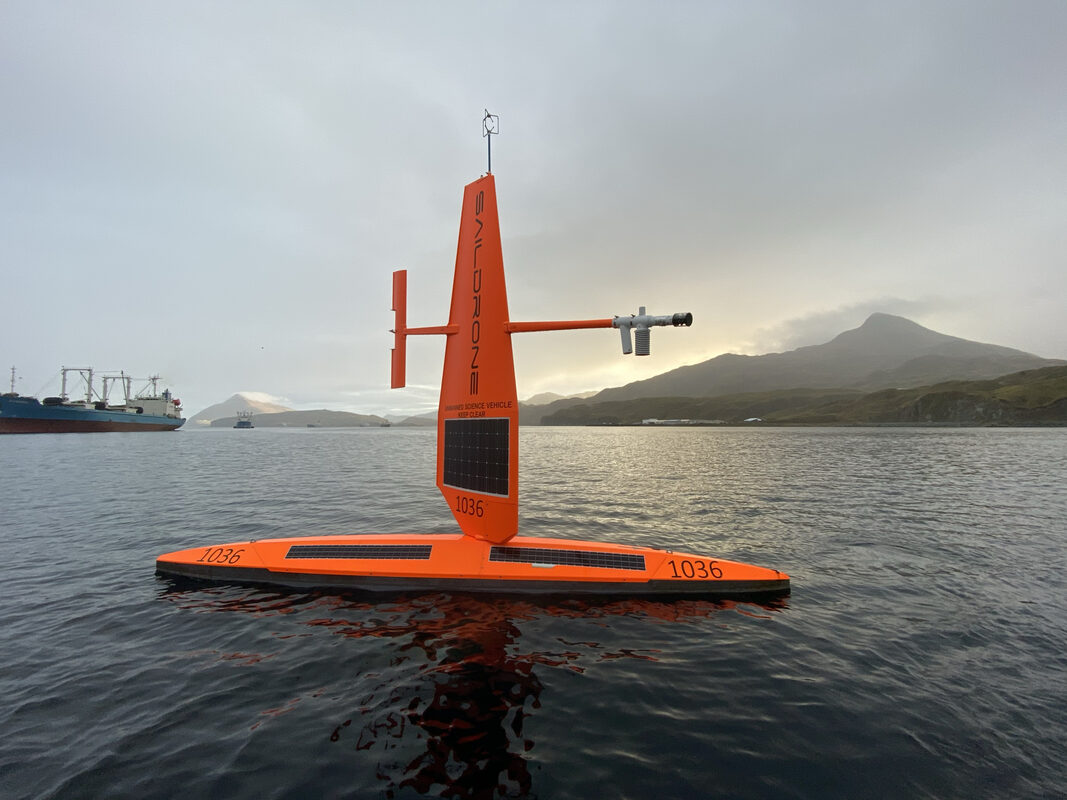
The Voyager is a 33-foot vessel propelled by wind, with solar power and a 4 kW auxiliary electric motor. According to the Coast Guard, each one carries marine radar, an AIS transceiver, meteorological instruments and an optical camera. Operators in mission control centers across three time zones pilot the boats remotely around the clock. WorkBoat reports that Saildrone, based in Alameda, Calif., says the vessels can go up to 100 days between stops. During the trial they measured wind speed, wave height, water temperature and barometric pressure, and monitored vessel traffic.
The Coast Guard lists four missions. The boats collected weather and wave data for search and rescue. They helped watch roughly 94,000 square miles of water. They supported fisheries enforcement along the international boundary, and they worked alongside Canadian partners. Marine Technology News, which republished the release, carried its force-multiplier framing: "Rather than replacing Coast Guard personnel..." In the service's telling, the drones add persistence to the existing workforce rather than cutting it.
The Great Lakes trial follows earlier evaluations in the Southeast, Southwest and Northeast districts. DroneXL reports that Saildrone says its $15.5 million contract, signed in March, covers 16 Voyagers split between the Great Lakes and the Northeast coast.
The schedule also changed along the way. DroneXL notes that the Great Lakes District's May 4 announcement described a May-to-October deployment, while the season actually ran from April to November. The Coast Guard's own release uses April through November and does not mention the change.
What the Release Promises
The privacy section is the part worth reading slowly. The Coast Guard says the optical cameras capture periodic still photographs, not continuous video. It says the system uses no facial recognition and is "not designed to target, track or process" recreational boat hull numbers.
The contract terms are just as specific. According to the release, the Coast Guard is the only party allowed to use the operational data. It keeps its rights to that data after the contract ends, and the vendor is prohibited from selling or sharing it with other customers.
Those clauses address two common worries about vendor-operated sensing programs: that the contractor will monetize what it collects, and that the government will lose control of the data when the contract runs out. Putting both in a public release, rather than leaving them buried in a contract, gives the public a fixed text to hold the service to.
What It Doesn't Say
The gaps are just as specific.
Retention. The release says nothing about how long the still photos are kept. DroneXL flagged the same omission. "Periodic stills" limits how much is collected, not how long it is stored. A retention schedule is the standard way to make a collection limit meaningful. DroneXL, citing Wisconsin Public Radio, reports that Marquette University's Michael Zimmer raised concerns about "function creep" and about who has access to the data. A retention period and an access list are the usual answers to those concerns, and the release provides neither.
"Not designed to" is not "will not." The hull-number language describes how the system was designed. It is not a prohibition. A system that is not designed to process hull numbers can still capture them in a photograph. The release does not say whether such images are filtered, redacted or simply kept.
How the boats appear to other mariners. DroneXL, citing June reporting by the Guardian, says the vessels were listed on MarineTraffic as pleasure craft, one of them as "SD 2050 UNCREWED." The release does not address how the drones identify themselves on AIS. That matters on lakes used, by the Guardian's count, by about 210,000 recreational boats.
The Canadian side. The release mentions working alongside Canadian partners. Yet DroneXL reports that Sarnia, Ontario, Mayor Mike Bradley told CBC Radio he learned about the program from journalists. DroneXL adds that the Coast Guard told CBC that Canadian authorities are aware of the program. Federal coordination and local notification are different things, and the release does not describe the second.
Results. The release lists missions but no outcomes. DroneXL reports that the Coast Guard declined in June to give the Guardian figures on drug seizures or unlawful crossings, and that a Detroit News reporter told WPR the agency said the program had not identified any wrongdoing in its first six months. The release gives no SAR assists, fisheries cases or boundary interdictions credited to the USVs. It may be that the drones' value lies in data and domain awareness rather than enforcement, which would be a fair result. The release just doesn't say so.
Armament. According to DroneXL, a Coast Guard official told the Guardian that the service does not envision armed systems on the lakes. That statement does not appear in the release. It would cost little to add it to the published terms.
Much of this critical reporting is secondhand. DroneXL's account lists WPR, the Guardian and CBC among its sources. The release itself does not address any of these points.
Why It Matters
The Great Lakes are where the Coast Guard's USV program meets many civilians. Here, persistent sensors sit on inland waters used by recreational boats, along a border with a close ally. If autonomy becomes routine across the service, as the "service-wide" framing suggests, the terms written for the lakes could become a template.
Right now those terms exist as a press release. That is better than nothing, and in some ways better than many sensing programs manage. But a press release is not a rule. It does not commit the service to anything once the next contract is signed, and it can change without notice. The spring 2027 return gives the Coast Guard a natural deadline. Before the Voyagers go back in the water, the service could publish the items still missing:
- A retention period for still imagery and other sensor data
- Who inside the Coast Guard, and which partner agencies, can access the data
- Whether incidentally captured hull numbers and faces are redacted or discarded
- How the vessels identify themselves on AIS, and the notification plan for shoreline communities on both sides of the border
- A summary of what the 2026 season actually produced, whether that is data products, SAR support or enforcement
- The no-weapons statement, in writing and on the record
None of these would obviously reveal operational secrets. Each would turn a set of good intentions into something that outlasts this contract. Saildrone says its boats can stay at sea for 100 days at a time. The policy covering them should be at least as durable.
Sources
- Coast Guard concludes seasonal autonomous vessel evaluation on Great Lakes (USCG press release, Nov. 9, 2026, via mirror)
- Coast Guard wraps Great Lakes Saildrone trial, plans spring return (WorkBoat, Nov. 9, 2026)
- Coast Guard Pulls Great Lakes Saildrones, Plans 2027 Return (DroneXL, Nov. 13, 2026)
- Coast Guard Wraps Up Seasonal Great Lakes USV Evaluation (Marine Technology News, Nov. 9, 2026)
