
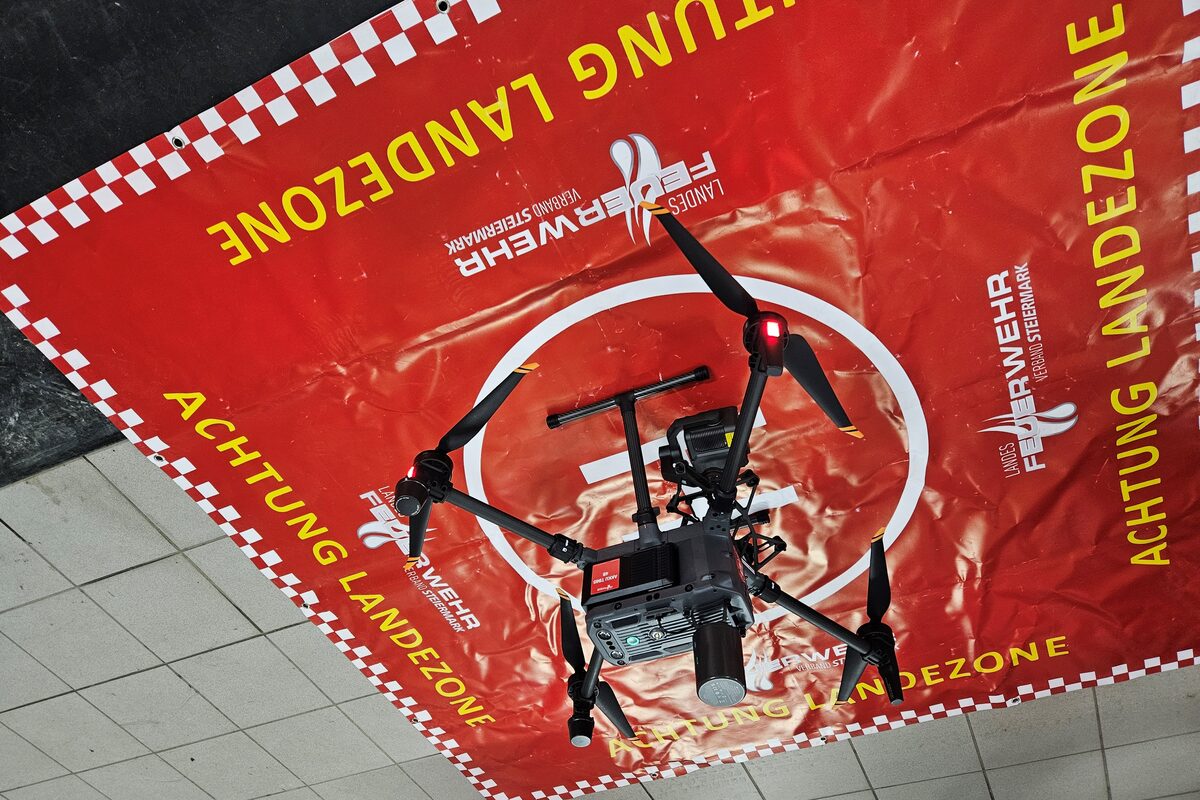
At 4:23 a.m. local time on June 1, 2026, a police DJI M300 flying over West Bridgford, Nottinghamshire, started to spin and fell from about 380 ft above ground level onto a residential road. Nobody was hurt and no property was damaged. The aircraft was written off as beyond economic repair. According to the UK Air Accidents Investigation Branch (AAIB), the cause was mechanical and simple: the rear right motor arm folded inward in flight because it had not been installed correctly.
The AAIB published its findings on Nov. 12, 2026 as a correspondence investigation in the UAS category. The faulty part is only half the story. The report describes a set of procedures that never required anyone to confirm the arms were locked, a checklist that was not signed off, and a body-worn camera that was switched on only after the drone was already in the air. The operator also found that its earlier audits had missed the late camera activation, and together these gaps make the crash a lesson for every police drone unit that flies folding-arm aircraft.
The Sequence of Events
The bulletin, which sUAS News has reproduced in full, gives a precise timeline. The pilot was 25 years old, with 128 flying hours, 84 of them on the M300. Earlier in the shift they had flown an Autel MAX 4N for 19 minutes, then changed to the M300 so they could send a live stream to the force's "top desk."
The M300 had a takeoff mass of 7.2 kg (15.9 lb). Each of its four arms is held in the flight position by a twist-to-lock collar. The arms had been set to the flight position at the start of the shift, and nothing in the force's procedures required anyone to check them again before later flights.
At 4 minutes 4 seconds into the flight, with the aircraft 355 m from its takeoff point, the flight controller issued a warning: "Land promptly and check whether frame arm sleeves are tightened securely." Nine seconds later the system logged a propulsion system error and an ESC auto-check error. The aircraft then began spinning uncontrollably. Telemetry stopped at about 250 ft, when the drone was descending at 3,740 ft/min, roughly 37 kt.
The debris was spread over about 20 m, and the batteries were thrown onto a footpath. When investigators examined the wreckage, three of the four collars were still engaged. The rear right collar, on the arm designated M4, was disengaged, and part of its thread had come away. DJI's analysis reached a short conclusion: "The accident was caused by the M4 arm not being properly installed."
DroneXL reports that the AAIB judged an aircraft of this mass could likely have killed a person if it had hit one. The bulletin does not name the police force involved.
Three Gaps, One Outcome
Mechanical failures that come from a missed assembly step rarely trace back to one person's mistake. The AAIB findings point to three separate places where the system could have caught the problem and did not.
The checklist did not ask
A pre-flight checklist was available to the crew. It did not include an item for confirming that the motor arms were locked. The arms were deployed once at the start of the shift and treated as set from then on. That assumption covered the aircraft through a change of airframe partway through the shift, when the crew switched from the Autel to the M300, which is exactly the point where a fresh hands-on inspection would have been most useful.
The checklist was not signed
The operator had not signed off the checklist on this occasion. An incomplete checklist would not have caught the collar fault directly, because the item was not on it. But a missing signature shows the procedure was not being enforced as a hard gate before flight.
The camera came on late
The body-worn video that might have recorded the pre-flight preparation was not turned on until after takeoff. That left no record of how the aircraft was assembled. According to the bulletin, the operator found that its previous audits had not identified that cameras were being switched on only after takeoff; they had checked that in-flight footage was captured, not that the pre-flight checks were recorded.
None of these failures caused the crash alone. Together they removed every chance to find a collar that was not fully seated before the aircraft took off over houses in the early hours.
What Changed After the Crash
The force acted before the AAIB published. DroneXL reports that it issued Safety Notice 1/2026 on June 24, 2026, which found that "critical assembly and safety checks were either missed or not verified." The notice makes arm-lock checks mandatory before every flight. Pilots must confirm three things:
- the alignment marks on the collar line up;
- the collar clicks into place;
- the arm does not move when tested.
When a second pilot or an observer is present, that person repeats the check. A collar that does not click, or a thread that shows wear, grounds the aircraft.
The National Police Chiefs' Council (NPCC) issued its own Safety Notice to every force flying the M300 and passed the information to the National Fire Chiefs Council. It made two recommendations. First, crews flying folding-arm drones should visually check the connecting parts. Second, body-worn cameras should record those checks. The NPCC also acknowledged that checklists still differ from force to force. A safety board led by the NPCC rated the severity of the occurrence as "medium."
This Has Happened Before
The AAIB points out that the West Bridgford crash was not the first of its kind. It cites three earlier M300 loss-of-control investigations from 2021 in which arms were not fully secured, including one at Blacon, Chester. So the failure mode was already documented in UK accident records five years before this crash, and this force's checklist still had no line covering it.
That history sharpens the policy question. The aircraft gave a specific, plain-language warning, telling the crew to check the frame arm sleeves, and the propulsion system error followed just nine seconds later, with the aircraft 355 m from its takeoff point. That is little time to bring a drone down safely from about 380 ft. By the time the software spots the problem, the moment for a human to catch it may already have passed.
Why It Matters
UK police drone units fly in support of live operations, sometimes at night and over homes. This incident shows how quickly the gap between "the arms were set at the start of the shift" and "the arms are locked right now" can open, especially when a crew changes airframes partway through a shift.
The fixes are not technically difficult. They are a checklist line, a click, an alignment mark, a second pair of eyes and a camera that is already recording. The harder part is the governance. The NPCC says checklists still vary between forces, which means a lesson learned in one force does not automatically become a requirement in the others. The AAIB had three 2021 cases of unsecured M300 arms on file, and the procedure in use in 2026 still did not ask the question.
For any agency flying folding-arm aircraft, the takeaway goes further than the M300. Pre-flight checks should be done per flight, not per shift. Sign-off should be a real gate, not paperwork completed afterwards. Recorded verification, which the NPCC now recommends through body-worn cameras, gives auditors something to inspect rather than something to assume. Previous audits at this force missed the late camera activation, because they checked for in-flight footage rather than recorded pre-flight checks. An audit can only find what the procedure makes visible.
