
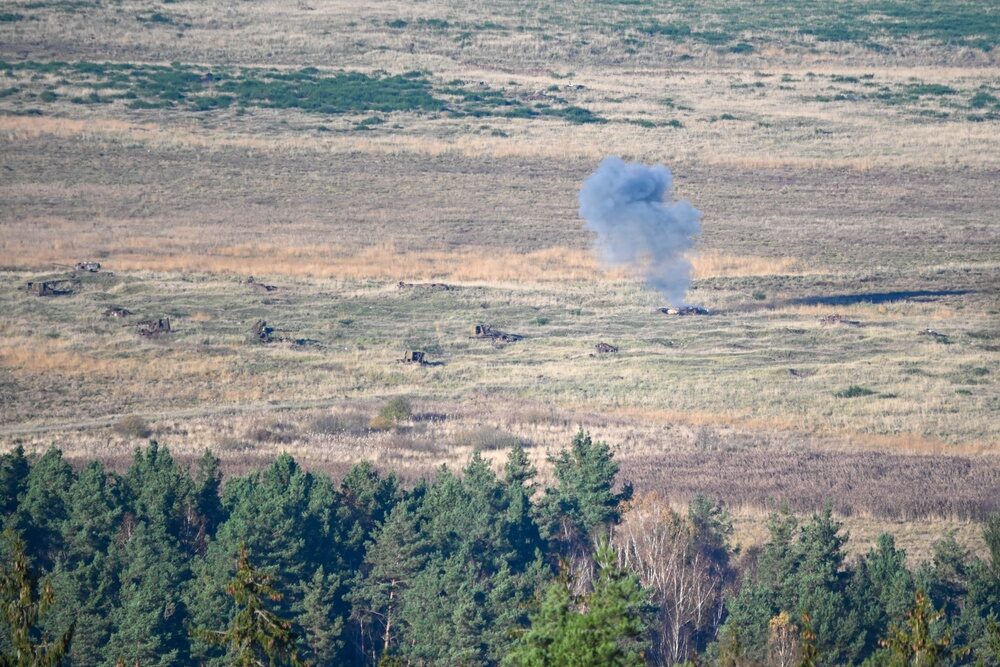
Picture a Harop airframe circling at altitude somewhere over a contested forward area. It has been airborne for six hours. Its electro-optical seeker is scanning. Below, an Armenian radar battery sits silent — operators aware that something is up there, unwilling to emit. The Harop has range to spare and endurance to wait. The moment the radar switches on, the kill chain compresses to seconds. The weapon does not need to be retargeted from a ground station. It has already found its target.
That patience — the ability to search for a target while airborne rather than be committed to a fixed aim point at launch — is the defining characteristic of the loitering munition (LM), also called a kamikaze drone, suicide drone, one-way attack UAS, or launched effect depending on the service branch doing the naming. The nomenclature is contested; the operational logic is not. As CEPA put it, these systems "fuse sensors and effectors into a single platform, allowing for accurate, dynamic prosecution of targets in real time." They are expendable by design. They are the munition itself.
What a Loitering Munition Is — and Is Not
The category is frequently conflated with adjacent systems, so the distinctions are load-bearing. A cruise missile optimizes for speed and range; it cannot loiter slowly over a target area searching for an opportunity. An uncrewed combat air vehicle (UCAV) — a Reaper, a Predator — is recoverable, multi-use, and priced accordingly. A loitering munition is neither: it is a one-way platform that spends its airframe budget on time-on-station and sensor fusion rather than a recovery system or a weapons bay.
The operator relationship varies by design. Most tactical LMs keep a human in the loop through terminal guidance — AeroVironment's Switchblade 300, for example, gives the operator a wave-off capability to abort an attack in progress. Anti-radiation variants like the IAI Harpy operate at the other end of the spectrum: once cued and released, they home autonomously on radar emissions with no man-in-the-loop requirement. The distinction matters for legal and policy reasons, as discussed below. What all LMs share is that search-while-armed quality: the weapon watches before it strikes.
Israel's 1980s Bet and the Harpy–Harop Arc
The lineage traces to Israel Aerospace Industries and the suppression-of-enemy-air-defenses (SEAD) problem. The IAI Harpy was developed in the late 1980s and first tested in 1989. Its logic was blunt: rather than risking a crewed aircraft to kill a radar, send a platform that can orbit indefinitely and commit autonomously the moment the emitter goes active. The Harpy's autonomous radar-homing seeker sat in acknowledged tension with emerging norms around human control of lethal force — tension that has never been fully resolved.
The Harop, arriving in service around 2005, added a man-in-the-loop EO seeker alongside the anti-radiation capability, making it both more flexible and more legally defensible. India ordered roughly $100 million in Harop systems in 2009. The current family — Harpy NG (2016), Harop, Mini Harpy — spans a range of engagement profiles while sharing the architecture: endurance up to six-plus hours, a 16 kg warhead, maximum speed around 417 km/h, range of 200 km, and a radar cross-section below 0.5 square meters. Approximately 1,200 have been built. The Harpy-Harop arc represents three decades of sustained investment in a concept that most Western militaries spent the 1990s and 2000s largely ignoring.
The Modern Field: Three Payload Tiers
Today's loitering munition market stratifies cleanly by payload class and mission profile.
Squad tier. The AeroVironment Switchblade 300 — 2.7 kg including launcher, roughly $6,000 per unit, 10 km range, 10–15 minutes endurance, cruising at around 101 km/h with a dash to 160 — targets personnel and light vehicles. The Block 20 upgrade stretches endurance to 20 minutes and adds an explosively formed penetrator warhead. Israel's UVision HERO-30 sits in a similar band at 3 kg with a 30-minute loiter.
Anti-armor tier. The Switchblade 600 is a different weapon entirely: a roughly 50-pound airframe with an anti-armor warhead, 40 km range plus 20 minutes of loiter (or 90-plus km with extended datalink), and a unit cost exceeding $100,000. Russia's ZALA Lancet-3, produced by Kalashnikov's ZALA Aero subsidiary, is the peer: 12 kg maximum takeoff weight, 3 kg warhead, 40 minutes endurance, 40–65 km range, diving at up to 300 km/h toward target. Its electronics package, notably, includes NVIDIA Jetson TX2 and Xilinx modules — Western components diverted through sanctions-evasion supply chains. Unveiled at ARMY-2019 and fielded in 2020, the Lancet entered Ukraine as a relatively marginal capability and became the conflict's signature precision strike tool. UVision's HERO-120, selected for USMC medium-weight requirements, rounds out this tier.
Strategic one-way tier. The Shahed-136/Geran-2, priced at $20,000–$50,000 per unit, sits at the intersection of loitering munition and cheap cruise missile — optimized for mass rather than individual precision, it has overwhelmed Ukrainian air defenses through sheer volume. Russia has also employed the Garpiya-3, a Chinese-manufactured system with 2,000 km range and a 50 kg payload.
Nagorno-Karabakh: Proof of Concept, With Caveats
The 2020 Nagorno-Karabakh war is invoked constantly in LM literature as the system's battlefield debut at scale — and the invocation requires a corrective. Over 44 days from September to November 2020, Azerbaijan employed Harop, Orbiter 1K/3, and SkyStriker loitering munitions against Armenian conventional forces in the first extensive use of LMs against a state military. The signature tactic deployed remotely piloted Antonov An-2 biplanes as decoys to bait Armenian air defenses into emitting; waiting Harops then destroyed the revealed systems. The combination was operationally devastating to Armenian integrated air defense.
And yet: "Drones didn't win the war," as the EVN Report concluded. The conflict was predominantly conventional in character — ground maneuver, artillery, logistics, political pressure — and the LM contribution was concentrated in destroying air defenses, which then enabled other capabilities rather than acting as a war-winning system in isolation. The lesson is more limited than the popular narrative: loitering munitions excelled at a specific task (SEAD and time-sensitive targeting of radar-emitting systems) within a combined-arms campaign. They did not substitute for combined arms.
Ukraine: Two Distinct LM Wars
Ukraine has produced the most extensive and analytically rich loitering munition dataset in history, but it is actually two simultaneous LM stories that risk being conflated.
The Russian Lancet campaign is a story of deliberate precision. Russia entered the invasion with few LMs and scaled production through 2023–24, developing hunter-killer team tactics that pair ISR scouts (typically Orlan-10 or similar) with Lancet strikers. Confirmed kills include Abrams, Leopard 2, and Challenger 2 main battle tanks — the full Western armor menu. Lancet strikes peaked at 303 in May 2024, and by early 2025 the weapon was operating up to 70 km behind Ukrainian lines via relay networks.
The hit-rate question has two incompatible answers depending on which tracker you consult, and both deserve presentation. Forecast International's tracking counted 872 documented Lancet uses through late December 2023, with 698 targets reportedly destroyed. A separate Army Recognition tally of 2,806 launches claims a 77.7% hit rate. The methodologies differ fundamentally — confirmed-strike counts versus launch counts, and stricter versus looser definitions of effect — so both sets of numbers are real, and neither is definitively correct. What is not in dispute is that the Lancet has destroyed or degraded more Western-supplied heavy equipment than any other single Russian weapon system.
The Shahed/Geran-2 story is the opposite: mass, not precision. By March 2025, Russian Shahed salvos had exceeded 1,000 per week, according to CSIS analysis. Russia tolerates interception rates above 75% because the arithmetic still works — a $20,000–$50,000 drone drawing the engagement of a multimillion-dollar Tor air-defense system is not a tactical failure. Ukraine has also fielded its own LMs, including the RAM II and ST-35. The US contributed 700 Switchblade 300s and 700 Phoenix Ghosts in 2022; the first confirmed Switchblade 300 use came in May 2022 near Kharkiv. The Switchblade 600 entered combat in spring 2023, and in June 2024 flew more than 30 km to destroy a Buk surface-to-air launcher.
A necessary hedge, articulated by War on the Rocks in 2022, holds that US-supplied LMs would not "turn the tide" — small payloads limit effects against hardened or dispersed targets, and a layered counter-UAS environment blunts attack density. That caution has proven accurate; the Lancet has been more operationally significant in Ukraine than the Switchblade, largely because Russia deployed it at volume with a dedicated ISR architecture.
US Programs and the Hundreds-vs.-Thousands Gap
American procurement reflects the Ukraine lessons in both structure and urgency. The Army's LASSO program (Lethal Autonomous Systems for Small Operations, awarded to Teledyne FLIR's Rogue 1 on May 13, 2026) targets infantry brigade combat teams with a man-portable anti-armor LM; FY2026 funding stands at $70 million. A separate Army Switchblade indefinite-delivery, indefinite-quantity contract — approximately $1 billion over five years, awarded August 2024 — includes a $288 million delivery order from February 2025 covering Switchblade variants.
The Marine Corps is running two parallel competitions. OPF-L (organic precision fires, light) evaluated three vendors — AeroVironment's Switchblade 300 Block 20, Anduril's Bolt-M, and Teledyne FLIR's Rogue 1 — with AeroVironment receiving an initial $8.9 million on a ceiling of $249 million. A fielding decision was planned for June 2026. "The fielding decision is planned for the June timeframe, and that will be the first time we'll get actual inerts and live warheads to the units," said Col. Bradley Sams, the Marine Corps ground weapons systems program manager, in April 2026. OPF-M (medium), won by the HERO-120, targets production in FY2028.
The Pentagon's Replicator initiative — announced August 28, 2023, by Deputy Secretary Kathleen Hicks with a goal of fielding "thousands" of attritable autonomous systems within 18–24 months at roughly $500 million per year — explicitly included Switchblade 600, Anduril Altius-600, Anduril Ghost-X, and PDW C-100 in its second tranche. The Congressional Research Service assessed that only "hundreds" had materialized by the August 2025 target date. Replicator 2, announced September 2024, pivoted emphasis to counter-drone. The gap between the political commitment and the industrial delivery is itself an operational data point: scaling LM production is harder than the procurement announcements suggest. More than 50 countries now operate loitering munitions; a May 2023 IAI–Estonia export deal alone was valued at $110 million.
Autonomy, Policy, and the Harpy Problem
The autonomy question is not theoretical. DoD Directive 3000.09 requires that a human exercise judgment over the application of lethal force; anti-radiation seekers like the Harpy, which commit autonomously once released against radar emitters, sit in acknowledged tension with that policy — grandfathered in practice if not in principle. The STM Kargu, a Turkish LM cited in UN reporting from Libya, was identified as possibly having conducted the first lethal autonomous attack on combatants — a claim that remains contested but has not been authoritatively refuted. Marketing claims about AI-enabled autonomy in current production LMs frequently outpace what the systems actually do. True closed-loop autonomy at scale, without human judgment over target selection, remains limited. That constraint is simultaneously policy, engineering reality, and operational choice — and all three are under pressure as the industrial race accelerates.
Loitering munitions are a genuine force multiplier. They are not a substitute for combined arms, as Nagorno-Karabakh demonstrated. They are not a war-winning silver bullet, as Ukraine's Switchblade results confirm. What they represent is a structural shift in the cost and risk calculus of precision strike — a shift in which the industrial capacity to produce cheap, expendable platforms at scale may matter more than any individual system's specifications. The factory, at this point, is the weapon.
Sources
- CSIS — Drone Saturation: Russia's Shahed Campaign
- CSIS — Russia-Ukraine Drone War: Innovation at the Frontlines and Beyond
- War on the Rocks — Loitering Munitions in Ukraine and Beyond
- AeroVironment — Switchblade 300 Selected for USMC OPF-L Program
- Breaking Defense — Marines to Field Light Loitering Munition to Operational Units in June Timeframe
- Breaking Defense — Pentagon Announces 4 Drones, Loitering Munitions Now Under Replicator
- CEPA — Adaptation Under Fire: Mass, Speed, and Accuracy Transform Russia's Kill Chain in Ukraine
- EVN Report — Beyond the Drone Hype: Unpacking Nagorno-Karabakh's Real Lessons
- Forecast International — The Evolving Landscape of Loitering Munitions
- Army Technology — HERO Family of Loitering Munition Systems
- IDGA — Loitering Munitions 101
