
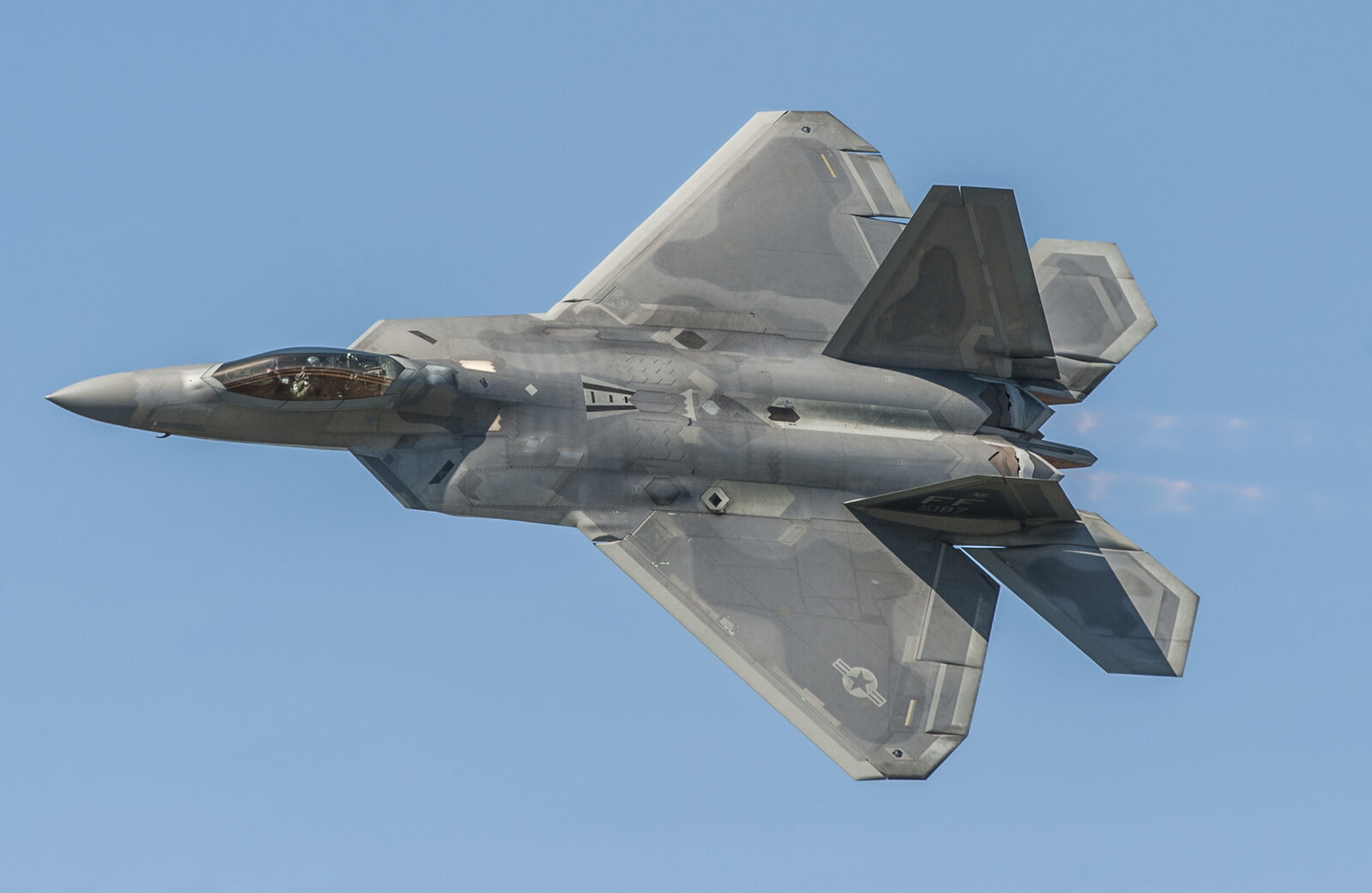
At dusk on December 6, 2023, unidentified unmanned aerial systems began appearing over Joint Base Langley-Eustis, Virginia — home to F-22 Raptor squadrons, the headquarters of Air Combat Command, and one of the key nodes in NORAD's coverage of the Washington, D.C. corridor. The installation sits on the Hampton Roads peninsula, across the Chesapeake Bay from Naval Station Norfolk, the Navy's largest fleet concentration on the East Coast. What followed was not a single intrusion but a 17-day incursion campaign that exposed structural gaps in American military homeland defense that no one had yet been forced to confront.
Seventeen Nights Over Hampton Roads
The base confirmed the basic facts, eventually. "The installation first observed UAS activities the evening of December 6 [2023] and experienced multiple incursions throughout the month of December," a Langley spokesperson said. "The number of UASs fluctuated and they ranged in size/configuration." The drones appeared primarily in evening hours — a pattern that held across all 17 days.
Air Force Gen. Mark Kelly, then head of Air Combat Command and the highest-ranking officer present during the incursions, personally witnessed the swarm. He described at least one aircraft as approximately 20 feet long, flying at more than 100 miles per hour. That is not a hobbyist quadrotor — it is closer in scale and speed to a large military-grade UAS or a light aircraft.
The Air Force response was limited and largely unsuccessful. Security Forces personnel on the ground deployed Dronebusters — handheld radio-frequency disruption devices — without result. Jamming was reportedly considered and ruled out, due to the risk of disrupting local Wi-Fi and wireless systems on the same 2.4/5.8 GHz frequencies. The FAA was notified. The FBI was brought in alongside the Department of Defense. The Air Force relocated some F-22 Raptors to a nearby installation.
On December 18–19, 2023, NASA's WB-57F high-altitude research jet (tail number N927NA) flew "Imagery Support" missions logged over the area. NASA stated these flights were to image the SpaceX CRS-29 spacecraft reentry — not to track or characterize drone activity.
A note on press accounts: Some reporting describes formations of up to 40 drones in a "conveyor belt" pattern with reddish-orange flashing lights; analytical commentary has described large overwatch drones paired with smaller quadcopters "presumably to collect intelligence." These are witness accounts and inference — not DoD-confirmed characterizations. Critically, some press descriptions of approximately 3-foot quadrotors conflict directly with Gen. Kelly's description of a 20-foot aircraft at 100-plus mph, suggesting multiple vehicle types were involved — but DoD has not officially characterized the mix. When pressed directly on whether the drones launched from a vessel in the Chesapeake Bay, NORAD commander Gen. Guillot stated he did not know.
Fourteen Months to Full Congressional Testimony
The Air Force made no official public statement for approximately three to four months — that silence broke not through an Air Force release but through investigative reporting in March 2024. Even the eventual public confirmation remained hedged. Pentagon spokeswoman Sabrina Singh acknowledged in October 2024 that "Langley Air Force Base did experience incursions of unauthorized unmanned aerial systems (UAS) last year in December 2023," adding that they "didn't appear to exhibit any hostile intent." The base's own spokesperson added a necessary qualification: "anything flying in our restricted airspace can pose a threat to flight safety."
Gen. Gregory Guillot assumed command of NORAD and USNORTHCOM in February 2024 and immediately designated the Langley incursions the centerpiece of his 90-day assessment. The scope of what he inherited clearly caught him off guard. "To tell the truth, the counter-UAS mission has dominated that so far in the first month," he said shortly after taking command. His candor extended further: "I wasn't prepared for the number of incursions that I see."
As of October 2024 — ten months after the incursions ended — neither the origin nor the controller of the drones had been identified. When Guillot testified before the Senate Armed Services Committee on February 13, 2025, that remained true. His answer to questions about what NORAD actually knew was stark:
"The only thing I can tell you about the Langley drones is roughly the number and roughly the altitude."
When pressed on foreign involvement, Guillot stated he had not seen "any organized or unorganized foreign nexus" behind the Langley incursions.
A Mandate Gap Wide Enough to Fly Through
The Langley incursions were not primarily a technology failure. They were an authority failure — and an authority failure that was structural by design. NORAD's counter-UAS mandate was, in Guillot's direct testimony, "very limited to something that would be an attack of national consequence." A sustained multi-night operation over an F-22 base and the headquarters of Air Combat Command did not meet that threshold as written. NORAD watched and logged.
The statute governing base commanders' authority to physically engage drones — 10 U.S. Code § 130i — applied only to designated "covered installations." As of Guillot's February 2025 Senate testimony, only roughly half of U.S. military base commanders held that authority. He was direct about the fix he wanted: "I would propose and advocate for expansion of 130i authorities to include all military installations, not just covered installations." The interagency dimension compounds the friction. DoD, FAA, FBI, and DHS hold overlapping and sometimes competing jurisdiction over airspace and drone interdiction. Jamming requires FAA coordination. Evening incursions don't pause for interagency working groups.
The scope Guillot laid out before Congress placed Langley in context. In 2024 alone, 350 small UAS detections were reported across more than 100 U.S. military installations. Since 2022, more than 600 drone incursions at military bases have been logged. Similar incidents had already been recorded at Nevada nuclear test facilities in October 2023, preceding the Langley incursions by roughly two months. A separate incident at NAS Oceana in Virginia Beach was reported in late 2024. By late 2024, analogous events were reported at RAF Lakenheath, RAF Mildenhall, and Ramstein Air Base in Germany.
Institutional reform followed, belatedly. In November 2024, the Secretary of Defense directed NORTHCOM to serve as the DoD's "synchronizer, integrator, and/or coordinator" of domestic counter-small UAS activities across the continental United States and Alaska. "Our command was named the 'department synchronizer,' not only within our department but within the interagency," Guillot said. NORTHCOM subsequently established Joint Interagency Task Force 401, commanded by General Matt Ross, and stood up a dedicated counter-drone operations branch within its headquarters. Guillot acknowledged the mission's rapidly expanding footprint: "It's certainly a mission that has expanded greatly over the last couple of years."
Why It Matters
The Langley case was not an anomaly — it was a diagnostic. The military's counter-UAS posture had been structured around discrete, attributable, high-consequence threats: ballistic missiles, manned aircraft, cruise missiles. A swarm of unidentified drones conducting nightly operations over restricted airspace at one of the most strategically significant air installations in the country occupied a gap in that posture large enough to operate in for 17 consecutive nights — and go publicly unacknowledged for over a year.
The threat model Guillot articulated to the Senate Armed Services Committee was clear: "The primary threat I see for them in the way they've been operating is detection and perhaps surveillance of sensitive capabilities." Not a kinetic strike. Reconnaissance. That is what Langley represents — the systematic probing of military assets at a base that anchors NORAD's homeland defense architecture for the D.C. corridor.
Gen. Kelly, who witnessed the swarm as the ranking officer on site, offered a structural prescription after retiring: "I believe we'd be in a better position if we had one organization that was resourced, that was empowered, that was tasked with working this problem for the nation."
What remains officially undetermined: who controlled the drones, whether any intelligence was successfully collected, why Langley was selected, and whether the late-2024 European base incursion wave at Lakenheath, Mildenhall, and Ramstein shares any operational lineage with Hampton Roads in December 2023. The military's honest answer, delivered by NORAD's commander to the United States Senate fourteen months after the fact, is that it doesn't know. That much, at least, has been confirmed on the record.
Sources
- The War Zone — Mysterious Drones Swarmed Langley AFB For Weeks
- The War Zone — Here's What NORAD's Commander Just Told Us About The Langley AFB Drone Incursions
- Sen. Cramer (senate.gov) — Cramer Questions NORTHCOM Commander Gen. Guillot on UAS Threats Over Bases
- DefenseScoop — Drone Incursions at U.S. Military Bases: NORAD/NORTHCOM Counter-Small UAS
- CBS News / 60 Minutes — The Challenge of Stopping Drone Swarms
- Task & Purpose — Mystery Drones at Langley AFB
- WHRO — The Pentagon Confirmed a Swarm of Drones Violated Langley Airspace
- Foreign Policy Research Institute — Small Drones, Big Problems: Managing the Unmanned Threat to the Homeland
- Air & Space Forces Magazine — Combatant Commanders on Small Drones
- Breaking Defense — Hundreds of Drone Incursions Reported at Military Installations Over Past Few Years: NORTHCOM
