
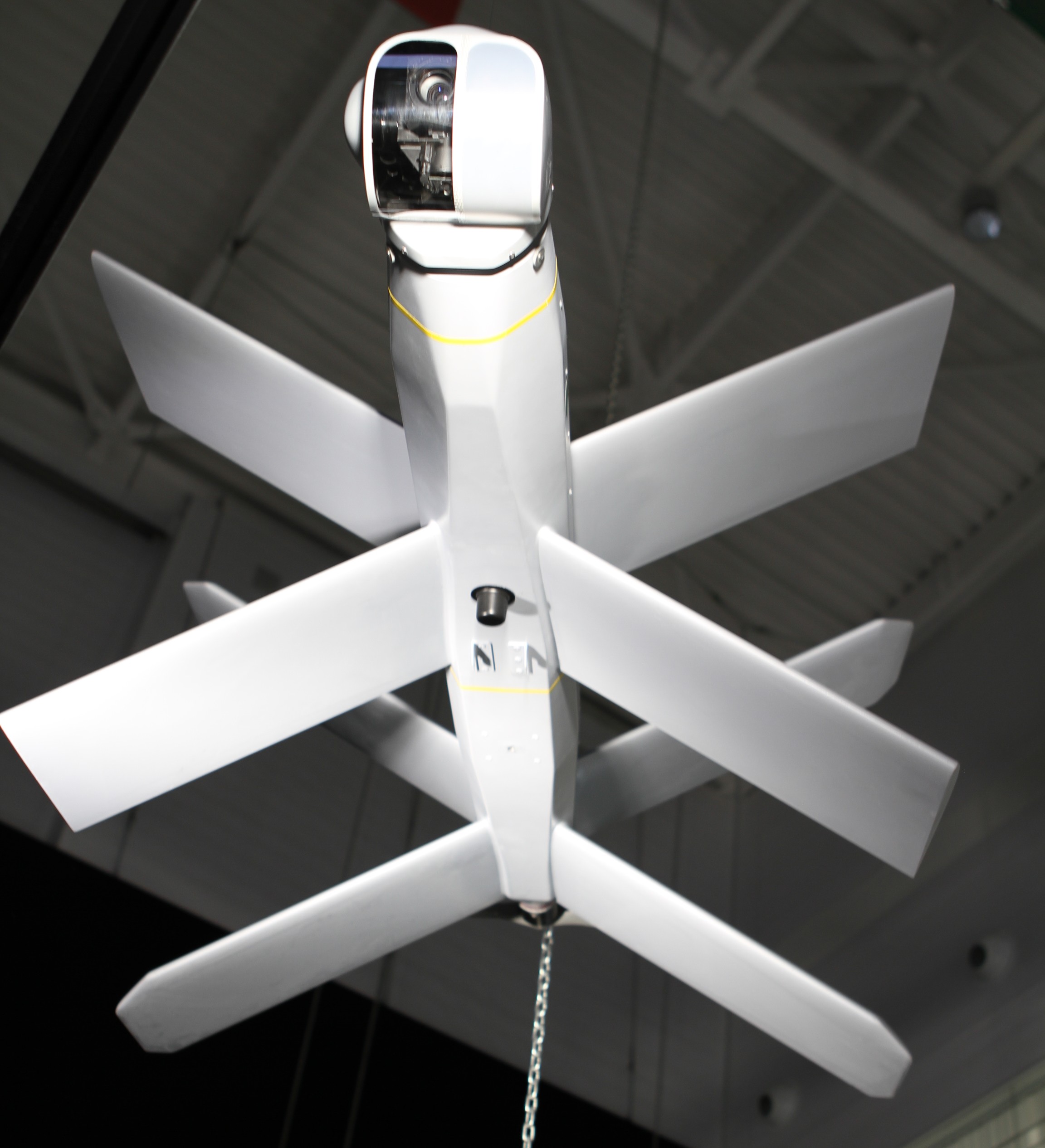
When Russian combat footage from above Ukraine's front lines began circulating in mid-2022, Western analysts quickly fixated on an aerodynamic oddity: two complete sets of X-shaped wings stacked along a cylindrical fuselage — one amidships, one at the tail — flanking a rear-mounted pusher propeller. The silhouette matched nothing in NATO inventories. By 2024, it had become one of the most feared shapes in Ukrainian skies, and defence analysts had assessed it as very likely one of Russia's most effective weapons in the conflict.
That silhouette belongs to the ZALA Lancet, a loitering munition produced by ZALA Aero Group, an Izhevsk-based subsidiary of the Kalashnikov Concern within Russia's state defense conglomerate Rostec. ZALA is reported to have debuted the system at a Russian defence expo in 2019. Its first documented combat use came in Syria in April 2020. Documented strikes in Ukraine began in summer 2022, intensifying through late 2022 — and the battlefield data accumulated since then is sobering.
Why the Double-X Wing Is Not an Accident
The Lancet's defining visual feature — dual X-arrangements separated along the fuselage — draws on rocket aerodynamics rather than conventional fixed-wing aircraft principles. Four-axis symmetry theoretically improves roll-axis maneuverability during a terminal dive and frees the cylindrical nose section for optical payloads without the fuselage-width penalty of a conventional trapezoidal wing layout.
The tradeoff is aerodynamic efficiency: the X-scheme generates less lift per unit area than a conventional planform, which constrains payload relative to airframe weight. At the Lancet-3's 12-kilogram maximum takeoff weight, that constraint is real. But for a steep terminal-dive attack profile — where the munition accelerates to a claimed dive speed of up to 300 km/h in the final seconds before impact — sustained lift matters less than precise terminal guidance. The airframe is composite (plastic and carbon fiber), limiting radar cross-section and acoustic signature, while an electric pusher motor eliminates the infrared exhaust plume that combustion engines produce. Dimensions on the Lancet-3: 153 centimeters long, 1.65-meter wingspan.
Variants, Warheads, and the Upgrade Cycle
ZALA produces the Lancet in two primary size classes. The Lancet-1 has a maximum takeoff weight of 5 kilograms, carries a 1-kilogram warhead, and achieves roughly 30 minutes of endurance. The Lancet-3 (official designation Izdeliye-52, or Item 52) carries a 3-kilogram warhead, weighs 12 kilograms at takeoff, cruises at 80–110 km/h, operates to approximately 35–40 kilometers, and stays aloft approximately 40 minutes at a service ceiling near 5,000 meters.
The upgrade cycle has tracked tightly with combat feedback. An upgraded Lancet-3 variant, fielded from roughly March 2023, extended endurance to 60 minutes and grew the warhead to approximately 5 kilograms. The Izdeliye-51 — the enhanced counterpart — features a substantially improved electro-optical guidance system. Both developments were direct responses to Ukrainian countermeasures.
The system fields four warhead types:
- High-explosive (HE) — general-purpose blast against unprotected targets and light vehicles
- HE-Fragmentation — combined blast-frag lethality against personnel and soft-skinned vehicles
- Thermobaric — fuel-air explosive for enclosed spaces, crew positions, and entrenchments
- HEAT / shaped charge — the KZ-6 variant claims penetration of up to 200 mm of rolled homogeneous armor, putting main battle tanks within nominal engagement range
The 200 mm penetration claim should be read alongside documented reality: footage from Ukraine shows a Lancet scoring a direct hit on a self-propelled howitzer and disabling a single wheel assembly without catastrophic kill. The heavier upgraded warhead is meaningful, but modest by conventional anti-armor standards.
How the Kill Chain Works
The Lancet does not rely on GPS in its terminal phase. Navigation to the target area uses pre-loaded maps and inertial data — a deliberate design choice that limits vulnerability to GNSS jamming. Terminal guidance is electro-optical: a nose-mounted video or infrared camera streams imagery to a ground control station, and operators lock onto the target visually in the final seconds of flight. The system incorporates an NVIDIA Jetson TX2 compute module for autonomous object tracking and a U-Blox module for navigation with claimed electronic-warfare resistance.
Standard operations pair the Lancet with a dedicated reconnaissance platform — typically the Orlan-10 or ZALA 421-16E UAV — operating at altitude to identify targets, relay coordinates, and conduct battle damage assessment while the munition loiters below, ready to dive. This sensor-shooter pairing compresses the kill chain significantly, but the latency window remains: documented Ukrainian footage shows alerted crews with seconds to evacuate, suggesting the high-speed terminal dive generates audible or visual warning.
ZALA and Russian state media have repeatedly invoked "artificial intelligence" and "automated target recognition" in Lancet promotional materials. Defence Express analysis of the alleged Izdeliye-53 combat footage from October 2023 near Toretsk — video showing targeting crosshairs with a "target locked" inscription — concluded the visible technology is visual tracking: machine-learning-assisted optical lock-on, not autonomous object classification. Critically, the Lancet's targeting computation occurs on the operator's ground control computer using camera-transmitted imagery, not onboard the airframe. The onboard TX2 handles tracking and flight control commands; target selection remains operator-dependent under normal operation. The power budget and weight envelope of a 12-kilogram munition cannot support the processor and cooling hardware required for real-time, high-confidence autonomous military object identification.
Defence analysts have consistently characterized the "AI drone" framing as optimistic marketing rather than an accurate description of fielded capability.
Advertisement
The Artillery Hunt: Combat Record and Scale
Analysis of 2,806 documented Lancet launches as of mid-2024 found 2,182 confirmed target engagements — a claimed 77.7 percent hit rate — comprising 738 completely destroyed targets and 1,444 damaged. May 2024 was the peak single month, with 303 documented strikes. Since January 2024, roughly 1,500 Lancet strikes have been publicly documented, representing 65 percent of the total from January 2023 onward: clear evidence of accelerating production and deployment tempo.
The target roster is effectively a catalog of Western artillery transfers. Confirmed Lancet strikes have engaged Western-supplied howitzers and self-propelled artillery across multiple systems — including light towed guns, wheeled howitzers, tracked self-propelled platforms, and rocket artillery — along with air defense systems of various types. The exchange economics are stark: a Lancet costs approximately sub-$35,000, and when strikes connect against high-value donated equipment, the exchange ratio is catastrophic for the defender. More broadly, the Lancet has compressed Russia's kill chain in ways NATO planners had not anticipated at scale: a two-person crew, a reconnaissance drone, and a sub-$35,000 munition can engage a target 70 kilometers behind the forward line within minutes of detection.
Countermeasures, Sanctions, and Product-53
Ukrainian forces have developed layered responses through battlefield trial and error. Metallic cage-and-mesh structures draped over artillery pieces became widespread after Ukrainian crews discovered that Lancets entangle in fine steel nets and fail to detonate. Russia's answer was the Izdeliye-51, which added a thermal imaging sensor and proximity/LiDAR fuze enabling non-contact detonation — detonating meters short of the target to defeat the netting. Inflatable artillery replicas and wooden mock-ups equipped with radar reflectors have also drawn Lancet strikes away from real platforms. Electronic warfare has had limited effectiveness once the system's camera acquires a target, since terminal guidance is optical rather than RF-dependent.
Production scaling has exposed its own vulnerabilities. ZALA acknowledged manufacturing capacity constraints in 2022. The Lancet-3 contains a substantial proportion of foreign electronics: analysts have assessed that a large share of Lancet components are Chinese-sourced. The NVIDIA Jetson TX2 and Swiss U-Blox navigation modules found inside recovered systems are subject to US and EU export controls. Russia circumvents sanctions through multi-hop routing via third countries and dual-use components from consumer electronics supply chains — motors and controllers sourced from e-bikes and scooters, which are more resistant to export enforcement. Production bottlenecks have had measurable battlefield effects: Lancet strike frequency declined sharply in January–February 2023, consistent with depleted stockpiles.
The next-generation platform — Izdeliye-53, or Product-53 — was revealed in July 2023 footage from a Russian TV report on Lancet production facilities. It differs from the Lancet-3 in several respects: folding wings replace the fixed double-X arrangement, allowing launch from a compact transport-launch container with an integrated catapult. The warhead grows to 5 kilograms in the base configuration. The transport-launch containers are designed to be carried individually or combined into blocks, enabling coordinated multi-unit launches — the architecture for swarm operations. ZALA's promotional materials describe a "network-centric" concept in which a neural network coordinates a swarm of Izdeliye-53 units, each autonomously detecting, selecting, and engaging targets. Defence Express analysis of early evidence suggests the first alleged "combat use" in October 2023 near Toretsk may have involved a standard Lancet-3 with updated tracking software rather than the new airframe — indicating the Product-53 hardware platform was not yet widely fielded as of late 2023. ZALA's designer asserted countermeasures against Izdeliye-53 would be "practically impossible" — language that warrants the same skepticism as the AI attribution claims for earlier variants.
From the catapult-launched Lancet-1 of 2019 to the container-launched, folding-wing, proximity-fuzed Izdeliye-51 of 2023, ZALA's iteration cycle has tracked combat feedback with notable discipline. The Product-53's swarm architecture, once operational, will present a qualitatively harder problem than any single Lancet-3 the interception units currently engage.
Sources
- ZALA Aero Group — Izdeliye 52-E product page
- Army Technology — Lancet Loitering Munition System, Russia
- Defence Express — What is Known About Russian Izdeliye-53
- Army Recognition — Russia Triples Production of Updated ZALA Lancet
- Army Recognition — Exclusive Report: Russia Launches Over 2,800 Lancet Drones, 77.7% Hit Rate
- SensusQ — Analysis on the ZALA Lancet
- CEPA — Adaptation Under Fire: Mass, Speed, and Accuracy Transform Russia's Kill Chain in Ukraine
- Grey Dynamics — Lancet 3: Russia's Spear in the Sky
- Frontier India — ZALA AERO's New Product 53
- Army Recognition — Russia Launches Lancet-E at Army-2024
- Congressional Research Service — Defense Primer: Categories of Uncrewed Aircraft Systems (IF12797)
