
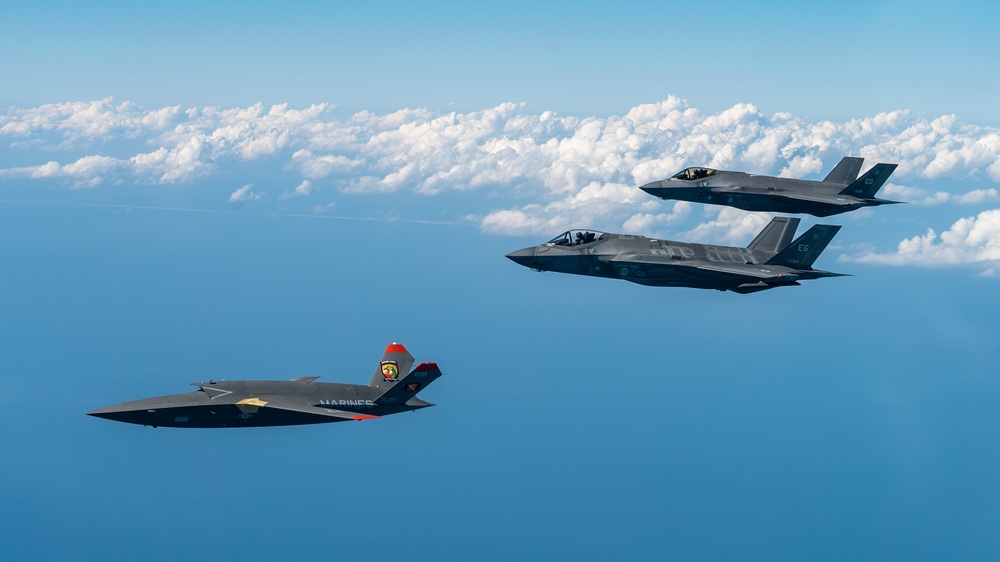
Kratos Defense & Security Solutions announced on July 6, 2026 that it is expanding its Oklahoma City manufacturing campus by more than 100,000 square feet, the San Diego-based contractor's latest move to scale up its jet-drone production line. The company says the added floor space is aimed squarely at one problem: it cannot build jet-powered drones fast enough to meet demand from the U.S. Department of War and allied militaries.
The Oklahoma City plant is where Kratos designs and produces its family of tactical jet drones, including the XQ-58 Valkyrie collaborative combat aircraft, the Firejet aerial target system, and the Mighty Hornet IV, a variant supporting Taiwan's defense requirements. According to the company, the facility currently turns out roughly 165 high-performance jet drones a year — a figure Kratos executives frame as the starting point for a much steeper production ramp, not the ceiling.
"The future fight demands the ability to rapidly produce affordable, high-performance systems at scale," said Steve Fendley, president of Kratos Unmanned Systems, in the company's announcement. "As autonomous systems become increasingly central to the future force, manufacturing readiness and producing at scale will be just as important as technology readiness, maybe more."
What's Driving the Expansion
The Oklahoma City buildout is tied directly to two program wins that have raised the stakes for Kratos' production capacity. The Valkyrie was selected for the Marine Corps' Collaborative Combat Aircraft program — a role that positions the airframe as one of the more mature entrants in the Pentagon's push toward uncrewed "loyal wingman" systems flying alongside crewed fighters. Meanwhile, the Mighty Hornet IV variant is being built to support Taiwan's defense needs, placing the Oklahoma City line at the center of one of the more geopolitically sensitive drone programs in the current export environment.
Kratos already had a substantial footprint in Oklahoma before this announcement. Reporting from Jane's Defence has previously documented the company's parallel buildout of turbojet-engine manufacturing capacity elsewhere in the state. That engine business is not incidental — Kratos disclosed last month, in a separate announcement, that it plans to expand production of its Spartan turbojet engine line toward 3,000 units in 2027. Read together, the two announcements describe a company trying to scale an entire vertical stack — airframes and the engines that power them — at roughly the same time.
By the Numbers
- 100,000+ square feet — new production space being added to the Oklahoma City campus
- ~165 — jet drones currently produced at the site annually
- 3,000 — Spartan turbojet engines Kratos aims to produce in 2027, per its prior month's announcement
Why It Matters
The Pentagon's Collaborative Combat Aircraft concept only works if the underlying airframes can be built in large numbers at a price point that makes attrition tolerable — the entire premise of "affordable mass" collapses if a jet drone costs nearly as much, or takes nearly as long to build, as a crewed fighter. Fendley's comment that "manufacturing readiness" may matter more than "technology readiness" is a direct acknowledgment of that reality: the Valkyrie and its peers have already cleared flight-test and program-selection hurdles, but none of that translates into deployed capability until a factory can turn out airframes on a wartime timeline.
The expansion also signals how quickly the CCA program has moved from concept demonstration to production planning. A jump from roughly 165 units annually to a facility built for substantially more output suggests Kratos and its Department of War customers are treating near-term demand projections as real rather than speculative — a meaningful data point for an industry that has seen plenty of drone programs stall between prototype and procurement.
There's an international dimension as well. The Mighty Hornet IV's role in supporting Taiwan places the Oklahoma City expansion inside the broader conversation about whether the U.S. defense-industrial base can arm both its own forces and key allies simultaneously without one program cannibalizing the other's production slots. Adding physical plant capacity, rather than simply reallocating existing lines, is one way a contractor can plausibly serve both customers at once — though whether the expanded footprint is enough remains an open question as more CCA-adjacent orders potentially materialize.
Finally, the timing relative to Kratos' Spartan turbojet-engine expansion — announced just a month earlier and aimed at reaching 3,000 engines in 2027 — suggests the company sees engine supply, not airframe assembly alone, as a potential bottleneck for jet-drone scale-up. Coordinating growth across both the airframe and propulsion sides of the business is a tacit admission that supply chains for these systems remain tight enough that Kratos is choosing to control more of the stack in-house rather than depend on third-party engine suppliers to keep pace.
Sources
- Kratos Expands Oklahoma City Manufacturing Facility to Accelerate Production of Valkyrie, Firejet and Other Jet Drone Systems
- Kratos announces Oklahoma plant expansion to boost jet drone production
- Kratos expands Oklahoma facility to boost drone production
- Kratos to build turbojet engine facility in Oklahoma
