
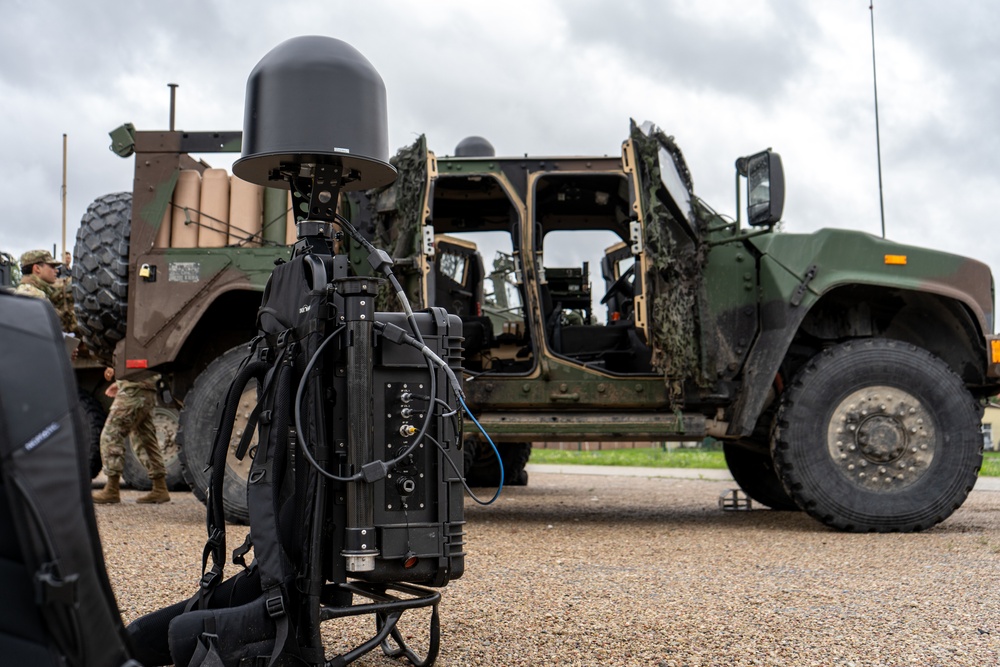
The Netherlands' new light tactical vehicles will be able to fight drones as well as move troops. On 29 September 2026, Kongsberg announced an agreement with Oshkosh Defense Europe to deliver PROTECTOR RS4 remote weapon stations fitted with the company's PROTECTOR CUAS capability. Oshkosh will integrate the stations on Joint Light Tactical Vehicles (JLTVs) for the Royal Netherlands Armed Forces.
Neither company disclosed the contract value, the number of weapon stations or a delivery schedule. The deal still shows a clear design choice. The Dutch are not buying a separate counter-drone vehicle. They are getting the capability as an addition to a weapon station and a vehicle they had already chosen.
What was announced
According to the Kongsberg release, reproduced by Esprit de Corps, the contract covers PROTECTOR RS4 remote weapon stations with PROTECTOR CUAS, to be integrated on Oshkosh JLTVs. Janes reported the order on 2 October and described the CUAS function as covering the full engagement chain: detect, track, identify and neutralise unmanned aerial vehicles.
Kongsberg says the system can engage single drones as well as "more complex threat scenarios." The company also says the PROTECTOR RS4 is in service with 31 nations, so the base hardware is a mature, widely exported product rather than a new development.
Kjetil Reiten Myhra, Kongsberg executive vice president and president of Kongsberg Defence Systems, framed the deal around the battlefield trend that drives most counter-UAS purchases today: "The increasing use of drones in modern conflicts highlights the importance of robust and adaptable Counter-UAS solutions."
Pat Williams, chief programs officer at Oshkosh Defense, pointed to the vehicle side of the integration and noted that the JLTV was "designed as an open architecture platform."
Counter-drone as software, not a new turret
The most notable part of the announcement is how the capability is delivered. In its analysis for Calibre Defence, Sam Cranny-Evans writes that PROTECTOR CUAS is likely a software layer added to the RS4's fire-control system. That layer would let additional sensor data, such as radar, along with other effectors, be fed into the system for greater air picture awareness. He also expects it to support the engagement process by providing target tracking for the heavy machine gun the weapon station carries.
Kongsberg's own description supports that reading. As The Defense News summarised it, the system brings sensors, targeting data and effectors together in a modular design. The CUAS software can be added to existing PROTECTOR stations as well as future ones. Calibre Defence reports that, according to Kongsberg, all existing and future Kongsberg remote weapon stations can be integrated with it.
If that holds, the counter-drone function could be added to vehicles that already carry a Kongsberg station, and the installed base of PROTECTOR stations across 31 nations would be a potential market for an upgrade. That is an inference; the sources do not describe any retrofit programme.
Cranny-Evans notes that AimLock and FN America have taken a similar approach with the Dune C-UAS system. He calls it a logical approach because many NATO vehicles already carry, or are designed to carry, a remote weapon station.
Already fielded
Kongsberg says PROTECTOR CUAS is not a first deployment. According to the company, the capability has already been fielded in Ukraine and with the US Marine Corps. Both The Defense News and Calibre Defence repeat that claim. The release does not say in what numbers or configurations, and the company has not published operational results. For now, readers should treat this as a vendor statement.
The vehicles: Kaaiman and the Dutch JLTV buy
The Kongsberg announcement does not name the specific Dutch JLTV variant or how many vehicles will receive the RS4. Janes, however, places the deal in the context of the Netherlands' recent JLTV purchases.
On 25 June 2025, the Dutch Ministry of Defence announced it would buy 150 Dutch Expeditionary Patrol Vehicles (DXPV) for the Korps Mariniers, the Netherlands Marine Corps. The vehicle, named "Kaaiman," is an unarmoured JLTV, and deliveries are scheduled for 2028. Calibre Defence places that 2025 order under the FLATM-PV programme. On 13 January 2026, Oshkosh announced that the Netherlands was ordering additional DXPVs and two training kits.
Calibre Defence says the systems will be added to the Dutch JLTV fleet to protect its marines and expeditionary forces. Whether the RS4 stations will go on the Kaaiman vehicles specifically is not stated. If they do, the pairing would make sense: an unarmoured patrol vehicle is the kind of platform small drones put at risk, and a weapon station that can also handle drones would give each vehicle some self-protection. That is our inference, not something either company has said.
Why It Matters
The contract shows one way counter-UAS capability is being spread through land forces. Calibre Defence places it within a wider Dutch air-defence modernisation that also includes Patriot, NASAMS, NOMADS and 22 Skyranger 30 counter-drone units, with the RS4 providing what it calls some defence for vehicles and deployed formations. If Calibre's analysis is right and PROTECTOR CUAS is mainly a fire-control software layer, then adding it to any vehicle that already carries a Kongsberg station could be a relatively straightforward route to wider protection, in Calibre's words. That assessment depends on whatever extra sensors and effectors each installation needs, and neither company has detailed those.
The deal also matters to the industry. The JLTV's open architecture, which Oshkosh highlighted, and Kongsberg's statement that all of its stations can take the CUAS software both point to a market where drone defence is sold as an upgrade to existing hardware. Calibre's comparison with the AimLock and FN America Dune approach suggests Kongsberg is not the only company pursuing that model.
Important details are still missing. The value, quantity and timeline are undisclosed, and the companies have not said which sensors and effectors make up the Dutch configuration. Kaaiman deliveries are scheduled from 2028, but no delivery date for the counter-drone stations has been given, so how capable the Dutch counter-drone protection will be remains an open question.
Sources
- Oshkosh orders Kongsberg Protector RS4 RWS with CUAS capability for Dutch JLTVs (Janes)
- Kongsberg to provide RS4s with C-UAS capability for Dutch JLTVs (Calibre Defence)
- KONGSBERG signs contract with Oshkosh Defense Europe to deliver counter-drone capabilities to the Netherlands (Esprit de Corps)
- Kongsberg Signs Contract With Oshkosh to Supply Counter-Drone Systems to Dutch Armed Forces (The Defense News)