
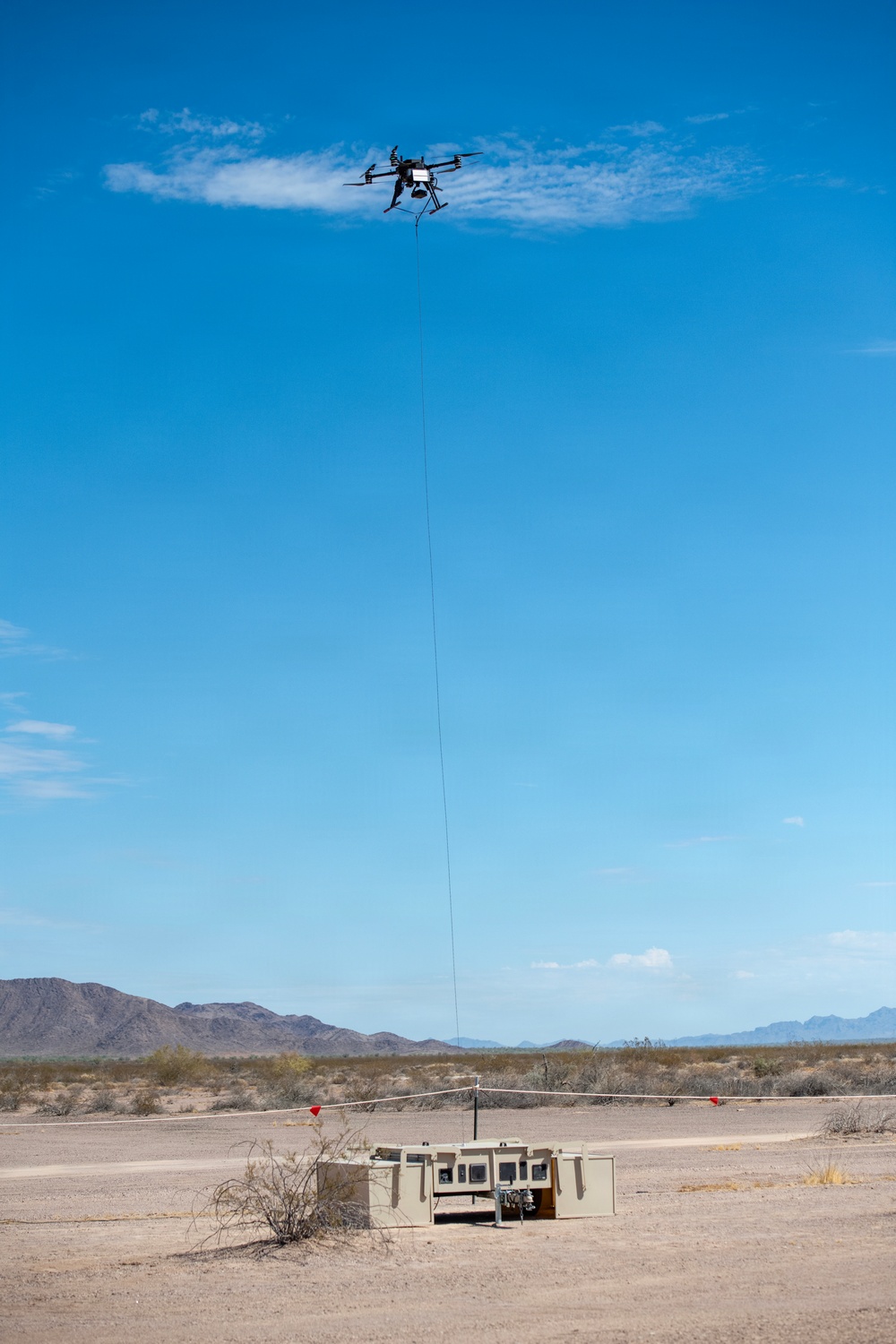
Most persistent-surveillance drones have the same problem: the longer they stay up, the more energy they burn. Kitemill, a Norwegian airborne-wind-energy company, is pitching the opposite. At DroneX in London on 29-30 September, it showed Kitewall, a tethered, vertical-takeoff kite UAV. The company says the wind pulling on the kite generates more electricity than the aircraft and its ground station consume.
That is a bold claim, and it rests entirely on Kitemill's own data. Janes, which reported on the showing, attributes every figure to the company. The Kitewall product page is also company material and carries the same caveat. Nothing below has been independently verified.
How the Kitewall Is Meant to Work
The concept is airborne wind energy. Rather than spinning rotors to hold position, the kite flies in the wind. Its pull on the tether turns a generator in the ground station. Janes lists a wind-generation capacity of 15 kW. Kitemill says this makes the system net energy positive, meaning it produces more than the platform and ground station use.
The company's product page describes a fully autonomous system with vertical launch and recovery. It lists these headline numbers:
- Operating altitude of 500 m.
- Payload of 20 kg.
- Line-of-sight range of 80 km, which Janes describes as the radio horizon at 500 m.
- A surveillance radius of roughly 50 km.
- Wind operation from 0 to more than 25 m/s.
- Temperatures from -20 to +50 C.
- More than 900 flights completed, according to the page.
The page lists endurance as "Unlimited*", with an asterisk tied to scheduled inspection and service. That qualifier matters. Continuous operation here means the energy supply is not the limiting factor. Maintenance still is.
Payloads and Links
Janes reports EO/IR and RF detection payloads. The product page gives more detail on the electro-optical gimbal: 1920x1080 video with 30x optical zoom, plus a 640x512 long-wave infrared sensor. It also lists a SIGINT and direction-finding payload configuration.
For communications, the company lists a MIMO/MANET/MESH link with anti-jamming features. Janes adds an optional fibre-optic tether link. Both are relevant to electronic warfare. A physical fibre line to the aircraft is not exposed to over-the-air jamming in the way a radio link is.
Detaching From the Tether
The most unusual feature is that the kite can leave its tether. Janes reports an untethered ISR mode with a 50 km radio line-of-sight and a 256-bit AES encrypted datalink. The product page calls this a detached patrol mode, flown on batteries charged while tethered. Away from the tether, the aircraft is no longer drawing on the ground station's wind-power supply, which suggests a trade of endurance for reach.
Kitemill also describes fielding several units together in a "wall" formation, or operating them independently. The idea is overlapping coverage and combined sensor data for wide-area surveillance. Janes does not report how many units, what spacing or what tether handling this would require, and neither source gives a deployed example.
The Show
DroneX 2026 ran at ExCeL London, Halls S13-S15, with free entry. According to the organiser, it spans commercial, defence, emergency-services and future-of-flight sectors. It is run by Uncrewed Tech Ltd with ARPAS UK as headline industry partner. Kitemill appears on the organiser's list of confirmed exhibitors.
Why It Matters
Persistent ISR is a standing demand, and tethered systems are an established way to get it. They trade mobility for time on station. Kitemill's pitch is that wind can pay for that time. If the power claim holds up, a fixed site could be watched for long periods without fuel resupply or battery swaps. That would be useful for border, base-perimeter or infrastructure monitoring.
There are open questions. The wind range of 0 to above 25 m/s sounds wide, but a kite that generates power from wind needs wind to fly and produce. How the system behaves in very low wind is not explained in the sources. The net-positive claim also depends on what is counted: the platform, the ground station, and any payload and communications loads. Janes says the system produces more than the platform and ground station consume, but it publishes no test data. The 900-plus flights figure is a count from the company's page. It does not say how long those flights were, in what conditions, or with what payload.
The tether is also a limit. At 500 m altitude and with a tether in the air, the system is likely a visible, fixed target, and it would constrain airspace around it. The untethered mode is a partial answer, but at that point the 50 km link range and the aircraft's battery become the constraints. Independent trials, with figures from a third party, would be the real test of whether this moves from trade-show concept to fielded kit.
