
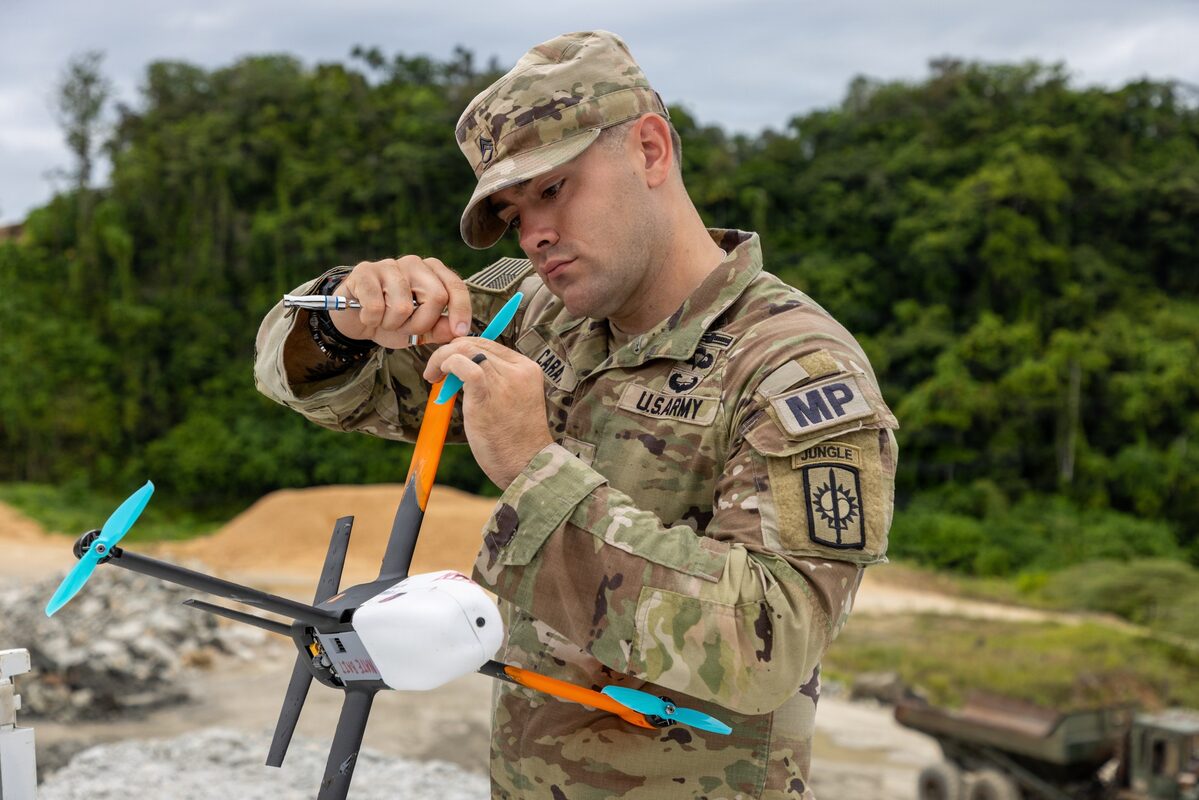
Japan's Acquisition, Technology and Logistics Agency (ATLA) signed a mass-production procurement agreement on August 27, 2026, for the Terra B1, a rocket-launched interceptor drone built by Terra Drone specifically to shoot down Shahed-style one-way attack drones and anti-radar loitering munitions in the mold of the IAI Harpy. The approval capped a roughly three-month span from tender to production contract — a pace industry insiders describe as the fastest ATLA has managed for a drone program, against a typical development-to-fielding cycle of one to two years for Japanese defense procurement.
The Terra B1 is the domestic counterpart to the Terra A1, an interceptor Terra Drone has already supplied for use in Ukraine. Both aircraft are built around 3D printing rather than conventional manufacturing, a choice the company says is central to how fast the program moved and how it intends to scale production if the interceptor goes to war.
How the Program Moved So Fast
ATLA's evaluation ran as a head-to-head demonstration. Terra Drone says ATLA selected Terra B1 on July 15, 2026 to join the trial, and the four-model demonstration itself was run by the Maritime Self-Defense Force from late July through early August 2026. According to Terra Drone's August 25 newsroom release, the Terra B1 was the only one of the four to pass ATLA's demonstration test outright. That result — a clean pass where three competitors did not — appears to have removed the ambiguity that normally stretches out a procurement decision, letting ATLA move from test result to signed production agreement in about three weeks.
Coverage from c4isrnet.com, UAS Weekly, and The Defense Post all corroborate the same sequence: a sole-surviving design, a rapid contract signature, and a program explicitly framed around countering the low-cost, mass-produced attack drones that have reshaped air defense thinking since Russia's large-scale use of Shahed-136-derived munitions against Ukraine. The Defense Post additionally reports that the effort sits inside a dedicated Japanese initiative it identifies as the Interceptor Drone Rapid Acquisition Program — Terra Drone's own release refers to the same initiative as the Interceptor Drone Early Acquisition Program — suggesting the compressed timeline was a designed feature of the acquisition track rather than an improvised exception.
Neither the number of units ATLA has ordered nor the contract's value has been disclosed by any of the reporting outlets.
Why 3D Printing Is the Point, Not a Footnote
Terra Drone CEO Toru Tokushige, quoted in the c4isrnet.com report, framed additive manufacturing as the mechanism that keeps the design current: because the airframe is 3D-printed rather than tooled through injection molds or machined components, the company says it gains ample time to modify the interceptor to adapt to evolving threats and the fast-changing drone tech landscape without delaying the deployment schedule. In a threat environment where one-way attack drones and loitering munitions are themselves iterated on rapidly and cheaply, a defender that has to re-tool a factory every time the target profile shifts starts from a structural disadvantage.
The company's longer-term plan extends the same logic to the supply chain itself. Terra Drone intends to distribute production across multiple sites rather than concentrate it in a single factory, and to move — eventually — toward local 3D-printing farms at those sites. Tokushige put the rationale directly: even if one production site were attacked by a system such as a Shahed-type drone, the distributed model could significantly reduce the risk of the entire supply chain being disrupted. Spreading fabrication across distributed, printer-based sites is meant to ensure that an attack on any one facility does not halt the interceptor's manufacture nationally.
What the Terra B1 Is Meant to Stop
The reporting identifies two specific threat classes the Terra B1 is designed against. The first is Shahed-style one-way attack drones — slow, cheap, long-range munitions that fly in numbers and rely on overwhelming or exhausting a defender's more expensive interceptor stock. The second is anti-radar loitering munitions in the vein of Israel Aerospace Industries' Harpy, which loiter over a target area waiting to home in on emitting radar systems. Both categories share a common feature that has driven interest in dedicated counter-drone interceptors worldwide: they are cheap enough to be produced and expended in volume, which makes traditional high-cost air-defense missiles an inefficient — sometimes uneconomical — way to stop them.
A rocket-launched interceptor built from 3D-printed components is, in principle, positioned to compete on that same cost and speed-of-production axis rather than relying on exquisite, expensive components that are slow to manufacture at scale.
Why It Matters
Japan's move matters less for the specifics of one airframe than for what the acquisition timeline demonstrates. A one-to-two-year procurement cycle has been the norm for ATLA, and for most national defense-acquisition bureaucracies generally, because testing, requirements review, and contracting are built for exquisite, low-volume systems. Shahed-style drones and other mass-produced loitering munitions do not respect that timeline: the threat evolves in months, not years, and a defender stuck on a multi-year acquisition clock is perpetually building yesterday's answer.
Compressing tender-to-production to roughly three months — enabled by a head-to-head demonstration that produced an unambiguous winner, and by a purpose-built rapid-acquisition track — is a signal that at least one government is willing to restructure its own bureaucratic process, not just its hardware, to keep pace with drone warfare's compressed innovation cycle. Combined with Terra Drone's plan for distributed, print-farm-based manufacturing, the Terra B1 program reads as a template attempt: build the interceptor to be fast to iterate, and build the acquisition and production system around it to be just as fast. Given that Terra Drone's related Terra A1 interceptor is already operating in Ukraine, Japan's fast-tracked B1 also extends a live combat feedback loop — lessons from one theater informing procurement and design in another — that could become a recurring feature of how interceptor drones are developed and fielded going forward.
Sources
- Japan approves mass production of 3D-printed interceptor drones — C4ISRNET
- Terra Drone's Japan-Made Interceptor Drone "Terra B1" Solely Passes ATLA Demonstration Test — Terra Drone
- Terra Drone's B1 Interceptor Drone Passes Japan ATLA Counter-UAS Demonstration Test — UAS Weekly
- Japan Selects 'Terra B1 Interceptor' in Effort to Defend Military From Shahed Drones — The Defense Post
