
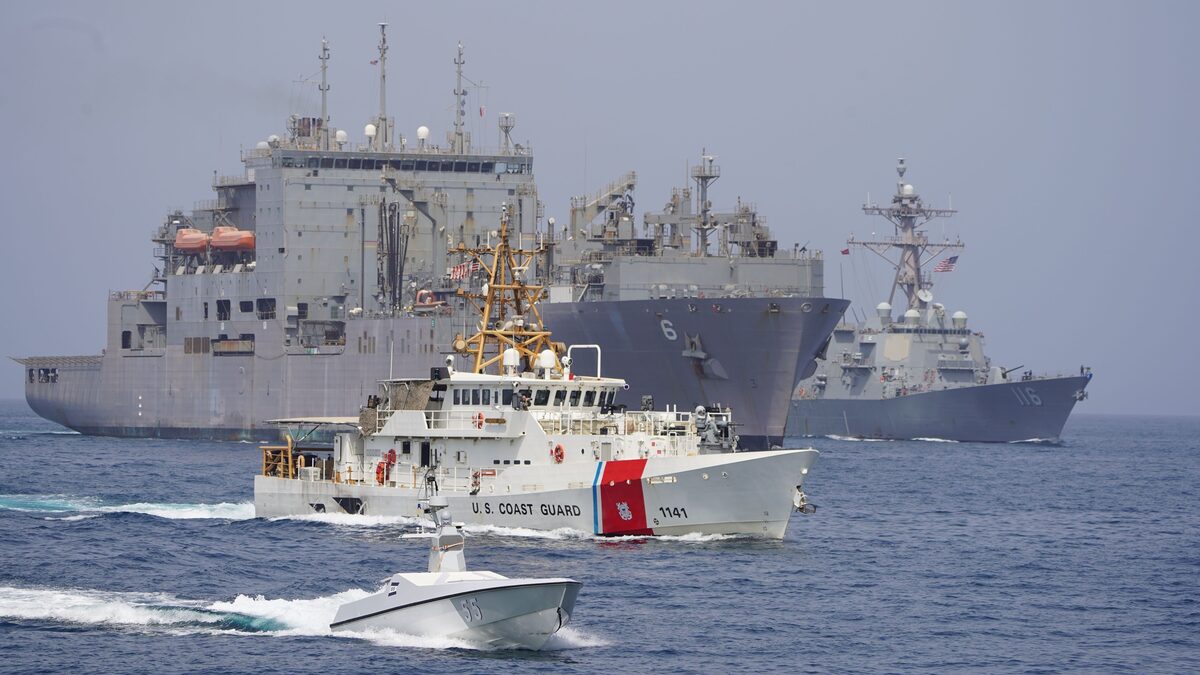
For three days at the end of June, the Strait of Hormuz stopped being a chokepoint that everyone worries about in the abstract and became an active drone-on-shipping battleground. The weapon at the center of it was not a ballistic missile or a fast-attack boat swarm — it was the one-way attack drone, the cheap, expendable loitering munition that has reshaped warfare from Ukraine to the Red Sea. Between June 25 and June 27, 2026, two of them found commercial vessels near the mouth of the world's most important oil-transit corridor, and the United States answered each strike with a night of air strikes against Iranian targets.
Here is what happened, why CENTCOM framed it the way it did, and why a cheap one-way attack drone hitting a tanker is a harder problem than the headlines about retaliation suggest.
The June 25 strike: M/V Ever Lovely
On June 25, according to U.S. Central Command, an Iranian one-way attack drone struck the Singapore-flagged cargo ship M/V Ever Lovely as the vessel was exiting the Strait of Hormuz along the Omani coast. That geography matters: the southern, Omani side of the strait is the outbound shipping lane, the route loaded tankers and cargo ships use to leave the Persian Gulf for open water. A drone reaching a ship there is reaching it at the precise moment that global energy and trade flows are most exposed.
CENTCOM did not absorb the hit quietly. On June 26, U.S. forces struck back. According to the official Central Command release, U.S. aircraft hit Iranian missile and drone-storage locations and coastal radar sites, including targets on Qeshm Island — the large Iranian island that sits inside the strait and gives Tehran a forward platform for surveillance and weapons that can range outbound shipping. Stars and Stripes corroborated the same target set: missile and drone storage, plus coastal radar.
CENTCOM's language was deliberate. It called the attack on the Ever Lovely "unwarranted aggression" and said it violated the ceasefire that the United States and Iran had agreed to. That ceasefire — a memorandum of understanding dated June 17 — is the political backdrop to everything that followed. Less than ten days old, it was already being tested by drone strikes on civilian hulls.
The June 27 strike: the tanker Kiku
The second hit came roughly 48 hours later. On June 27, 2026, the Panama-flagged tanker Kiku was struck by a one-way attack drone in the Strait of Hormuz at around 4:30 a.m. Eastern Time, per Al Jazeera's reporting. Two different vessels, two different flags — Singapore and Panama — both struck by the same category of weapon in the same waterway within two days.
The U.S. response escalated in scope. Where the June 26 strikes concentrated on missile and drone storage and coastal radar, the second night's strikes reached deeper into the kill chain. According to Al Jazeera, U.S. forces hit Iranian surveillance infrastructure, communications, air-defense sites, drone-storage facilities, and — notably — minelaying capabilities. That last category is a tell: it signals U.S. concern that Iran's options for closing or contesting the strait extend beyond drones to sea mines, the other classic asymmetric tool for holding a chokepoint at risk.
The renewed attacks strained the June 17 U.S.–Iran ceasefire, which Al Jazeera reported might be "at breaking point." One analyst quoted in the same reporting cautioned that the agreements were "very, very fragile, and this tit-for-tat could get out of hand" — a reminder of how little it took to push the memorandum of understanding toward collapse.
Why the one-way attack drone is the real story
It would be easy to file these three days under "U.S.–Iran tensions flare again." But for anyone tracking unmanned systems, the specific weapon matters more than the diplomatic ledger.
A one-way attack drone — a loitering munition that flies to a target and detonates, rather than returning — is cheap, hard to attribute in the moment, and well suited to hitting slow, large, radar-conspicuous targets like tankers and cargo ships. A commercial vessel cannot maneuver out of the way of a drone, has no hard-kill defenses, and presents an enormous, predictable target moving along a known shipping lane at a known speed. The economics are lopsided: a small drone threatens a vessel and cargo worth orders of magnitude more, and forces a military response worth more still.
That asymmetry is exactly why CENTCOM's strikes targeted what they did. Hitting drone-storage facilities, coastal radar, surveillance and communications nodes, and air-defense sites is an attempt to degrade the launch-and-cue infrastructure behind the drones rather than to intercept the drones one by one in flight. You cannot economically shoot down every cheap drone over a 100-mile-long strait; you can try to take apart the system that finds, targets, and launches them.
How this differs from the earlier June fighting
This episode is distinct from the earlier June 2026 exchanges that centered on Iranian attacks against U.S. bases. The news here is not bases-under-fire. It is commercial shipping under fire — and specifically, cheap one-way attack drones being used to hold global maritime trade at risk in the single waterway through which a large share of the world's seaborne oil moves.
That reframes the problem from force protection to freedom of navigation, and from defending fixed installations to defending a continuous stream of civilian vessels that no navy can fully escort. It is a counter-UAS problem at the scale of an entire trade route, and it does not have a clean military answer.
Why It Matters
The Strait of Hormuz is the most consequential maritime chokepoint on Earth, and these strikes demonstrate that a one-way attack drone — not a submarine, not a destroyer, not a ballistic missile — is now a credible tool for putting global shipping at risk there. Two vessels under two different flags were hit in 48 hours, and each strike pulled the United States into a night of retaliatory air strikes against drone-storage, radar, air-defense, and minelaying targets. That is the core dynamic of modern asymmetric warfare: a low-cost, expendable system imposes high-cost responses and threatens trillions in trade.
It also exposes the limits of counter-UAS. You cannot economically intercept every cheap drone across a strait, which is why CENTCOM went after launch and cueing infrastructure rather than the drones in flight. And it shows how fragile a ceasefire can be against this class of weapon: the June 17 U.S.–Iran MOU was barely a week old when drone strikes on the Ever Lovely and the Kiku strained it to the point of two U.S. military responses. For the shipping industry, allied navies, and anyone working the C-UAS problem, the takeaway is blunt: defending a global trade artery against cheap, expendable drones is now an unsolved, recurring problem rather than a hypothetical one.