
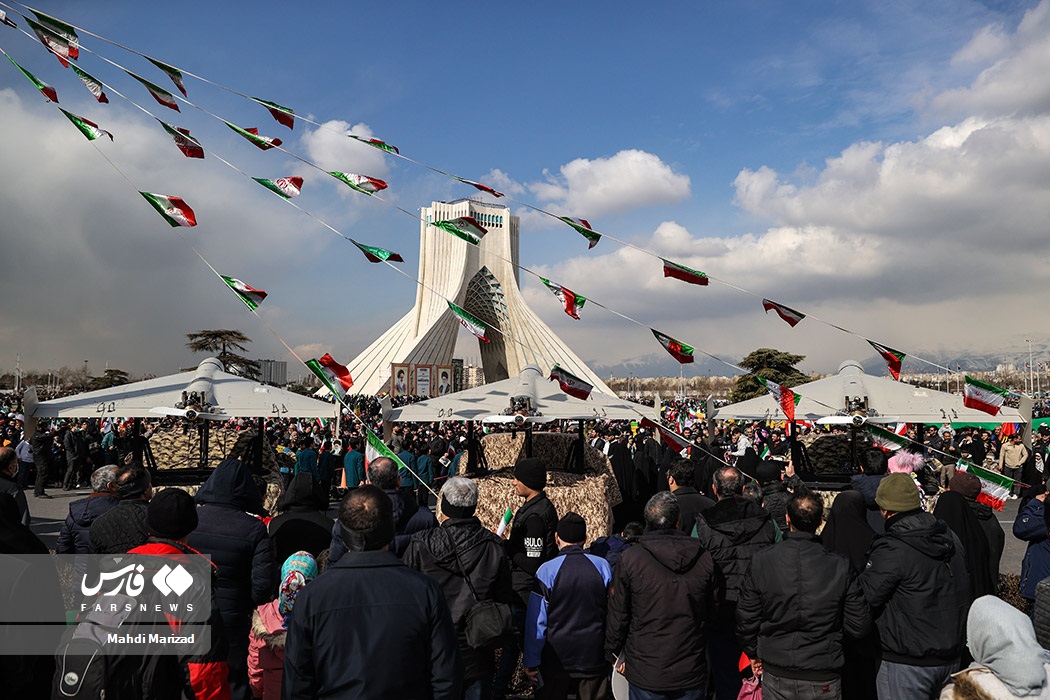
The program didn't begin with Shahed-136 saturating Ukrainian airspace. It began with rocket-fitted prototypes on the banks of the Shatt al-Arab during the grinding Iran-Iraq war of 1980–88 — a conflict fought under international export restrictions that forced Tehran to improvise or go without. Four decades later, that improvisation has produced the most consequential non-Western UAS program on the planet: one that has shifted battlefield economics, outlasted two generations of sanctions regimes, armed proxy forces from Lebanon to the Red Sea coast, and placed Iranian-built airframes in active combat over Eastern Europe.
Two Factories, One Design Bureau, and a Unified Command
Iran's drone industrial base rests on two major production pillars and a single, dominant design authority. HESA — Iran Aircraft Manufacturing Industries, located in Shahin Shahr near Isfahan — was originally a Bell Textron licensed plant. Nationalized after the 1979 revolution, it lost its foreign supply chain but retained its manufacturing infrastructure and the institutional knowledge of how to build aircraft in volume. Qods Aviation Industries (QAI), based in western Tehran, became the second major producer, responsible for the Mohajer family and related platforms.
Above both sits SAIRS — the Shahed Aviation Industries Research Centre, the IRGC Aerospace Force's own in-house design bureau, sited near Badr Air Base south of Isfahan. The division of labor is deliberate: SAIRS designs, HESA produces. The broader ecosystem encompasses more than eight production sites and seven storage sites — a dispersed footprint that complicates any adversary's targeting calculus before the first drone launches.
"Drone warfare is exclusively conducted by the IRGC Aerospace Force, which also controls Iran's strategic-missile force." — ITSS Verona
That consolidation is not incidental. By placing drones and ballistic missiles under the same command structure — with Saeed Aghajani heading IRGC UAV systems — Iran has built an integrated strike architecture optimized for simultaneous, multi-altitude saturation: missiles force defenders to commit interceptors at altitude; drones arrive low, slow, and numerous. Launches originate from small airstrips and underground bases dispersed across central and southern Iran.
Reverse-Engineering as State Doctrine
Iran never developed a deep indigenous aerospace design tradition. What it cultivated instead was a systematic reverse-engineering capability — a doctrine of capture, study, and replicate applied across both airframes and propulsion systems.
Two events defined this approach in the public record. In December 2011, a CIA RQ-170 Sentinel stealth reconnaissance drone crash-landed in northeastern Iran — whether through Iranian electronic warfare or a navigation fault remains unresolved. Iran claimed to have reverse-engineered a working copy, unveiling a reported replica in May 2014 and conducting a publicized test flight in November 2014. The resulting Shahed-141 through -191 series and the Saegheh are flying-wing designs visibly derived from the RQ-170 platform. A year later, in December 2012, the IRGC claimed to have hijacked a Boeing ScanEagle reconnaissance drone over Kharg Island. Whether electronic capture or a downed and recovered airframe, Iranian engineers gained direct access to the platform's construction and systems.
The reverse-engineering doctrine extends to propulsion. The Shahed-131's 38-horsepower Serat-1 engine is a copy of the British AR731 Wankel. The Shahed-136's 50-hp engine — the unit that powered hundreds of Geran-2 strikes on Ukrainian grid infrastructure — traces to the German-designed Limbach L550. Neither copy required original design work. Both required exactly the kind of mechanical and manufacturing competence that a nationalized Bell Textron plant, properly redirected, could provide.
The Platform Families
Iran's current inventory spans at least four distinct lineages, each calibrated to different mission sets across the ISR-to-strike spectrum.
Mohajer. Iran's first ISR drone dates to the 1980s. The current Mohajer-6, built by QAI, is a mid-range multi-role platform capable of ISR and precision strike with laser-guided munitions — reusable, with a stated range of roughly 1,200 miles. It has been documented in combat in Ethiopia's Tigray conflict and, from February 2023 onward, in Russian service via Mahan Air and Iran Air smuggling routes and disassembled Caspian shipments. The first Mohajer-6 downed over Ukraine appeared over Odesa in late September 2022, operating in a surveillance role to cue Shahed-136 swarm attacks — a two-platform kill chain that illustrates the program's systems-level thinking.
Ababil. HESA's Ababil line dates to the 1990s, evolving into surveillance and loitering variants — Ababil-3 and Ababil-5 — and remaining in service with Hezbollah and other proxies as an older but functional layer of the distributed arsenal.
The Shahed family. The full Shahed series is covered in a dedicated piece, but the platform contours matter here. The Shahed-129 is Iran's longest-endurance platform: 8 meters long, 16-meter wingspan, 24-hour loiter capability, capable of carrying up to eight anti-tank missiles. The Shahed-149 and Fotros represent the higher performance tier. The Shahed-131 and -136 — the one-way attack variants — have defined the program's global reputation. The -136 specification: 3.5 meters long, 2.5-meter span, 200-kilogram gross weight, 20–40-kilogram warhead, cruise speed of 185 km/h, carbon-fiber and honeycomb construction, commercial INS plus GPS/GLONASS navigation. Debris analysis from Ukraine found no onboard homing sensors; terminal accuracy depends on pre-programmed coordinates rather than active seeking. Unit cost is estimated at $20,000 to $50,000.
"The Shahed 136's simplicity, combined with its almost uncanny accuracy, long range and low cost, makes it unique among strategic standoff weapons." — Uzi Rubin, missile-defense expert, via RUSI
The Shahed-136 entered Iranian inventory in 2021. Its operational logic was demonstrated earlier, in the September 2019 attack on Saudi Aramco's Abqaiq processing facility — actually the Shahed-131 — which showed that a sub-$50,000 one-way drone could impose billions in economic damage on hardened energy infrastructure. The July 2021 Mercer Street tanker strike extended the same logic to maritime targets: a direct hit on a moving vessel at sea.
Karrar. Iran's jet-powered combat drone occupies the high-speed end of the portfolio, designed for strike missions where propeller-driven platforms lack the kinematic margin to survive or reach defended targets.
Proliferation, Proxy Networks, and the Russian Deployment
Iran's IRGC Quds Force Unit 340 manages drone-program assistance to proxy forces across the region. The network predates the platforms that made Iran internationally notorious by a significant margin. Hezbollah flew an Iranian Mersad-1 drone over northern Israel as early as November 2004 — years before one-way attack drones entered mainstream strategic analysis. Today Hezbollah's estimated stockpile exceeds 2,000 drones. The Houthis receive Qasef, Sammad, and Shahed-136 variants — designated "Waid" in Houthi service. Iraqi and Syrian militias and Hamas have received various platforms. Ethiopia's acquisition of Mohajer-6 for use in the Tigray conflict marked one of the first documented exports to sub-Saharan Africa in an active civil war context.
The Russia relationship represents the most significant proliferation event in the program's history. Iranian Shahed-131 (Geran-1 in Russian service) and Shahed-136 (Geran-2) entered combat over Ukraine beginning in September 2022, launched from Belarus and Crimea in mass strikes targeting the power grid. NATO estimates suggest approximately 6,000 total units agreed under the supply arrangement; reporting indicates 1,700 to 2,000 delivered by late 2022. Russian troops trained in Iran in August 2022. Iran's willingness to arm a permanent UN Security Council member conducting offensive operations against a European state was a qualitative escalation in the program's geopolitical reach — and a proof of concept for drone exports as strategic currency.
Sanctions evasion and the COTS problem. Analysis of Shahed-131 and -136 debris recovered in Ukraine found that 82 percent of components by count were of US origin, per a Biden administration task force analysis. One systematic examination of 52 components from a single Shahed-136 identified 40 sourced from 13 American firms, with the remainder from Canada, Switzerland, Japan, Taiwan, and China. A DLE-111 engine retails at roughly $500 on commercial platforms. Iranian procurement networks use agents in Western countries, diplomatic mail, and transshipment through third-country intermediaries to acquire components at scale.
The structural problem is that civilian commercial off-the-shelf components fall largely outside MTCR and Wassenaar Arrangement controls. They were not designed as weapons components, and controlling their global trade at the granularity required to deny Iran access is not practically achievable under current export-control frameworks. As Alma Research Center analysts concluded: "Iran's UAV manufacturing industry is not affected by international sanctions. The main reason for the ineffectiveness of the sanctions is that many components used in this industry are civilian off-the-shelf components that are very easy to purchase on websites."
The cost-imposition doctrine. Iran's operational concept is not precision — it is saturation economics. One documented campaign deployed approximately 4,400 one-way attack drones at an average rate of roughly 120 per day across the campaign. At an interception rate of 85 to 90 percent, the residual penetration rate still degrades defended targets. Iran's own planning explicitly treats a survival rate of 10 to 20 percent as operationally acceptable — an inversion of Western precision-strike logic that Western C-UAS architectures were not designed to handle at that price ratio.
Senior U.S. military commanders, including then-CENTCOM Commander Gen. Kenneth McKenzie, warned publicly around 2021 that American forces faced aerial threats for the first time since the Korean War without assured air superiority. Defenders expend Patriot or NASAMS interceptors priced in the millions against drones that cost tens of thousands. The spread — 20:1 or higher per engagement — is not a side effect of Iran's strategy. It is the strategy. Ballistic missiles remain a separate deterrent layer; drones don't replace them. They complement them, forcing defenders to split finite interceptor inventories across simultaneous high- and low-altitude threats while Iran replenishes from a production base that sanctions have largely failed to reach.
Sources
- RUSI — Russia's Iranian-Made UAVs: Technical Profile
- Washington Institute — Iran's Game of Drones
- Washington Institute — Iran's Drone Strategy, Part 1: Wartime Performance and Adaptations (2026)
- Jamestown Foundation — More Options, More Lethality: Mohajer-6 Enters Russia's Strike Package in Ukraine
- Alma Research Center — The Propagation of the Iranian UAV Threat into Europe
- ITSS Verona — Iranian Drone Warfare: Theory and Praxis
- Bulletin of the Atomic Scientists — A Conflict of Attrition: Iran's Bet on Asymmetric Warfare (April 2026)
- Congressional Research Service — Iran: Background and U.S. Policy (R47321)
