
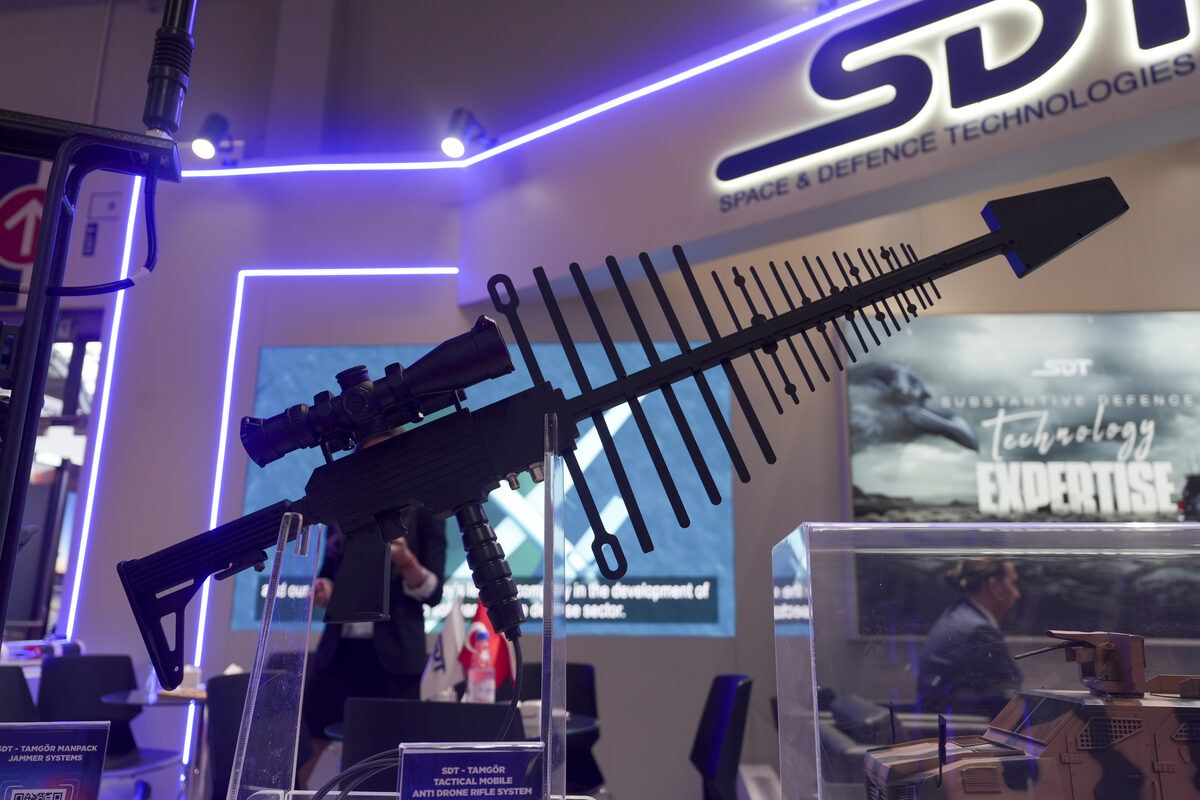
State applications for FEMA's second $250 million counter-drone grant round closed at 5 p.m. ET on Nov. 16. Awards are expected Dec. 10. Houston is one of the cities in the queue, and it got there in an unusual order. According to DroneXL, the City Council approved the bid on Nov. 4, while the policy that would govern how the city uses the equipment was still being written.
That sequence is legal. Under the federal rule that now covers local counter-drone operations, a written policy is a condition for operating, not for applying for money or buying hardware. Still, Houston shows how the paperwork and the procurement can come apart. It also shows a split inside the rule that matters for what cities actually buy: the rule covers some of the equipment FEMA's grant pays for and leaves out other parts of it.
What the rule actually is
The regulation is an interim final rule issued jointly by the Justice Department and the Department of Homeland Security. Its title is "Counter-UAS Authority for State, Local, Tribal, and Territorial Law Enforcement and Correctional Agencies." It appears in both 6 CFR Part 124 and 28 CFR Part 124 under Docket FBI-2026-0001. The rule took effect July 1, and the Federal Register published it on July 6, 2026, at 91 FR 41466.
Its legal basis is the SAFER SKIES Act (Pub. L. 119-60), signed Dec. 18, 2025, which added the authority at 6 U.S.C. 124n(a)(2). As UAShield's breakdown of Part 124 summarizes it, certified state, local, tribal and territorial police and corrections agencies can now track, warn, seize or disable a drone that poses a credible threat. The rule governs agencies, not pilots. Disabling a drone, which the rule calls mitigation, carries extra conditions. The agency must hold an FBI-issued Mitigation Certification, and it must find in real time that the drone poses a credible threat.
The policy requirement, in plain terms
Section 124.6 is the provision Houston is still working to meet. It requires each agency to adopt and maintain a written implementation policy before it conducts any operations. The rule spells out four things about that policy:
- Timing. The policy has to exist before the first operation. The rule ties it to operations, not to grant applications or equipment purchases.
- Legal review. Per DroneXL's reading, legal counsel must review the policy when the agency adopts it and again at each annual renewal.
- Self-certification. The agency attests through a federal portal that it has a compliant policy, and it renews that attestation every year.
- No pre-approval. The policy is not subject to pre-approval by the NCUTC, the FBI's National Counter-UAS Training Center.
The last point is the one most likely to surprise city officials. No federal office reads the policy and signs off before an agency starts operating. The check comes afterward. The NCUTC keeps authority to audit agencies and to suspend their accreditation. The penalties also have real weight. The Federal Register text cites civil fines of up to $100,000 per violation, or suspension of counter-UAS authority, under section 8605(f) of the SAFER SKIES Act. UAShield describes those fines as aimed at agencies that skip the required federal coordination.
So the design relies on trust first and enforcement later. A city writes its own rules, has its lawyers review them, attests to them, and then has to live with them if auditors come asking.
Where radar and cameras fall
The second issue DroneXL raises concerns hardware. The interim final rule says that detection and warning activity using systems that do not need the Act's authority or its relief from certain laws, such as electro-optical and infrared cameras, acoustic sensors and radar, is not subject to the rule. In other words, the rule's controls are written around the capabilities that needed new federal authority in the first place, such as intercepting a drone's control link or taking over or disabling a drone. Passive detection equipment that agencies could already operate lawfully is outside the rule.
FEMA's grant does not draw the same line. DroneXL notes that radar, cameras and acoustic sensors all appear on the equipment list FEMA's grant pays for. A city can therefore spend counter-drone grant money on a detection-only system that the federal rule does not cover in the same way as a jammer or another mitigation tool.
This creates two separate questions for any city that wins an award. The first is what the grant pays for. The second is which parts of the purchase trigger Part 124's requirements. The answers can differ. A council that approves a package mixing sensors with mitigation gear is approving equipment under two different federal treatments, even though one grant funds it all.
Houston's position
The public record supports only limited conclusions about Houston. The council voted for the bid on Nov. 4, and the use policy was not finished at the time. Applications closed Nov. 16, and the Dec. 10 award date is a few weeks away. If Houston wins money and buys equipment, the Section 124.6 policy has to be adopted, reviewed by counsel and attested in the federal portal before the city runs any operation under the rule's authority.
DroneXL's coverage cites Marshall White, founder of UAShield, a site that tracks federal drone law. UAShield's guide states the rule's basic division of labor clearly: Part 124 governs agencies, not pilots, and adds no flight rules. For pilots in Houston or elsewhere, the rule does not create new obligations. It changes who may legally act against their aircraft and under what conditions.
Why It Matters
Part 124 extends counter-drone authority to certified state and local police and corrections agencies, and the FEMA rounds supply money for equipment at the same moment. Houston's timeline may well be common. Grant windows and council calendars set the pace, and written policies can catch up later.
Two design choices in the rule shape how that plays out. The first is the absence of pre-approval. Policy quality depends on each agency's lawyers and on the NCUTC's later audits, not on a federal review before operations begin. The second is the carve-out for sensors that do not need the Act's authority. The most heavily regulated part of a counter-drone program is the mitigation capability, while detection hardware bought with the same grant money sits outside the rule.
Residents, councils and pilots trying to judge a local program should ask two questions. Does a lawyer-reviewed Section 124.6 policy exist yet? And which items in the purchase actually fall under it? The $100,000-per-violation fine and the NCUTC's suspension power are the federal backstop. The local policy is the first line of control, and in at least one major city it was still being drafted when the money was requested.
Sources
- Houston's Counter-Drone Policy: Federal Rule Covers Jammers, Not Radar (DroneXL, Nov. 16, 2026)
- Counter-UAS Authority for State, Local, Tribal, and Territorial Law Enforcement and Correctional Agencies; Interim Final Rule (Federal Register, July 6, 2026, 91 FR 41466)
- 6 CFR Part 124: When Police Can Take Down Your Drone (UAShield, reviewed Nov. 15, 2026)
