
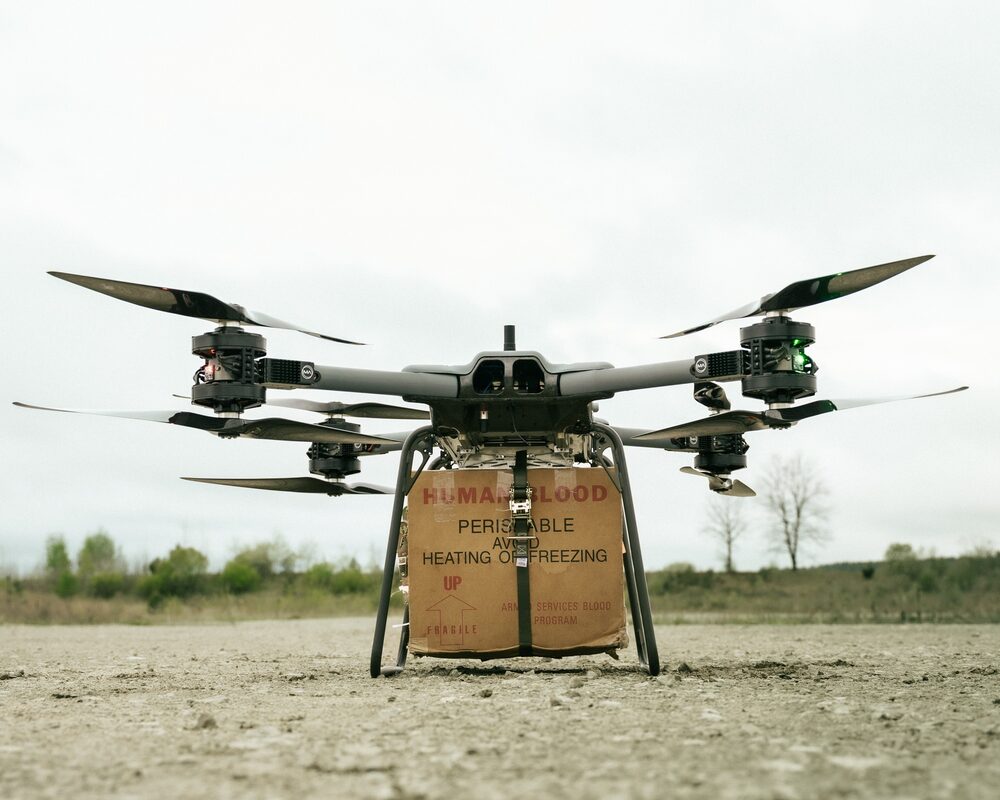
Hillsborough County Fire Rescue (HCFR) in Florida is about to start a program the county calls the first of its kind in the United States: launching a drone to a trauma scene carrying whole blood, so paramedics can begin a transfusion at the scene before hospital transport. The agency held its first public demonstration on Monday, Sept. 28, and says live service begins in October.
The numbers the county is putting forward are specific. Two drone systems, each covering 35 square miles, will protect a combined 70 square miles. The county says blood will reach the scene in three and a half minutes or less, with an average of just under three minutes inside each system's footprint and a worst case of five minutes at the outer edge. Those are design targets. As of DroneXL's Sept. 30 report, no live call had been flown.
What is being deployed
The drones will be based at two fire stations: Station 9 in Sabal Park and Station 37 in Riverview. The county's release describes the two service areas as bounded by I-4 and I-75 to the north and by a line just south of Gibsonton Drive. HCFR as a whole covers 900 square miles, so the pilot touches a fraction of its territory.
The partners are Tampa General Hospital, drone-as-first-responder provider ArcherFRS, and the blood bank OneBlood. The concept came from Rescue Division Chief Todd Carnell, and the county says he has worked more than two years to put it together. County commissioners approved the program Sept. 2, according to DroneXL.
The pilot runs one year. DroneXL reports that year one is framed as a proof of concept, with a planned expansion to 50 square miles per area.
How the delivery works
Per DroneXL, the drone hovers at about 197 feet (60 meters) over the scene and lowers its payload on a tether, which avoids the need for a landing zone near a crash or incident. Chief Carnell told Spectrum Bay News 9 that "the drone can get anywhere in about three and a half to four minutes," and said crews can start IVs and medications while the blood is en route.
The aircraft will not be flown by firefighters on site. ArcherFRS staff pilot the drones remotely from the company's operations center in Sarasota. Fire Rescue holds the FAA beyond-visual-line-of-sight (BVLOS) Certificate of Waiver that makes those flights legal, and the county has contracted ArcherFRS for piloting, monitoring and maintenance. The waiver stays in Fire Rescue's name even though the company's pilots are at the controls.
What is not known
Several things are still open:
- Cost. The county has not published what it pays ArcherFRS, according to DroneXL.
- Real-world performance. The three-minute average and five-minute worst case are projections. They have not been measured on live 911 responses in Hillsborough.
- Dispatch use. How often dispatchers will actually launch the drones is untested here.
That last point has a precedent. DroneXL, citing Government Technology, notes that ArcherFRS's earlier Manatee County deployment, which began in May 2024, went more than seven months without a 911 dispatcher using it. A drone that can beat an ambulance is only useful if the dispatch workflow calls for it, and Manatee shows that integration can lag the hardware.
Why It Matters
The county's argument is that most ambulances do not carry whole blood and that it is hard to predict where it would be needed, so getting a unit to a patient is a logistics problem across a 900-square-mile county. A drone that places units at the scene in minutes, while crews are already working the patient, shifts that timeline. Hillsborough's program is a public-safety test of that idea with named partners, defined coverage areas and published time targets that can be checked against results.
It is also a test of the operating model. Contractor pilots in Sarasota flying under a county-held BVLOS waiver, with drones sitting at fire stations in Hillsborough, is an operating model other agencies may study. First responders and Tampa General have said they hope to add stations, and ArcherFRS says it wants to bring blood drones to communities nationwide. Whether that happens will depend on the first year's data: launch counts, actual delivery times, units used, and what the service costs per square mile covered.
The Manatee County experience is the best caution. The metric to watch in Hillsborough is not the demo time but the number of real dispatches in the first few months, and whether the county publishes them.