
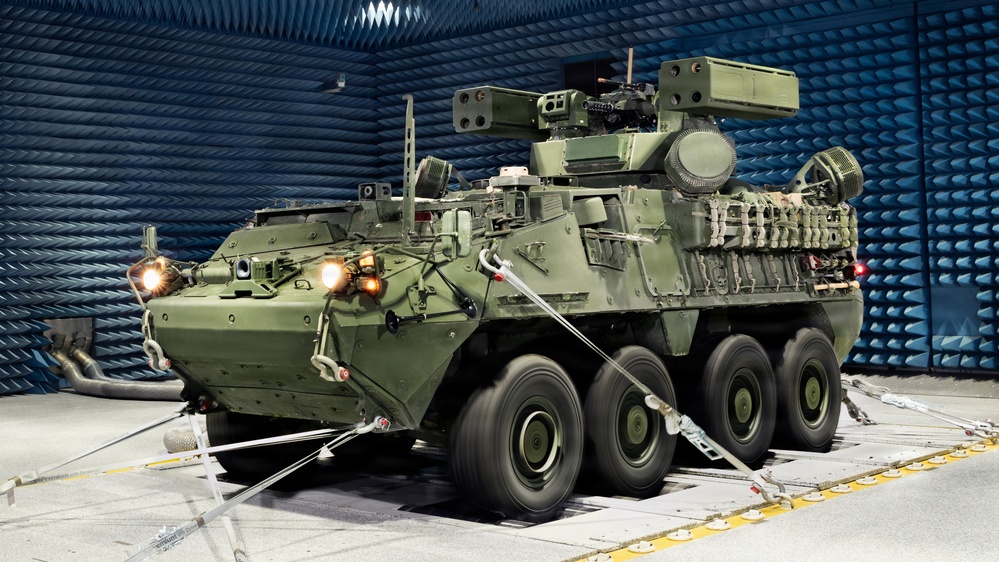
Hanwha Systems used the MSPO defense exhibition in Kielce, Poland, to unveil a prototype that takes its combat-proven stationary counter-drone laser and puts it on wheels. The South Korean firm showed a 50kW laser weapon mounted on its Tigon 8x8 armored personnel carrier — a mobile derivative of the Cheongwang system, the fixed-site laser South Korea has fielded operationally since 2024.
The unveiling was reported by C4ISRNET and Defense News on September 8, 2026, and by Interesting Engineering the following day, placing Hanwha squarely in the middle of a market that NATO's eastern-flank states have been racing to fill: affordable, scalable defenses against the cheap drones and loitering munitions that have reshaped modern battlefields. A prototype has already been built, according to the company, with serial production targeted for the end of 2027.
From Fixed Site to Armored Chassis
The Cheongwang laser that underpins the new system is not a paper concept. South Korea has operated it as a stationary air-defense asset since 2024, giving Hanwha an existing base of combat-relevant performance data to draw on as it adapts the weapon for a mobile platform. Moving the laser onto the Tigon — an 8x8 armored personnel carrier — is meant to convert a static point-defense tool into something that can accompany maneuvering forces or redeploy quickly between threatened sectors, rather than sitting fixed in one location.
Interesting Engineering, in a September 9, 2026 report by Kaif Shaikh, added detail on the broader family this vehicle-mounted laser belongs to: Hanwha is also displaying a separate 20kW tactical laser vehicle alongside the 50kW Tigon-mounted system, giving the company multiple mobile directed-energy concepts rather than a single design.
One figure likely to draw attention from budget-conscious defense planners is cost per engagement. Per Interesting Engineering's reporting, a Cheongwang laser shot costs around 2,000 South Korean won, or about $1.50 USD. Directed-energy weapons have long been pitched on exactly this economics: a shot that costs a couple of dollars against a drone that might otherwise require a missile costing tens of thousands of dollars is the value proposition that has driven interest in laser-based counter-UAS systems across multiple countries.
Export Push Already Underway
Hanwha is not waiting for serial production to start selling. Hyungun Park, manager of Hanwha Systems' laser system business team, told reporters at MSPO: "We are currently in talks with a number of countries over potential exports of the Cheongwang laser, including potential clients from Europe, Asia and the Middle East." The quote, along with the platform details and the 2027 production target, appeared in near-identical form in both C4ISRNET's report and a companion piece from Defense News — sister publications under the same media group, carrying the same byline (Jaroslaw Adamowski) — rather than as separate, independent confirmations from unrelated outlets.
The choice of venue is not incidental. MSPO, held annually in Kielce, has become one of the primary showcases for defense industry pitching to NATO's eastern-flank states — Poland chief among them — as those countries continue large-scale rearmament programs. Per Defense News's reporting from the show, Poland and numerous other NATO eastern-flank countries are looking for inexpensive ways to bolster their counter-drone capabilities. A mobile, relatively low-cost-per-shot laser system pitched directly at a Kielce audience is a deliberate signal to that customer base.
What's Still Unconfirmed
The reporting to date establishes the platform, the power output, the lineage from Cheongwang, the cost-per-shot figure, the 2027 serial-production target and the existence of export talks. It does not specify engagement ranges, target types the system has been tested against, whether any government has signed a letter of intent or contract, or how the 50kW variant's performance compares directly to the fixed Cheongwang installation beyond sharing its underlying laser technology. It also does not establish any prior industrial relationship between Hanwha and Poland specifically. Those details, along with any formal export agreements, will need to come from follow-on reporting or official Hanwha disclosures as the program moves from prototype toward the 2027 production milestone.
Why It Matters
Cheap first-person-view drones and loitering munitions have forced militaries — particularly those along NATO's eastern flank — to find counter-drone defenses that don't cost more per engagement than the threat they're stopping. A missile-based interceptor solves the problem tactically but loses the economic argument fast when the adversary can build attack drones for a few hundred dollars each. Hanwha's pitch, a $1.50-per-shot laser mounted on an armored vehicle that can move with maneuver forces rather than sit fixed at a single site, targets exactly that cost-exchange problem while adding mobility that static laser installations can't offer.
That mobility argument fits the broader shift NATO's eastern-flank states have been pursuing as they rearm: repositionable defenses rather than reliance on fixed, high-value-site installations alone. Hanwha's decision to debut the system at MSPO, with an executive on record confirming active export talks across Europe, Asia and the Middle East, signals the company intends to compete directly for that business well before serial production begins. Whether the system delivers on its cost and mobility promises at scale — and whether any NATO member signs on before 2027 — will be the next test of the program.
