
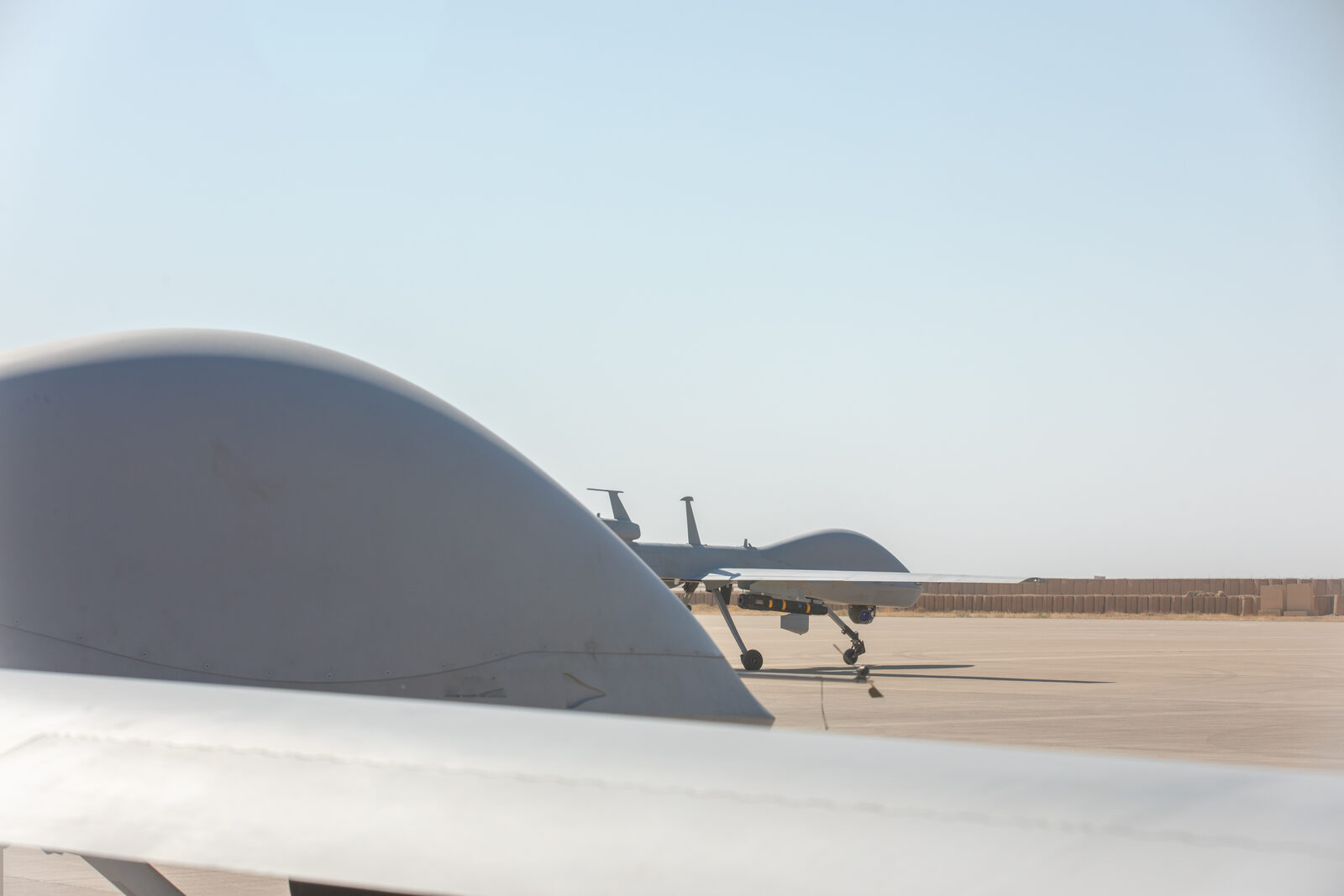
In May 2025, Army Secretary Dan Driscoll and Army Chief of Staff Gen. Randy George announced they were zeroing out MQ-1C Gray Eagle procurement in the FY2026 budget. Their reasoning was blunt: "Yesterday's weapons will not win tomorrow's wars." Months later, the Senate Appropriations Committee responded by adding $240 million for Gray Eagle 25M systems anyway — a move that, as of early 2026, remains in conference with the House. The platform that has accumulated more than one million safe operating hours is now the subject of one of the sharper civil-military budget fights in recent memory. To understand why, you have to understand what the Gray Eagle actually is, what it was built to do, and why the answer to both of those questions is more complicated than either side of that debate lets on.
Predator Roots, Army Requirements
The Gray Eagle's lineage runs directly to the MQ-1 Predator, but the two aircraft serve fundamentally different institutional contexts. In 2002, the Army launched its Extended Range/Multi-Purpose (ER/MP) competition to replace the RQ-5 Hunter with a true medium-altitude, long-endurance armed UAV that could be owned and operated by ground forces — not borrowed from the Air Force. General Atomics' "Sky Warrior" design, a modest dimensional expansion of the Predator airframe, won in August 2005 with a $214.4 million development contract, defeating designs from Northrop Grumman, Aurora Flight Sciences, and IAI.
The dimensional differences between the Gray Eagle and its Predator ancestor are narrow on paper — a 56-foot wingspan and 28-foot length on the Gray Eagle — but the capability delta is larger. Payload capacity reaches 1,075 pounds across internal and external stations on the Gray Eagle. More consequentially, the Army specified a heavy-fuel engine operating on jet or diesel fuel, satisfying its "single fuel on the battlefield" logistics doctrine. That single engineering requirement is part of why the Army never adopted the Air Force's MQ-9 Reaper, which is sized for Air Force basing and command structures and operates at altitudes and ranges optimized for theater-wide rather than formation-level tasking.
Originally designated the MQ-1C Warrior, the aircraft was renamed Gray Eagle in August 2010 when AGM-114 Hellfire integration was completed. An unarmed Quick Reaction Capability variant had deployed to Iraq starting December 2009. The first full company deployment followed in June 2012.
What It Is and What It Does
The production Gray Eagle sits at 9 meters long, 17 meters of wingspan, 2.1 meters tall, with a maximum gross takeoff weight of 1,633 kilograms. Its service ceiling is 29,000 feet, max speed 150 knots true airspeed, and endurance up to 25 hours. The original heavy-fuel engine — rated at approximately 160–165 hp depending on variant — was succeeded in the 25M by the Lycoming DEL-120 HFE and ultimately the HFE 2.0.
The mission set is broad: reconnaissance, surveillance, and target acquisition form the core, supplemented by command and control relay, SIGINT collection via BAE Traveler pods, electronic warfare using Raytheon NERO jamming equipment, IED detection, battle damage assessment, and direct attack. The weapons load runs to four AGM-114 Hellfires — range 500 meters to 8 kilometers — along with qualification for the GBU-44/B Viper Strike and GBU-69/B Small Glide Munitions. The sensor suite centers on an EO/IR ball with laser designator and a Northrop Grumman AN/ZPY-1 STARLite synthetic aperture radar with ground moving target indication capability.
The operational integration model distinguishes the Gray Eagle from Air Force MALE platforms in ways that go beyond specs. Army personnel — 15W operators, 15E repairers, 150U warrant officer technicians — own and fly the system, not commissioned pilot-rated officers as in the USAF Predator/Reaper model. Automatic takeoff and landing was standard on the Gray Eagle from the start. Since 2014, the aircraft has operated in manned-unmanned teaming configurations with the AH-64E Apache, giving attack helicopter crews an organic ISR platform that can pass targeting data directly without routing through separate service channels.
"The aircraft excels as an enabler for Fires, Maneuver, Network, and Intelligence operations." — Patrick Shortsleeve, VP of DoD Strategic Development, General Atomics Aeronautical Systems
The 25M Modernization
Against that backdrop, General Atomics unveiled the Gray Eagle 25M in October 2022. First flight followed in December 2023 under a contract valued at up to $389 million. The 25M is not a cosmetic refresh.
The propulsion upgrade to a 200 hp HFE 2.0 engine brings meaningfully extended intervals between engine replacements; a durability test simulating a 2,500-hour service life was completed by May 2024. The flight computer delivers substantially increased processing speed and data storage capacity compared to the legacy Gray Eagle, with onboard electrical power also increased — necessary headroom for the intelligence and networking payloads that matter most in near-peer environments. The EagleEye multi-mode radar adds moving target indication and mapping capability. Onboard AI and machine learning edge processing enables real-time analysis without downlinking everything to a ground station. The legacy vehicle-mounted ground control console has been replaced by a MOSA-compliant laptop-based station, reducing the logistics tail and improving interoperability.
Perhaps most significant for survivability: the 25M is designed to deploy Air Launched Effects — loitering munitions released from the airframe itself, extending reach into denied areas without placing the Gray Eagle directly in the threat envelope. The Army National Guard ordered 12 GE-25M systems via FY2023 congressional appropriations, announced in May 2024, with operational service projected through 2050.
Survivability, Ukraine, and the Obsolescence Argument
The Pentagon's resistance to exporting Gray Eagles to Ukraine in 2022 exposed what the Army's subsequent "obsolete" framing was really about. When sixteen bipartisan senators — including Joni Ernst and Joe Manchin — wrote to Defense Secretary Austin on November 22, 2022 urging Gray Eagle transfers, the Pentagon declined on three grounds: survivability in contested airspace, risk of sensitive technology capture, and potential NATO escalation.
Pentagon spokeswoman Sabrina Singh stated officials must "examine what impact it would have on us, and specifically the Army. But nothing has been ruled out." That measured language reflected a starker technical reality: the Gray Eagle, like all first-generation MALE drones, was designed for and has operated in permissive, uncontested environments. Its radar cross-section is large, it carries no stealth shaping, and it lacks the electronic survivability to operate in airspace covered by modern integrated air defense systems. The war in Ukraine, where Russian and Ukrainian forces destroyed ISR drones at scale, made that vulnerability impossible to talk around.
As of early 2025, no Gray Eagle airframes had been transferred to foreign partners. The survivability concern is part of why. The technology-capture risk — particularly for the SIGINT and EW payloads — compounds it.
The Army's FY2026 procurement zero and the "obsolete" declaration reflect a genuine doctrinal shift: the service is betting on loitering munitions, attritable platforms, and collaborative combat aircraft rather than expensive persistent-ISR platforms with limited contested-airspace survivability. The launched effects capability on the GE-25M is partly a hedge against that logic — the argument that you don't need to fly the platform into the threat if it can reach into the threat via expendable submunitions. Whether that argument survives contact with the Army's acquisition priorities, or whether Congress's $240 million addition ultimately sticks, will determine whether the Gray Eagle is a transition platform or a dead end.
Sources
- Army Technology — MQ-1C Gray Eagle UAS
- Defense Industry Daily — Warrior ERMP: An Enhanced Predator for the Army
- The Aviationist — U.S. Army National Guard Acquires Gray Eagle 25M
- The War Zone — MQ-1C Drones the Army Called Obsolete Added in New Budget Plan by Congress
- Defense News — Senators Urge Pentagon to Send Advanced Gray Eagle Drones to Ukraine
- MILMAG — US Army Orders Additional MQ-1C Gray Eagle 25M
- General Atomics Aeronautical Systems — Gray Eagle