
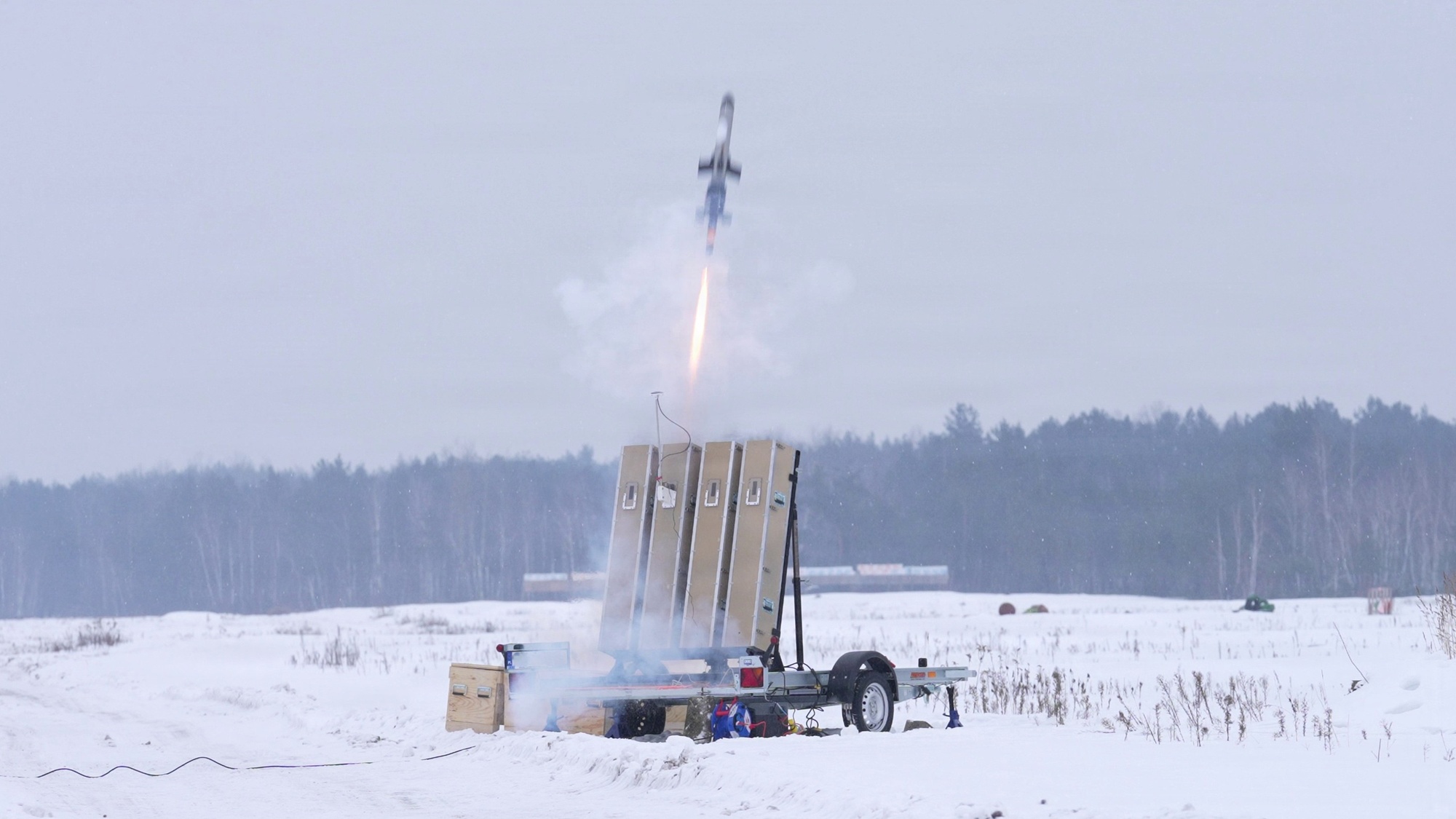
German Chancellor Friedrich Merz used an Oct. 4 visit to Kyiv to put money behind one of the most pressing problems in Ukraine's air defense: jet-powered Shahed-type drones that fly too fast for many of the propeller-driven interceptors Ukraine has been using against Russia's slower attack drones. According to Quantum Systems, the German company behind the deal, Berlin will fund the procurement of "tens of thousands" of interceptor drones built in Ukraine, as part of a winter military aid package, Ukrainska Pravda reported.
The interceptor funding is one part of a larger package. According to the Office of the President of Ukraine, Merz announced support worth more than EUR1.3 billion. CNBC and DroneXL put the split at about EUR1 billion in military aid and EUR350 million for repairs to Ukraine's energy grid. Ukrainian President Volodymyr Zelensky said the package includes "funding for the production of new interceptors specifically against jet-powered shaheds."
The interceptor deal
The drones will come from Quantum WIY Industries, a venture between Germany's Quantum Systems and Ukraine's WIY Drones, and will be made in Ukraine, according to Ukrainska Pravda, which cited Quantum Systems' press service. DroneXL reported that Quantum Systems signed an agreement with Ukraine's Ministry of Defense covering testing and procurement of interceptors for jet drones.
"Ukraine needs interceptor drones at an industrial scale," Sven Kruck, co-CEO of Quantum Systems, said in the company's statement, as quoted by Ukrainska Pravda.
The airframe at the center of the deal appears to be WIY Drones' SPYS (written "Spys" by some outlets). DroneXL reported that the SPYS has passed testing, has a top speed of 600 km/h and carries a 300 g payload, and that the first 50 were delivered in July. Ukrainska Pravda said the Spys has been in testing since August, with an initial 50 units delivered. The two outlets give different starting points for that timeline, and neither explains the gap. CNBC reported that Zelensky praised the SPYS interceptor during the visit.
Quantum Systems also signed a memorandum with Ukrainian manufacturer Fire Point to jointly develop unmanned technologies to counter modern aerial threats, according to both Ukrainska Pravda and DroneXL.
How big was the deal? It depends who you ask
The headline figures differ depending on the source.
- Kyiv's version: The president's office said "15 agreements and documents" were signed during the visit, with a total value of "more than EUR8.5 billion."
- Berlin's version: CNBC, citing German officials, reported that executives signed 14 agreements with the Ukrainian government and Ukrainian businesses, worth roughly EUR6.6 billion. CNBC said these included deals with Diehl for IRIS-T air defense, Hensoldt for radar, and Quantum Systems for jet-drone interceptors.
Neither source reconciles the two counts. None of the published totals breaks out how much of the money goes to the interceptor procurement.
Separately from the commercial deals, Ukrainian Interior Minister Ivan Vyhivskyi and German Ambassador Boris Ruge signed a Joint Declaration of Intent on Cooperation in the Field of Countering Unmanned Systems, according to the president's office. Zelensky also said the two countries already produce drones together, that work has begun on UAV units in Germany, and he thanked Germany for taking part in the FREYJA program.
The jet-Shahed problem in numbers
The deal is aimed squarely at the jet-powered variants of Russia's Shahed-family attack drones. According to DroneXL, Ukraine's propeller-driven interceptors were built for a Shahed cruising near 185 km/h, and a jet-powered Geran runs at roughly twice that, which leaves many interceptor drones too slow to catch them.
Zelensky gave figures on both the threat and Ukraine's results, though the numbers vary by source:
- Volume: The president's office quoted Zelensky as saying Russia launched 900 jet-powered Shaheds "this week alone." DroneXL, also citing Zelensky, reported that more than 800 of the 1,900 attack drones launched in a week were jet-powered. These may describe different weekly windows or different ways of counting. What both show is that jet drones now make up a large share of Russia's drone attacks.
- Interception rates: According to DroneXL, Zelensky said Ukraine's Bars interceptor downs up to 30% of its targets. DroneXL also reported that on Sept. 22 Zelensky said Ukraine was intercepting about 55% of jet Shaheds. That figure appears to cover all of Ukraine's defenses, not one interceptor type, so the two numbers do not contradict each other. Even so, they suggest that the best drone-on-drone option is still missing most of its targets.
- Production: DroneXL, citing RFE/RL, reported that Russia builds about 3,000 Geran-4 drones a month.
At those numbers, the case for buying "tens of thousands" of interceptors is simple. If a single interceptor type hits less than a third of the time, and the attacker can send hundreds of jet drones a week, defenders need interceptors in very large numbers. A SPYS top speed of 600 km/h, as reported by DroneXL, is the kind of speed margin an interceptor needs to chase a jet-powered drone rather than simply wait in its path, though DroneXL notes the guidance for a head-on intercept is still being refined.
The rest of the package
The interceptor deal sits alongside more conventional air defense. CNBC and DroneXL both reported agreements involving Diehl's IRIS-T missiles and Hensoldt radars. Taken together, the deals appear to cover several layers: radar to detect incoming threats, IRIS-T missiles, and cheap interceptor drones for large numbers of one-way attack drones.
The EUR350 million for energy repairs goes to grid repairs ahead of winter, according to DroneXL, which lists generators, substations and grid repairs. CNBC reported that air-raid sirens sounded during Merz's visit, and that a drone strike on the Academy of Sciences in Kyiv the previous week killed at least two people.
Why It Matters
The deal shows Germany paying to scale up a production line inside Ukraine rather than mainly shipping finished systems from German factories. The interceptors will be made in Ukraine under a German-Ukrainian venture, with German money and a German partner. In the company's words, as quoted by Ukrainska Pravda, manufacturing of interceptors "will expand precisely as the need for protection against Russian strike drones grows."
It also shows how quickly the counter-drone fight is shifting. Jet-powered variants arriving at hundreds per week threaten to outpace propeller-driven interceptors unless new interceptors get faster and are built in much larger numbers. Zelensky's own figures, up to 30% for the Bars and about 55% across Ukraine's defenses, show the current gap. Whether German funding closes it will depend on numbers not yet published: how many SPYS-class interceptors Quantum WIY can actually build each month, at what unit cost, and what kill rate they reach against jet drones in combat rather than in testing.
Finally, the joint declaration on countering unmanned systems and Zelensky's mention of UAV units being set up in Germany suggest the cooperation also runs the other way. Zelensky tied the counter-drone work to Russian sabotage attempts, including at an airfield in Leipzig, and Kruck said expanding production in Ukraine would also build industrial capacity that strengthens Germany and its allies.
Sources
- EUR1.3 Billion to Strengthen Ukraine's Defense and Energy Sector: Results of the Meeting Between Zelenskyy and Merz (Office of the President of Ukraine, via mirror)
- Germany to fund thousands of anti-Shahed interceptors for Ukraine (Ukrainska Pravda)
- Merz unveils fresh military aid in Kyiv, says Germany won't be intimidated (CNBC)
- Germany Funds Jet-Drone Interceptors As Ukraine's Best Hits 30% (DroneXL)
