
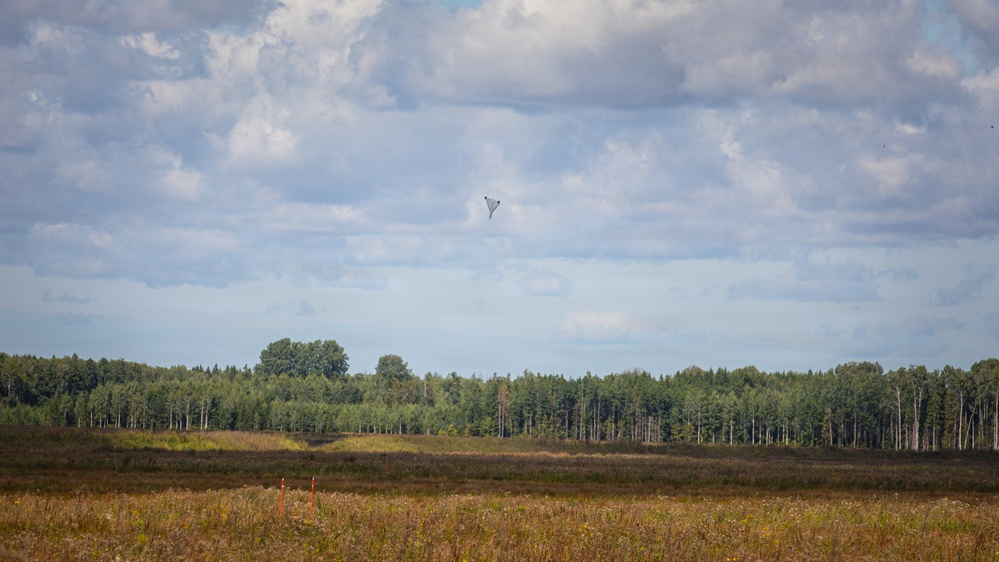
For three years, the war in the skies over Ukraine has run to a familiar rhythm: swarms of slow, propeller-driven Shahed-136/Geran-2 drones grinding toward their targets at roughly 180km/h, low enough and loud enough that even improvised countermeasures — machine guns, mobile fire teams, cheap FPV interceptors — could occasionally bring them down. That rhythm is now breaking. According to Ukraine's Main Directorate of Intelligence (GUR, also rendered HUR), Russian industry is manufacturing more jet-powered Geran-4 and Geran-5 drones each month than the piston-engine model that opened the drone war, and the newer airframes are fast enough that Ukraine's existing low-cost interceptor fleet largely cannot catch them yet.
The production crossover
Ukraine's Defense Intelligence Directorate (GUR, also known as the DIU) told Militarnyi that Russia now turns out approximately 3,000 Geran-4/5 jet drones per month, compared with roughly 2,800 monthly units of the original Geran-2 — the Russian-produced version of Iran's Shahed-136 that has been launched against Ukrainian cities and infrastructure since 2022. Kyiv Post independently covered the same GUR assessment, confirming that jet-powered output has now overtaken piston-engine output for the first time.
The production figures point to more than a manufacturing milestone. In June, then-Commander-in-Chief of Ukraine's Armed Forces Oleksandr Syrsky said jet-powered drones could eventually account for half of all Russian attack-UAV production — a Ukrainian intelligence assessment of where Russia is headed, not a publicly declared Russian target, but one that reads as a deliberate pivot toward a faster, harder-to-intercept weapon rather than an upgrade rolled out at the margins.
GUR's public "War & Sanctions" database has also published a technical breakdown of the Geran-4's internal construction — a 3D model, component list, and foreign-parts inventory — tracing its control-system electronics to the same Alabuga Special Economic Zone production line that builds the rest of Russia's Geran family, part of Ukrainian intelligence's ongoing open-source effort to expose the supply chains behind Russia's long-range strike drone program.
What changed under the hood
The performance gap between the two families comes down to propulsion. The Geran-2 flies on a piston engine driving a rear propeller — cheap, simple, and slow. The Geran-4 and Geran-5 replace that with a turbojet, and per Ukrainian defense-intelligence figures reported by Militarnyi and Kyiv Post, the difference in performance is dramatic:
- Geran-4: cruise speed up to 500km/h, range of roughly 850km, 50kg warhead.
- Geran-5: top speed up to 600km/h, range of nearly 1,000km, a larger 90kg warhead, maximum take-off weight of about 850kg, and roughly two hours of flight endurance.
Six hundred kilometers per hour is more than three times the Geran-2's roughly 180km/h cruise speed. That gap is the crux of the problem for Ukrainian air defense: a weapon category built around "slow and numerous" has abruptly acquired a fast variant, without shedding the numerous part.
The jet engines themselves are not domestically produced. GUR's own technical breakdown of the Geran-4 identifies two Chinese-made turbojets used in the airframe — a discontinued Telefly LX-WP-160 and the newer Telefly TF-TJ2000A, the same engine used in the Geran-5 — and GUR Deputy Head Vadym Skibitsky told RBC-Ukraine, in remarks relayed by Militarnyi, that Russia remains fully dependent on Chinese engine supplies, at roughly $35,000 to $40,000 per unit, while it works to build its own. That dependency is a supply-chain chokepoint as much as it is a technical detail: every Geran-4/5 rolling off the line represents a Chinese-sourced engine Moscow cannot yet build for itself in volume.
Why speed breaks the intercept math
Ukraine's layered defense against Shahed-type drones was built for the Geran-2's flight profile: slow, low, and predictable enough that mobile fire teams, gun trucks, and — more recently — cheap FPV and propeller-driven interceptor drones could be scrambled to run it down or shoot it out of the sky. The Kyiv Independent reports that, until very recently, Ukraine had no dedicated interceptor capable of catching the faster jet-powered Gerans — its existing low-cost interceptor fleet, built to run down slow Shahed-class targets, simply could not close the distance on something moving at up to 600km/h. That changed only on Aug. 21, 2026, when Ukraine's first jet-powered interceptor drone, the Alexa Spatium, officially entered service — a single new type, days old at the time of that reporting, set against a Russian jet-drone production run already running at roughly 3,000 units a month. An FPV interceptor with a top speed well under that of its target is not an interceptor against that target — it's a spectator.
The result, per that reporting, is an accelerated race inside Ukraine's drone-defense industry to get newly fielded interceptor types like the Alexa Spatium into service at scale and to design further types that can match or exceed jet-Geran speeds — a harder engineering problem than the one that produced the current generation of anti-Shahed interceptors, since a faster airframe needs more thrust, better guidance at higher closing speeds, and a warhead or kill mechanism that works in a much shorter engagement window.
Q&A: the essentials
Is the Geran-5 replacing the Geran-2?
Not yet, based on the reported figures — both are still in mass production. But Ukraine's own intelligence assessment, a projected 50% jet-powered share of all Shahed-type output, signals a probable Russian pivot rather than a niche variant.
Why does the warhead size matter?
The Geran-5's 90kg warhead is nearly double the Geran-4's 50kg — meaning the newer drones aren't trading payload for speed, they're delivering more explosive weight, faster, and farther.
What's the actual bottleneck for Russia?
Engines. Every jet-powered Geran currently depends on a Chinese-made turbojet costing tens of thousands of dollars per unit — a far more expensive, and more externally sourced, component than the piston engines used in the Geran-2.
Can Ukraine's current air defenses hit a Geran-5?
Traditional systems — guns, missiles designed for faster/higher threats — can still engage it. The gap identified by Ukrainian reporting is in the low-cost interceptor-drone layer, which was purpose-built for slow Shahed-class targets; Ukraine fielded its first jet-capable interceptor, the Alexa Spatium, only on Aug. 21, 2026, and has not yet scaled that capability to match the volume of jet-powered Gerans coming off Russian production lines.
Why It Matters
The Shahed/Geran-2 threat forced Ukraine to build an entire low-cost defensive ecosystem — mobile fire teams, acoustic sensors, cheap interceptor drones — specifically tuned to a slow, low-flying, propeller-driven target. That ecosystem is a genuine strategic asset: it lets Ukraine impose a favorable cost exchange against a drone that is itself relatively cheap. A monthly production run of roughly 3,000 jet-powered Gerans, some capable of speeds more than three times faster than the drone Ukraine's air defenses were built to stop, threatens to invalidate a large share of that investment overnight, not through a single decisive weapon but through a volume shift in what "the average incoming drone" looks like. If jet-powered variants become half of Russia's Shahed-type output, as Ukrainian intelligence assesses could happen, Ukraine's defenders will increasingly be facing a mixed threat where legacy interceptors work against one drone in two and cannot yet catch the other at scale — a split that complicates targeting doctrine, strains scarce higher-tier air-defense assets, and puts pressure on Ukraine to scale its newly fielded jet-interceptor category under wartime timelines. The Chinese-sourced turbojet dependency is also a lever: it is currently the one hard constraint on how fast Russia can scale the faster, more dangerous half of its drone fleet.
Sources
- Russia Produces 3,000 Geran-4/5 Attack Drones Each Month, Ukraine's Intelligence Says — Kyiv Post
- Production of the Geran-4/5 Jet Drones Has Surpassed That of the Geran-2 — Militarnyi
- Russia's Jet-Powered Geran-5 Drone Can Fly 600 km/h, Carry 90 kg Warhead – HUR — Kyiv Post
- As Russia turns to jet-powered drones, Ukraine scrambles for new interceptor tech — Kyiv Independent
- War&Sanctions: ГУР розкриває будову нового російського реактивного удаpного БпЛА «Ґєрань-4» — GUR (Ukraine's Main Directorate of Intelligence)