
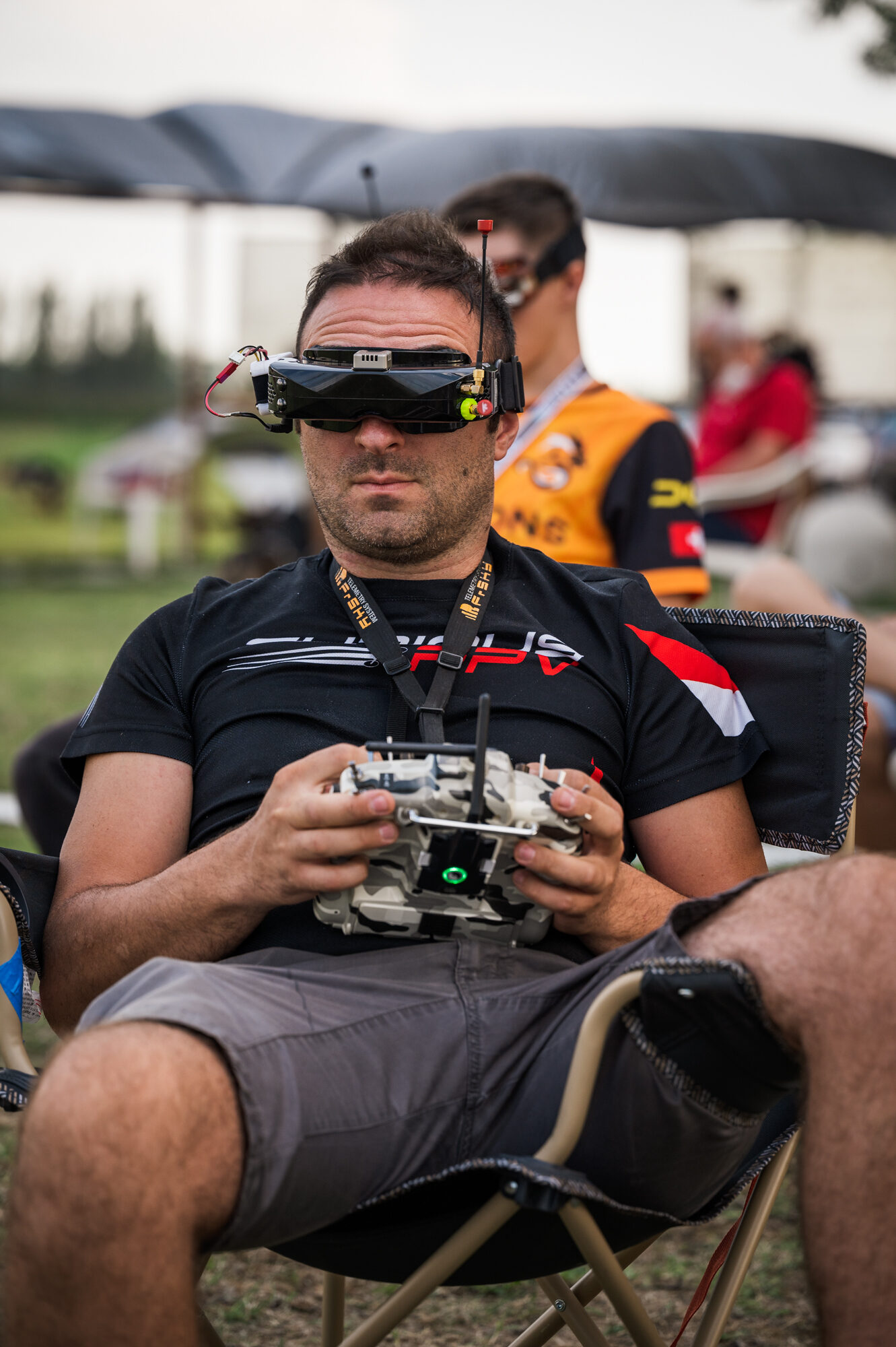
In 2022, Ukrainian engineers and hobbyists began converting racing drones into strike weapons. They faced a choice that would have seemed mundane in any other context: which video system to use. They chose analog — a signal modulation technology whose origins trace to the 1970s — and that choice has persisted through three years of industrialized drone warfare, even as high-definition digital alternatives proliferated. The reason is not nostalgia. It is physics.
Continuous Wave, Zero Delay
Analog FPV transmits raw, uncompressed composite video — PAL or NTSC — using continuous wave modulation. There is no encoding or decoding step in the transmission chain. The signal the camera captures is, within the bounds of physics, the signal the pilot sees. The result is a glass-to-glass latency of 10 to 20 milliseconds: the time from photons hitting the camera sensor to an image appearing in the goggles.
That figure matters more than it appears. At 100 mph — roughly the cruise speed of a combat FPV drone — a 10-millisecond latency difference means the drone travels an additional 0.45 meters before responding to pilot input. In a high-speed terminal attack threading debris, a doorway, or a defended position, those 45 centimeters are the difference between a hit and a miss. Analog also degrades gracefully: as signal weakens, the image becomes snowy and static-filled but remains interpretable. A pilot can still navigate toward a target through snow. They cannot navigate through the pixelated blockiness that overtakes a digital system under identical conditions.
Model Aviation, the American Model Aviation Association’s publication, captures the failure mode precisely: “The DJI system responds to low signal strength by reducing the effective resolution of the image. Basically, the image gets ‘blocky.’”
The analog camera and VTX (video transmitter) combination costs 0 to 0. This is not an afterthought — it is a strategic parameter. When Ukraine aimed to procure 4.5 million FPV drones in 2025 and monthly production had scaled from garage operations to 50,000-plus units, cost per airframe became existential. A complete armed combat FPV drone runs 00 to 50 depending on the video system selected.
Spectrum and Power: The 5.8GHz Tradeoffs
Most FPV video links — analog and digital alike — operate in the 5.8GHz band, a choice that reflects both regulatory reality and engineering constraint. The shorter wavelength allows compact, lightweight antennas, a premium for airframes measured in grams. The 5.8GHz allocation sits partially overlapping with the congested 5GHz Wi-Fi range (5170–5835 MHz), reducing infrastructure interference. The band contains over 100 assignable channels; analog channels occupy 30MHz of bandwidth while DJI and Walksnail Avatar systems occupy 20 to 40MHz depending on bitrate mode.
Power output is where regulatory and battlefield realities diverge. Most jurisdictions cap 5.8GHz VTX output at 25mW without a license. Analog VTXs can be legally pushed to 10W in some regions, providing substantial range advantages over digital VTXs that max at 1W (HDZero). Higher power means greater range and better penetration through obstacles and interference. The legal ceilings governing civilian hobbyists are irrelevant on a contested frontline; the physics are not.
The Digital Contenders: Resolution vs. Latency
Digital FPV systems encode video as binary data, enabling error correction, encryption, and HD resolution — at the cost of processing delay. The three dominant platforms each represent a distinct engineering compromise.
DJI’s O3 and O4 systems deliver 1080p video with glass-to-glass latency of 20 to 50 milliseconds depending on frame rate and signal quality. Tested range under ideal conditions reaches approximately 23km (O3) and 26km (O4). The airside unit costs $99 to $229; DJI goggles run $229 to $500. DJI FPV products may become unavailable in the US market in 2026, complicating prospective procurement for Western-aligned forces dependent on the Chinese supply chain that dominates FPV component manufacturing globally.
HDZero achieves fixed 14 to 20ms glass-to-glass latency at 90fps in race mode — the lowest among digital systems and comparable to analog — at the cost of range and ecosystem breadth. Walksnail Avatar sits between the two, with variable latency between analog and DJI levels. None of these systems are cross-compatible with each other, a fragmentation that creates logistical headaches at production scale.
FPV educator Oscar Liang, who maintains detailed comparative latency benchmarks, offers a frank assessment aimed at recreational users: “If you can, get DJI.” Digital systems have found adoption for specific mission profiles in Ukraine — deep-strike operations where image clarity aids target identification at range and electronic warfare density is lower than at the frontline. But they remain the exception.
Why It Matters
Ukraine’s frontline FPV operations locked onto analog because of how it fails under jamming, not because of how it performs under ideal conditions. Russian electronic warfare systems — notably the Silok and Cheburashka jammers — target the analog video link specifically, attempting to blind the pilot with static interference rather than seize drone control. Ukraine’s response is not to abandon analog but to make its video link adaptive.
Operators maintain transmitters across multiple frequency bands — 3GHz, 1.2GHz, 6GHz and above — enabling rapid component swaps as Russia reconfigures its jamming on a daily basis. Ku-band microwave transverters hide FPV signals inside satellite traffic clutter. Multi-receiver systems with different antenna polarizations maintain a usable link under simultaneous interference across channels.
“Using two or three different receivers on separate frequencies…significantly increases the chances,” a Ukrainian drone trainer told C4ISRNET in November 2025, speaking without attribution for operational security reasons. The same trainer underlined the human requirement: “If something goes wrong, you should be able to repair it.”
China-made components dominate FPV construction globally. Field-repairable, component-swappable systems built around a technology that costs 0 and degrades gracefully are better suited to this supply environment than proprietary HD platforms that fail silently and require manufacturer support.
The third tier of this evolution is now operational. Fiber-optic FPV drones carry HD digital video over a thin optical cable spooled from the airframe — sub-15ms latency, zero RF signature, unjammable by conventional electronic warfare. Russia deployed fiber-optic FPV drones to strike Kramatorsk, the first major Ukrainian city reached this way, from behind Russian frontlines. Operational range expanded from 15–20km to 25–30km as tether technology matured. But even here, human performance remains the binding constraint: elite pilots achieve 70–80% mission success; mid-level operators achieve 40–50%; new operators roughly 20%. Fiber-optic missions cap at 40–50% even for experienced operators. The video link is one input. The pilot is the system.
The FPV drone has compressed the sensor-to-shooter loop to a single person, creating cost asymmetry in which a 00 airframe destroys assets worth thousands to millions more. The video link enabling that — 10 milliseconds, uncompressed composite, continuous wave modulation — is fifty years old. Under the conditions that define modern drone warfare, it is often the best tool available.
Sources
- C4ISRNET — Of fiber optics and FPVs: 6 questions with a Ukrainian drone trainer
- Oscar Liang — FPV System Comparison Guide
- Oscar Liang — FPV Drone Latency Explained
- Oscar Liang — FPV Channels and Frequencies
- Military Machine — How FPV Drones Work
- Model Aviation (AMA) — The Switch to Digital FPV
- ArduPilot — Video Systems for FPV
- GIS Reports — Ukraine DIY Drones
- Combating Terrorism Center at West Point — Moving Targets: Implications of the Russo-Ukrainian War for Drone Terrorism
