
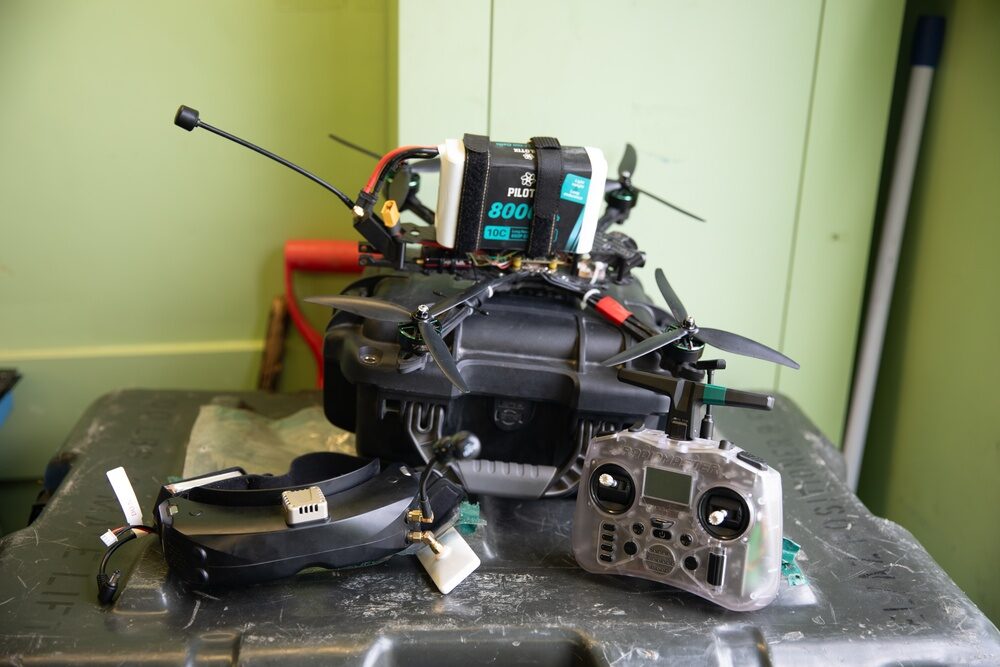
In June 2025, approximately 117 first-person-view drones — each worth roughly a thousand dollars — attacked five Russian airbases simultaneously in what Ukrainian officials called Operation Spiderweb. When the smoke cleared, more than 40 aircraft had been damaged or destroyed; the total hardware value erased exceeded $7 billion, according to Just Security's accounting of the raid. The entire strike package cost an estimated $117,000. That ratio — call it roughly 60,000-to-one in value destroyed versus value expended — is not an anomaly. It is the operating logic of the FPV era, and understanding it requires understanding what these machines actually are.
Anatomy of a Racing Drone Turned Weapon
An FPV drone is, at its core, a racing quadcopter: carbon fiber frame, four brushless electric motors, a flight controller board, a radio receiver, a forward-facing camera, and a video transmitter. The pilot wears immersive goggles that relay a live camera feed, flying as if seated inside the airframe. Standard platforms cruise above 100 km/h; purpose-built interceptor variants push 300–400 km/h, per Defence Ukraine's technical analysis. Payload capacity runs roughly 2 kg on a standard attack frame, scaling up to more than 7 kg on heavier platforms like the "Queen Hornet" and as much as 20 kg on hexacopter variants like the "Baba Yaga."
Cost sits at $300–500 per unit in the Ukrainian market, with RUSI pegging the baseline at "$400-and-up." Analog video dominates because it is lighter, cheaper, and carries lower latency than digital — critical when the pilot is threading a 150 km/h airframe through a tank's open hatch. The tradeoff is image quality, but in most attack profiles, the operator only needs to hold a lock on a vehicle silhouette for the final few seconds of flight.
The warhead selection has expanded dramatically from the original improvised designs. Current Ukrainian and Russian inventories carry RPG-7 and RKG-3 shaped charges, fragmentation rounds, thermobaric munitions capable of collapsing enclosed trenches, thermite "Dragon" incendiary packages, and dropped anti-personnel mines. A specialized class of platforms — RPG-launcher drones — mounts a complete rocket tube on a servo-arm trigger: Ukrainian forces have used the RPG-18, RPG-7, and the Bulgarian Bullspike-AT (rated at 400mm penetration, approximately 3.4 kg loaded); Russian equivalents employ the RPG-26, RPG-22, and RPG-18, with some designs that jettison the spent tube after firing for potential airframe recovery, according to Armourer's Bench's detailed technical analysis. The Bulava unit of Ukraine's 3rd Battalion, Separate Presidential Brigade, completed the first documented RPG-armed FPV test fires in September 2024 and reported first combat use in May 2025.
From Dozen to Million: The Industrial Conversion
The origin story is roughly what you would expect from a country where the hobbyist-to-soldier pipeline compressed into months under existential pressure. Ukrainian enthusiasts and racing pilots began strapping RPG-7 and RKG-3 warheads to commercial racing quads — first by the dozen, then by the thousand — filling a gap that the pre-invasion military acquisition system had not anticipated. The Georgetown Security Studies Review's 2025 analysis captures the arc: Ukraine had approximately 7 drone manufacturers before the full-scale invasion; by 2025 that number had reached roughly 500, with around 160 specifically producing FPVs.
The ramp is steep enough to be difficult to internalize as a production figure. Monthly Ukrainian FPV output stood at roughly 20,000 units in 2024; by early 2025 capacity had reached 200,000 per month. Georgetown and the Kyiv Independent's December 2025 reporting put total FPVs received by Ukrainian forces in 2025 at 3 million — 2.4 million delivered via Ukraine's Defense Procurement Agency plus roughly 200,000 via the DOT-Chain mechanism — with manufacturing capacity exceeding 8 million units per year by early 2026. According to the National Security and Defense Council of Ukraine (RNBO), FPVs now account for approximately 60% of confirmed Russian army equipment losses.
Russia is not standing still. Ukrainian Foreign Intelligence Service spokesperson Oleh Aleksandrov told Politico that Russia's 2025 production target is 2 million FPVs, alongside 30,000 long-range drones and 30,000 decoys. The race is industrial as much as it is tactical.
"The role of unmanned systems on the battlefield is growing, and therefore the production of innovative instruments of war is our number one priority." — Denys Shmyhal, Ukrainian Defense Minister, December 24, 2025
One structural vulnerability runs through both sides: heavy dependence on Chinese-sourced components. OSW's category-level data puts Chinese content at 98 percent for drones under 7 kg, and roughly 90 percent of the fiber-optic thread used by both sides is sourced from China.
Battlefield Economics and Operational Doctrine
The kill economics are striking enough that Defence Ukraine's analysis states flatly: "A single $500 drone, piloted by a skilled operator, can disable or destroy a multi-million dollar main battle tank." Ukraine's National Security and Defense Council attributes roughly 60 percent of confirmed Russian equipment losses to FPV strikes, and OSW's October 2025 analytical report puts drone systems broadly at roughly 85 percent of targets engaged on the front line and 70–80 percent of Russian casualties.
Accuracy has improved substantially: from roughly 30% hit rate in 2022 to approximately 70% by 2024, per OSW and Georgetown estimates — though even at that ceiling, 60–80% of strikes still fail to achieve outright destruction, meaning many FPVs are trading against damaged mobility rather than kills. Ukrainian operators have developed standardized aim-points: optics blocks, turret rings, engine decks, and track runs, each chosen to maximize mission-kill probability against armored targets.
Tactically, both sides now establish dedicated FPV kill zones over supply roads and troop movement corridors. Ukraine's "Drone Line," formalized in February 2025 across five elite units, targets a 10–15 km deep interdiction belt. Frontage density along the contact line has escalated from approximately 1.1 FPV sorties per day per mile in January 2024 to 11 by December 2024, with projections above 20 for 2025. Beyond direct lethality, the suppressive effect — what analysts term "dronephobia" — has measurably degraded Russian unit movement even when individual strikes miss. Convoys halt, soldiers shelter rather than advance, and the psychological cost of constant surveillance compounds the material attrition.
An emerging class of FPV-versus-FPV interception has added another tactical layer. Ukrainian firms including developers of the Shrike and Sting platforms are producing interceptor variants capable of 300–400 km/h and armed with either ramming profiles or miniature shotgun payloads. Production reportedly reached up to 1,000 interceptors per day in early 2026. In February 2026, interceptors accounted for 70% of Shahed drone intercepts over the Kyiv region; in one documented March 2026 engagement, a two-person Sting crew downed 23 Shaheds in a single sortie.
The Fiber-Optic Escalation
Electronic warfare has been the primary tactical counter since the conflict's early phases. OSW estimates that up to 75% of all drones deployed by both sides in 2024 were neutralized by jamming — a figure that illustrates why the fiber-optic FPV emerged as a priority development. Russia began fielding cable-guided variants from spring 2024, with the program surging during the Kursk incursion in fall 2024. The mechanism is straightforward: the drone spools out a thin fiber-optic tether as it flies, transmitting the pilot's control inputs and camera feed through glass rather than radio. Jamming is simply irrelevant to a signal that does not travel through air.
Range scales with cable length — initial systems reached roughly 10 km, with newer models reaching further. The tradeoffs are weight and speed; fiber-optic FPVs are slower and less maneuverable than their radio-frequency counterparts. By late 2024, fiber variants constituted approximately 10% of FPV output on both sides, and production has continued to scale since.
Counter-measures against fiber-guided drones are correspondingly low-tech: physical nets stretched across roads and treelines, shotguns, attempts to sever the tether with another drone's propeller, and Ukraine's Magyar Birds mobile radar system paired with interceptor FPVs. None of these are decisive; they trade attrition for attrition.
The next escalation step is already visible: AI-assisted terminal guidance. On-board inference that locks onto a target silhouette for the final approach phase renders the drone resistant to jamming regardless of its radio link, since no uplink command is required once the terminal phase begins. OSW and Georgetown analysts suggest AI guidance could push strike accuracy toward 80%. Integration with existing airframes is iterative rather than revolutionary — the computing hardware involved is comparable in cost to the rest of the platform.
The US Response and the Scale Gap
The US Army moved FPVs and tethered drones into formal programs of record for FY2025, with initial fielding to infantry platoons targeting FY2026. Requirements documentation emphasizes "attritable, consumable, and expendable" characteristics, distinguishing the FPV role from longer-duration systems like the Switchblade 600 — which runs above $80,000 per unit under the LASSO program. Training pipelines run three to four weeks at the Maneuver Center of Excellence. Staff Sgt. Adrian O'Neal, quoted in Defense One's May 2024 coverage, framed the operator appeal directly: "I can zip around...I can avoid being shot at and I don't care if it gets shot down."
The Marine Corps stood up its Attack Drone Team (MCADT) at Quantico in January 2025. OIC Maj. Alejandro Tavizon described the doctrine as hunter-killer pairing: a reconnaissance FPV identifies and tracks targets while an attack platform closes for the kill. Operating range runs to approximately 12 miles; individual drone cost sits below $5,000. In November 2025, USMC awarded a $17 million contract for roughly 8,000 Neros Archer FPVs — a 2 kg payload platform with 20 km range, of which 6,000 had previously been delivered to Ukraine. The service's target is 10,000 FPVs at under $4,000 each by January 1, 2027, with an IDIQ ceiling of $249 million covering Teledyne FLIR, AeroVironment, and Anduril. The first 12 Marine FPV operators certified for forward deployment completed their qualification at Camp Schwab, Okinawa, in December 2025.
The scale gap is real and acknowledged. Ukraine is producing FPVs at a rate that will approach or exceed 8 million units annually; US procurement targets are in the tens of thousands. RUSI's 2025 analytical guidance is direct on the implications: FPVs complement, and do not replace, traditional firepower against hardened targets. The weapon system that dominates flat terrain and open supply roads remains a supporting arm when the objective is a reinforced bunker complex or a hardened command node. The lesson from Ukraine is not that FPVs win wars alone — it is that a force that cannot field them at scale will lose the attritional arithmetic before any decisive engagement is reached.
The trajectory from here runs through interceptor fleets and AI terminal guidance simultaneously. A battlefield where both sides deploy autonomous terminal homing and dedicated anti-drone interceptors at densities above 20 sorties per day per mile is qualitatively different from the one that existed three years ago — and the industrial base capable of sustaining it, not the drone design itself, is the binding constraint.
Sources
- OSW Centre for Eastern Studies — Game of Drones: Production and Use of Unmanned Systems on the Ukrainian Battlefield
- Defense One — FPVs, Tethered Drones Could Become Formal Army Programs in 2025
- The War Zone — Marines Seeking 10,000 First-Person-View Drones at $4K a Pop
- Georgetown Security Studies Review — A First-Point-of-View: Examining Ukraine's Drone Industry
- CEPA — A New and More Deadly Drone on Russia's Battlefields
- Defence Ukraine — FPV Drones: Ukraine War Analysis
- Armourer's Bench — RPG FPV Rocket Launcher Drones in Ukraine
- Military.com — Introducing the Marine Corps Attack Drone Team
- Kyiv Independent — Ukraine on Track to Receive Total of 3 Million FPV Drones in 2025
- Kyiv Independent — Russia Aims to Produce 2 Million FPV Drones in 2025, Ukrainian Intelligence Says
- National Security and Defense Council of Ukraine (RNBO) — Drone Production and Losses Data
- RUSI — NATO Should Not Replace Traditional Firepower with Drones