
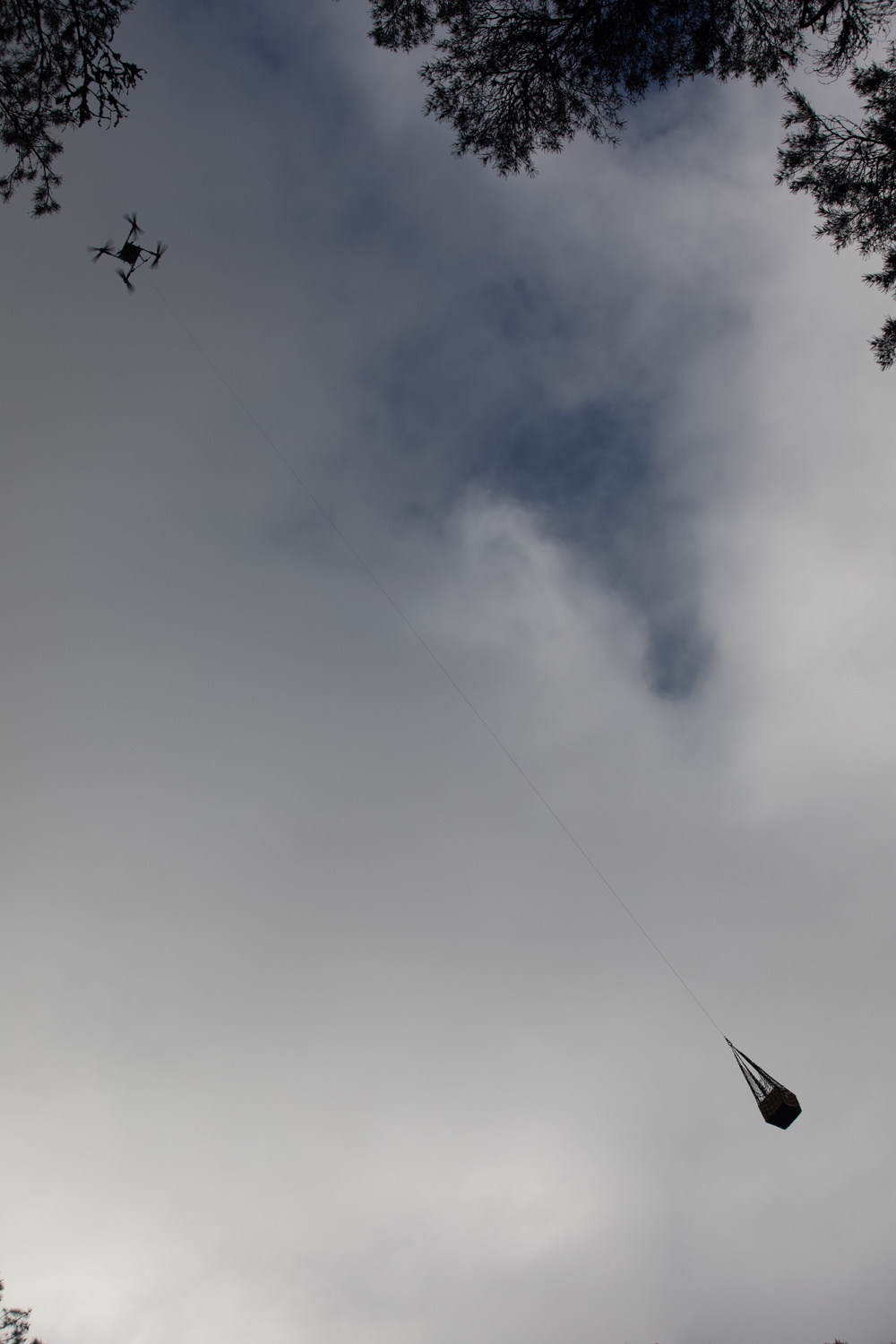
When the Royal Navy talks about a “hybrid” carrier air wing, the headline usually goes to the fast jets — the F-35B Lightnings ranged across the deck of HMS Prince of Wales. But some of the more consequential work during Operation Firecrest happened lower, slower, and closer to the waterline, where a rotor-heavy cargo drone learned a new way to hand a box to another ship without ever touching down.
During the deployment in the North Atlantic off Norway in late June 2026, the carrier's strike group used the exercise to develop fresh capabilities for the Malloy Aeronautics T-150B, a heavy-lift uncrewed air vehicle operated at sea by the 700X Naval Air Squadron. According to a report from Janes, the primary technical source on the trials, the standout addition was a 15-metre drop-down cable that lets the drone lower payloads onto a receiving vessel while remaining airborne — and, for the first time, the aircraft was tested in a search-and-rescue role.
What actually changed
In its baseline configuration, the T-150B carries up to 60 kg clipped to its underside — the familiar model of a heavy-lift multirotor flying a slung load from point A to point B and setting it down. That works well when there is a clear deck and trained personnel on the far end to receive it. At sea, across a dispersed carrier strike group, neither of those is a given.
The 15-metre cable rewrites that transaction. Instead of landing, the drone hovers above a receiving ship and pays out its load on the line, delivering the payload directly to the deck below. Crucially, the weight ceiling does not change: the cable delivery is still capped at 60 kg, the same as the underside clip. What changes is the choreography. A vessel no longer needs a suitable landing spot or a qualified deck party to take the delivery — the aircraft comes to a hover, lowers the goods, and moves on.
That distinction — same payload, radically different delivery — is the whole point. It converts the T-150B from something that needs a prepared receiving environment into something that can service almost any ship in the formation.
Cross-strike-group logistics without the trained receiving party
The scenario the 700X Naval Air Squadron put the drone through was cross-strike-group logistics resupply: moving stores between the ships of the carrier strike group without requiring trained personnel on the receiving vessel. In practical terms, that is the difference between a delivery any ship can accept and one that only a handful of suitably equipped, suitably crewed platforms can.
The squadron noted a further implication that reaches beyond the Royal Navy's own hulls. Because the cable method removes the need for a specialist receiving team, it could ease deliveries to non-UK NATO ships operating alongside the strike group, while cutting the personnel burden on both ends of the transfer. In a coalition setting, where a British drone might need to drop a load onto an allied deck whose crew has never trained on the system, a hover-and-lower delivery that asks nothing of the receiving side is a meaningful simplification.
The first search-and-rescue role
Firecrest also marked the first time the T-150B was tested in a search-and-rescue capacity. Rather than hauling cargo between ships, the drone was flown to drop life-rafts and life-jackets — the kind of payload a person in the water needs delivered fast, and delivered accurately, in conditions where launching a crewed helicopter or boat may be slower or riskier.
It is an obvious extension of a heavy-lift airframe that can already carry, hover, and lower a load precisely, but it is a distinct mission from logistics, and one the Royal Navy had not previously exercised with this system. The same drop-down capability that hands a box of stores to a ship can, without much conceptual leap, place survival equipment near someone in the sea.
Cold-weather performance held up
None of this matters if the aircraft cannot function where the exercise takes place. Operation Firecrest ran in the North Atlantic and into the High North, an environment that punishes batteries, motors, and airframes alike. Per Janes, the T-150B's cold-weather performance during the trials was satisfactory — a modest-sounding verdict that is, in fact, a prerequisite for any of the capability claims above to hold in the region the Royal Navy is increasingly focused on.
The bigger frame: a “hybrid” navy
Naval News, covering the deployment independently, positioned Firecrest as a demonstration of the Royal Navy's “hybrid” shift — a transition toward a crewed-plus-uncrewed air wing rather than an all-crewed one. In that framing, the Malloy heavy-lift UAV logistics work is not a sideshow to the F-35B operations but a central element of what the service is trying to prove: that carrier strike groups can fold autonomous systems into everyday tasks like resupply and rescue, not just experiments.
The official Royal Navy service account corroborates the shape of the deployment — HMS Prince of Wales and her carrier strike group operating in the High North with F-35Bs embarked. Between the three vantage points — a technical trade source, an independent naval outlet, and the service itself — the picture is consistent: Firecrest was as much about maturing uncrewed logistics as it was about projecting fast-jet airpower.
Why It Matters
At-sea logistics is one of the least glamorous and most constraining problems in naval operations. Moving stores between ships in a dispersed formation traditionally means helicopters, boats, or bringing vessels dangerously close together — all of which consume crewed platforms, deck space, and trained people, and all of which get harder in bad weather and cold seas. A heavy-lift drone that can lower a 60 kg load onto any ship, including an allied one whose crew has never seen the system, without landing and without a receiving party, chips away at that constraint directly. Layer a search-and-rescue role on top — delivering life-rafts to people in the water — and the same airframe starts covering two jobs that would otherwise demand crewed aircraft. Firecrest did not field a finished operational capability; it developed and tested one, in the environment where the Royal Navy expects to need it. But the direction is clear: uncrewed heavy-lift is moving from novelty to a routine tool in the carrier strike group, and the cold-weather validation in the High North is a signal that the service intends to use it exactly where the weather is worst.
