
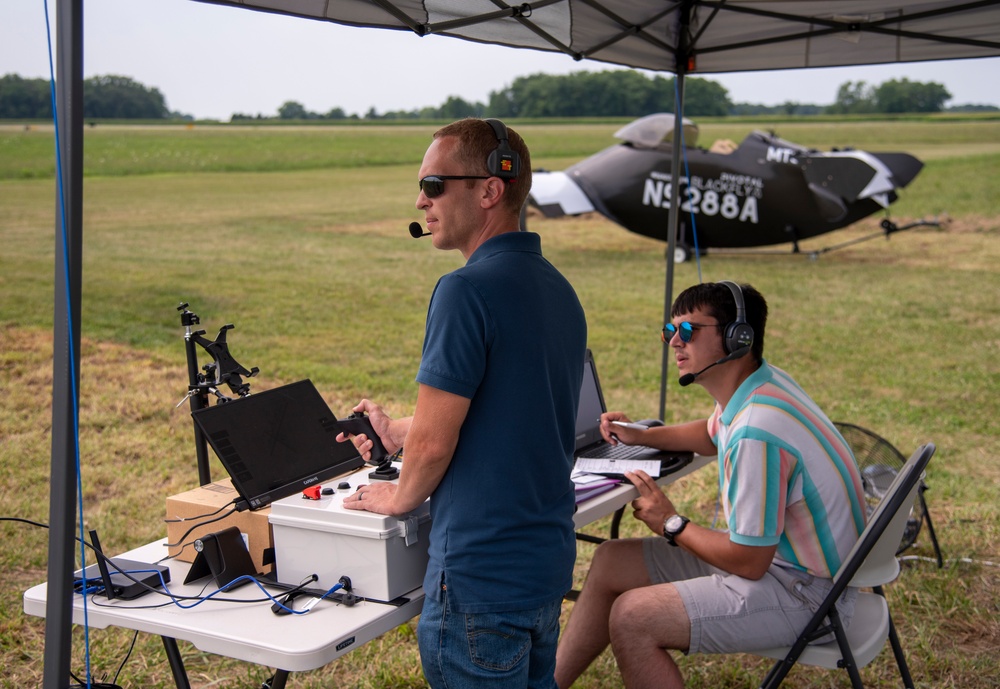
DARPA announced on July 9 that it has selected more than 30 additional teams for its Lift Challenge, pushing the total field to more than 120 competitors ahead of a head-to-head flyoff next month in Dayton, Ohio. The expanded roster spans more than 20 countries and includes small businesses, university students, and independent entrepreneurs, according to the agency's announcement, "Meet the DARPA Lift Challenge teams," published on darpa.mil.
The competition, backed by a $6.5 million prize pool, is built around a deceptively simple demand: teams must design an aircraft that weighs no more than 55 pounds — including fuel or its power source — yet can lift a minimum payload of 110 pounds, exactly four times its own weight, and carry it across a five-nautical-mile circuit course. That ratio, confirmed on DARPA's official Lift Challenge program page, is the central engineering hurdle the agency is asking competitors to clear.
What DARPA Is Actually Testing
The Lift Challenge is not a paper competition. Teams that make the cut will fly their aircraft in trials against each other over the same five-nautical-mile course, a format designed to produce direct, comparable performance data rather than isolated demonstrations. DARPA has framed the effort as a search for teams whose designs "demonstrate the potential to lift four times their own weight and/or represent a breakthrough innovation in propulsion, power, control, aerodynamics, and systems integration," according to the agency's announcement. Program manager Phillip "Donna" Smith framed the stakes more broadly in the same announcement: "This competition is about more than developing better drones; it's about reimagining how our society thinks about aerial mobility."
The 4x lift-to-weight requirement is the number that separates this challenge from typical small-UAS payload work, where lift fractions well under parity with airframe weight are the norm. Hitting four times empty weight while staying inside a 55-pound cap forces tradeoffs across every subsystem — battery or fuel density, motor and rotor efficiency, structural weight, and control authority — that DARPA is betting a broad, non-traditional competitor pool is better positioned to solve than a handful of established contractors working alone.
From Invitation Wave to a 120-Plus Team Field
DARPA's competitor pool has grown in stages. A first wave of invitations went out in June, reported at the time by sUAS News in "DARPA invites first wave of Lift Challenge competitors," which noted DARPA had left the door open to inviting up to 150 teams across multiple selection rounds. The July 9 announcement confirms DARPA exercised that option, adding more than 30 teams in this second wave and bringing the confirmed field to more than 120 — still short of the 150-team ceiling the agency floated, suggesting further additions remain possible before the August event, though none have been announced.
The international makeup of the field — competitors from more than 20 countries — combined with the mix of small businesses, students, and entrepreneurs signals a deliberately wide net. That structure mirrors DARPA's traditional prize-challenge model, familiar from programs like the Grand Challenge and Robotics Challenge, where the agency uses open competition to surface unconventional engineering approaches it might not reach through standard defense-contractor solicitations.
The Dayton Flyoff: Dates and Access
The finals will run August 2-9 at the National Museum of the U.S. Air Force in Dayton, Ohio, according to both DARPA's program materials and the earlier sUAS News reporting. The first days of that window are reserved for the head-to-head circuit-course trials among qualifying teams. The final four days, August 6-9, are free and open to the public starting at 8 a.m. each day — an unusual level of public access for a DARPA hardware competition, and one that puts the flyoff inside a working aviation museum rather than a closed test range.
Neither DARPA nor sUAS News detailed how many of the 120-plus teams will actually fly in Dayton versus how many were selected only to continue development, so the exact size of the flying field at the August event has not been confirmed in the available source material.
Q&A: The Basics
What has to happen for a team to win? Teams must field an aircraft weighing 55 pounds or less, including its fuel or power source, capable of lifting at least 110 pounds — four times its own weight — around a five-nautical-mile circuit course, competing directly against other teams' aircraft.
How much prize money is on the table? DARPA has set a $6.5 million total prize pool for the Lift Challenge, per the program's official page.
Who can watch? The public can attend the final four days of the Dayton event, August 6-9, beginning at 8 a.m., at the National Museum of the U.S. Air Force.
What program is this part of? DARPA has tied the Lift Challenge to the Department of War's Drone Dominance initiative, positioning the competition as a contributor to broader efforts to advance U.S. uncrewed-systems capability.
Why It Matters
Heavy vertical lift in a small, efficient airframe is one of the persistent bottlenecks in uncrewed aviation: rotorcraft that can carry meaningful payload tend to be heavy, fuel-hungry, and expensive, while lightweight drones typically sacrifice lift capacity to stay small. A verified 4x lift-to-weight ratio at 55 pounds all-up weight would represent a substantial efficiency gain over conventional designs, with obvious applications in logistics resupply, casualty evacuation, and contested-environment missions where every pound of airframe competes directly with payload and range.
By opening the competition to more than 120 teams across more than 20 countries — rather than restricting it to established defense primes — DARPA is explicitly betting that unconventional propulsion, power, and control solutions are more likely to emerge from a broad, competitive field than from a narrow set of incumbent contractors. The agency's explicit link to the Department of War's Drone Dominance initiative also signals that whatever wins in Dayton is intended to feed directly into near-term U.S. uncrewed-systems priorities, not sit as an academic exercise. The public-access finals, held inside a national Air Force museum rather than a restricted test range, further suggest DARPA wants this result to be visible and quickly benchmarked, not quietly filed away.
Sources
- Meet the DARPA Lift Challenge teams — darpa.mil, July 9, 2026
- DARPA Lift Challenge program page — darpa.mil
- DARPA invites first wave of Lift Challenge competitors — sUAS News, June 2026
