
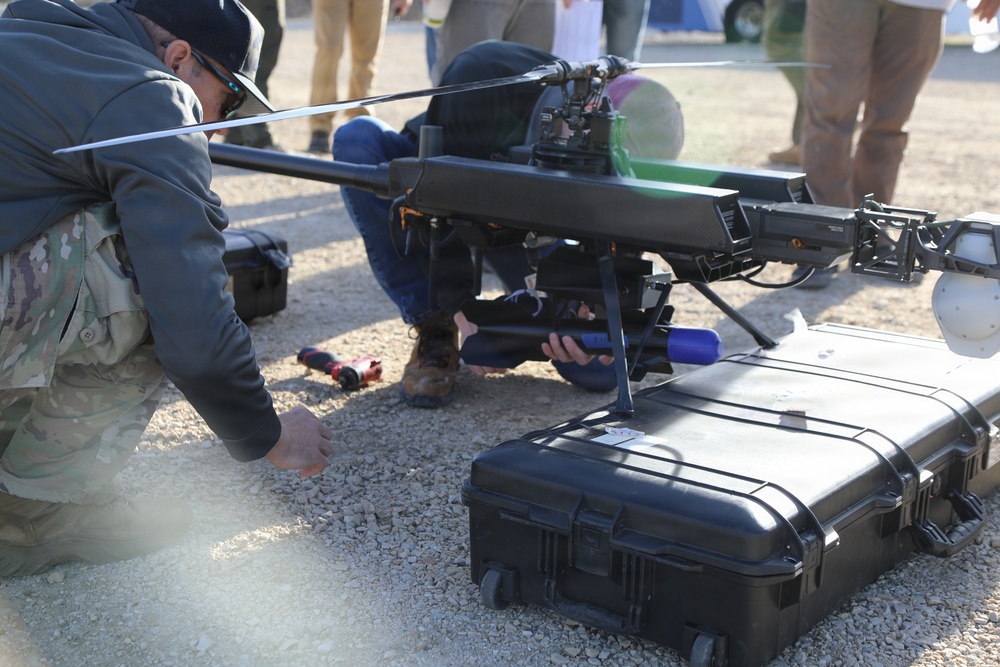
DJI has released a new safety accessory for its flagship enterprise platform that does something no amount of software polish can: it changes what airspace the drone is legally allowed to fly in. The AP100 Parachute, announced July 8, is an independently powered, redundant deployment system built specifically for the Matrice 400, DJI's flagship enterprise airframe. Strap it on, and operators in Europe and the UK gain a path to flying over populated areas — terrain that is otherwise off-limits to a drone of the Matrice 400's size without a case-by-case regulatory exemption.
It is a narrow piece of hardware solving a narrow problem, but for the enterprise operators who make up the Matrice 400's customer base — utility inspectors, public safety units, survey firms working in dense urban environments — that problem has been the single biggest thing standing between them and jobs they'd otherwise have to turn down.
What the AP100 Actually Does
The AP100 is a 935-gram module that mounts to the rear of the Matrice 400. According to DJI's official release, the system runs on independent power and maintains full-link redundancy, meaning it does not rely on the drone's primary flight battery or main communication link to function. That matters in the exact scenario the parachute exists for: a catastrophic failure of the aircraft itself.
The system supports both manual deployment, triggered by the remote pilot, and automatic deployment, triggered by onboard fault detection. DJI states the AP100 responds in under 600 milliseconds and slows the aircraft's descent to below 5 meters per second before touchdown — fast enough and slow enough, per the regulatory categories discussed below, to bring a 15.8-kilogram aircraft down over a crowd without it behaving like a projectile.
The module also runs continuous self-diagnostics, monitoring the status of its gas generator (the pyrotechnic-style charge that fires the canopy) and its communication link, and pushes real-time anomaly alerts to the operator if something is off before the parachute is ever needed.
The Weight and Power Trade-Off
Bolting nearly a kilogram of safety hardware onto an aircraft is never free, but DJI appears to have kept the tax small. Per DroneXL's reporting, the AP100 preserves the Matrice 400's full 15.8-kilogram maximum takeoff weight rather than forcing operators to shed payload capacity to compensate for the parachute's mass. The flight-time cost is similarly modest: roughly six minutes off the aircraft's endurance, a trade most enterprise operators will take without hesitation in exchange for legal access to overhead-crowd operations.
Q&A: What Does This Actually Unlock?
Q: Why does a parachute matter more than a new drone would?
A: Because for Matrice 400 operators in Europe and the UK, the parachute is the compliance gate, not a performance upgrade. DroneXL's coverage frames the AP100 as more consequential to that customer base than an entirely new airframe would be, precisely because regulatory pressure — not raw capability — has been the limiting factor on where these drones can legally fly.
Q: What compliance category does it unlock?
A: DJI's official release confirms the AP100 lets the Matrice 400 meet the EASA C5 and UK CAA UK5 operational safety class requirements as a retrofit, corresponding to STS-01 (Standard Scenario 1) operations — flights adjacent to open-category rules that permit operation over populated areas under defined conditions.
Q: Does the retrofit cover every populated-area scenario?
A: No. DJI's official release states that the higher C6/UK6 classification, tied to STS-02 operations, is not achievable through the AP100 retrofit alone. That tier requires the factory-integrated Matrice 400 (C6) Worry-Free Plus Combo — a version of the aircraft built to the standard from the ground up rather than upgraded after the fact. Operators who need STS-02-level clearance will still have to buy into that specific configuration rather than add a parachute to an existing unit.
Q: Is parachute-based compliance unique to Europe?
A: No — the U.S. has a parallel framework built around the same underlying engineering standard. The FAA's Category 2 and Category 3 rules for small-drone flights over people accept vendor-specific parachute "means of compliance" built on ASTM F3322, the same style of recovery-system standard the AP100 is designed against; the agency accepted a new one from ParaZero effective March 2026, according to a Federal Register notice. The AP100 is DJI's answer to the European side of that same regulatory logic — a sign that overhead-people clearance is converging on parachute recovery systems as the accepted technical answer on both sides of the Atlantic.
Why It Matters
European and UK drone regulation has increasingly organized itself around a simple question: what happens if this aircraft fails mid-flight, and where does it land? The Specific Operations Risk Assessment framework that underpins EASA's Standard Scenarios, and the UK CAA's mirrored classifications, explicitly reward aircraft that can demonstrate a controlled, low-energy descent in a failure. A parachute that deploys in under 600 milliseconds and caps descent speed below 5 m/s is a direct, legible answer to that question — one a regulator can check against a published standard rather than adjudicate case by case.
That is precisely why the AP100 is being treated as a bigger deal for this customer segment than a new sensor or a faster processor would be. A utility company that needs to fly transmission-line inspections over a town, or a public safety agency that needs to fly a heavy sensor payload over an active incident in a city center, has not been blocked by the Matrice 400's flight performance. It has been blocked by paperwork: the aircraft, as sold, did not qualify for the operational category that overhead-crowd work requires. The AP100 changes that calculus for a large share of those missions in one retrofit, without forcing a fleet-wide hardware replacement.
The catch — and it is a meaningful one — is that the retrofit only reaches the C5/UK5 tier. Operators whose missions require the higher C6/UK6 classification still need the factory Worry-Free Plus Combo, meaning DJI has effectively created a two-tier compliance ladder within the same airframe family. For fleet operators planning purchases now, that distinction will shape whether they retrofit existing Matrice 400 units or specify the C6 combo outright for aircraft earmarked for the most demanding urban missions.
Sources
- Meet DJI AP100 Parachute: An Independent Safety System Built for Compliant Operations Over Populated Areas — DJI Enterprise Insights
- DJI AP100 Parachute Is the 'Priceless Below' Reveal — DroneXL
- DJI launches AP100 parachute system for Matrice 400 enterprise drone — TechNode
- Accepted Means of Compliance for Small Unmanned Aircraft (sUA) Category 2 and Category 3 Operations Over Human Beings; ParaZero Technologies Ltd. — Federal Register
