
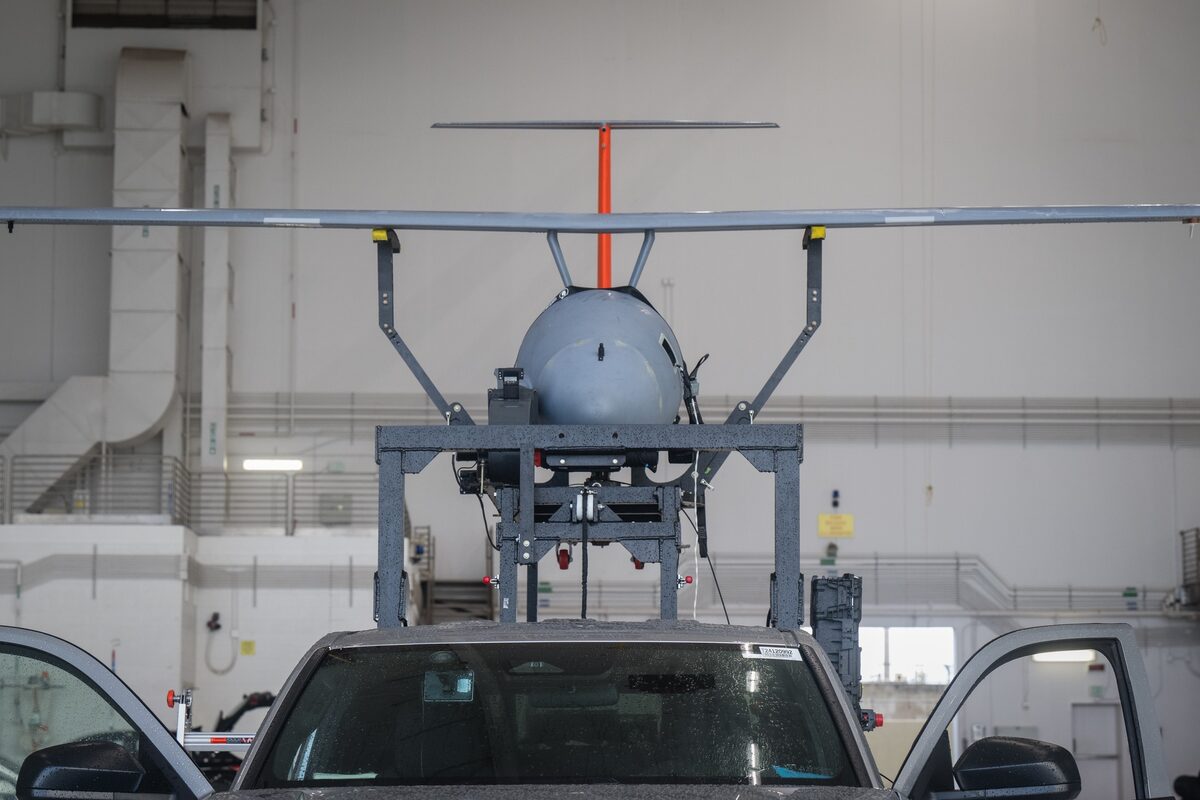
The endurance problem has dogged drone designers since the first quadcopter left the ground: batteries are heavy, fuel runs out, and solar panels are useless at night or under cloud cover. DARPA's answer, unveiled this spring, is to stop generating power the conventional way entirely and instead harvest it directly from radioactive decay — using nuclear waste that already exists in vast quantities on American soil.
On April 2, 2026, DARPA awarded a $3.37 million contract to Morgan State University to lead "Rads to Watts," a program built around a device called SYMPHONEE — Strontium-Yttrium Multi-junction PIN-based High-Density Output Nano-system for Extreme Environments. The goal is a radiovoltaic power cell that converts the decay energy of Strontium-90 directly into electricity, at a power density exceeding 10 watts per kilogram, with a service life DARPA is targeting at roughly 30 years.
Morgan State, a historically Black university in Baltimore, serves as the prime contractor on a team that also includes Pacific Northwest National Laboratory (PNNL), defense contractor Northrop Grumman, applied-research firm ARA, semiconductor power specialist Widetronix, and radiovoltaic-power startup Project Omega.
How a Radiovoltaic Cell Differs From a Nuclear Battery
Radioisotope power has been used in space missions for decades — the plutonium-238 "RTGs" that powered Voyager and the Mars rovers convert heat from radioactive decay into electricity via thermocouples. SYMPHONEE takes a different physical path. Rather than converting heat, it aims to convert the radiation itself directly into electrical current, using a multi-junction PIN (positive-intrinsic-negative) semiconductor structure similar in principle to a photovoltaic solar cell — except the "light" it captures is beta radiation from decaying Strontium-90 rather than sunlight.
Project Omega CEO Stafford Sheehan, quoted in Defense One's July 3, 2026 report on the program, drew exactly that comparison: the device functions like a solar cell, but tuned to harvest radiation instead of photons. That distinction matters for drones specifically, because it sidesteps the bulky heat-to-electricity conversion hardware that thermoelectric radioisotope generators require, potentially yielding a lighter, more compact power source.
Why Strontium-90
The choice of isotope is deliberate. Strontium-90 is a byproduct of nuclear fission and one of the more abundant radioactive materials sitting in America's nuclear waste stockpile — Defense One's reporting cites more than 100,000 metric tons of nuclear waste held across 52 U.S. reactor sites. Rather than treating that material purely as a disposal liability, DARPA's program frames it as an untapped fuel source: reclaim the Strontium-90, embed it in a purpose-built power cell, and let its multi-decade half-life do the work that fuel tanks and battery packs currently can't.
Strontium-90 has a half-life of about 28.8 years, a figure that lines up closely with the 30-year endurance target Tom's Hardware reported DARPA is pursuing for the SYMPHONEE cells — a power source that, in principle, would still be delivering meaningful output near the end of a three-decade deployment.
Q&A: What's Actually Being Built, and When
What is DARPA actually funding?
A multi-organization research and development effort to design, fabricate, and demonstrate a radiovoltaic power cell — SYMPHONEE — that converts Strontium-90 decay energy into usable electrical current at a power density above 10 W/kg.
Who's on the team, and who does what?
Morgan State University is the prime contractor overseeing the program. PNNL, a Department of Energy national laboratory, is set to host the working prototype. Northrop Grumman and ARA are handling computational modeling, simulation, and radiation-effects analysis; Widetronix is designing the semiconductor converter; Project Omega, led by CEO Stafford Sheehan, is building the power generator.
When will there be a working prototype?
According to Defense One's reporting, the team is targeting delivery of a working prototype at PNNL in early 2027 — roughly ten months after the contract was awarded.
What would this actually power?
DARPA's interest, as characterized in Tom's Hardware's coverage, centers on persistent, refuel-free power for military drones — platforms where swapping batteries or refueling is impractical or impossible during long-duration missions. Project Omega CEO Stafford Sheehan, in Defense One's reporting, pointed to satellites as another example: losing power on a satellite means losing the satellite entirely, since there's no way to swap in a new battery once it's in orbit.
Is this the same as a plutonium RTG on a spacecraft?
Not exactly. RTGs convert decay heat into electricity through thermoelectric junctions. SYMPHONEE is described as a direct radiation-to-electricity conversion device using a semiconductor PIN junction, more analogous to a solar cell than a thermoelectric generator — though both fall under the broader umbrella of radioisotope power sources.
Why It Matters
Endurance is the single biggest constraint on what a drone can be asked to do. A quadcopter that can fly for 30 minutes is a tool for inspection and photography; a platform that could fly, sit dormant, or loiter for years at a stretch is something closer to permanent infrastructure — a sensor node, a communications relay, or a persistent watcher that never needs to land. A 10 W/kg radiovoltaic cell with a multi-decade output curve, if it works as designed, would let military planners stop thinking about drone power in terms of sorties and start thinking about it in terms of decades, the same way satellites are planned.
The program also matters as a data point in how the U.S. defense-industrial base is trying to solve two problems with one contract: it converts a long-standing environmental liability — Strontium-90 sitting in waste stockpiles at dozens of reactor sites — into a strategic asset, while simultaneously expanding the pool of institutions doing frontline DARPA research. Morgan State's role as prime contractor on a DARPA defense program — leading a team that includes a national laboratory and a major defense contractor — is notable on its own terms, independent of whether SYMPHONEE ultimately reaches the field.
None of that is guaranteed yet. Radiovoltaic conversion at useful power densities is still an emerging technology, and the program is explicitly at the prototype stage — PNNL isn't expected to have working hardware in hand until early 2027. Questions that matter for eventual deployment, including cost, shielding, regulatory handling of Strontium-90-bearing hardware, and how the cells perform outside laboratory conditions, remain to be answered by the program itself. What's confirmed for now is the award, the team, the technical target, and the prototype timeline — the rest will depend on what PNNL sees on the bench next year.