
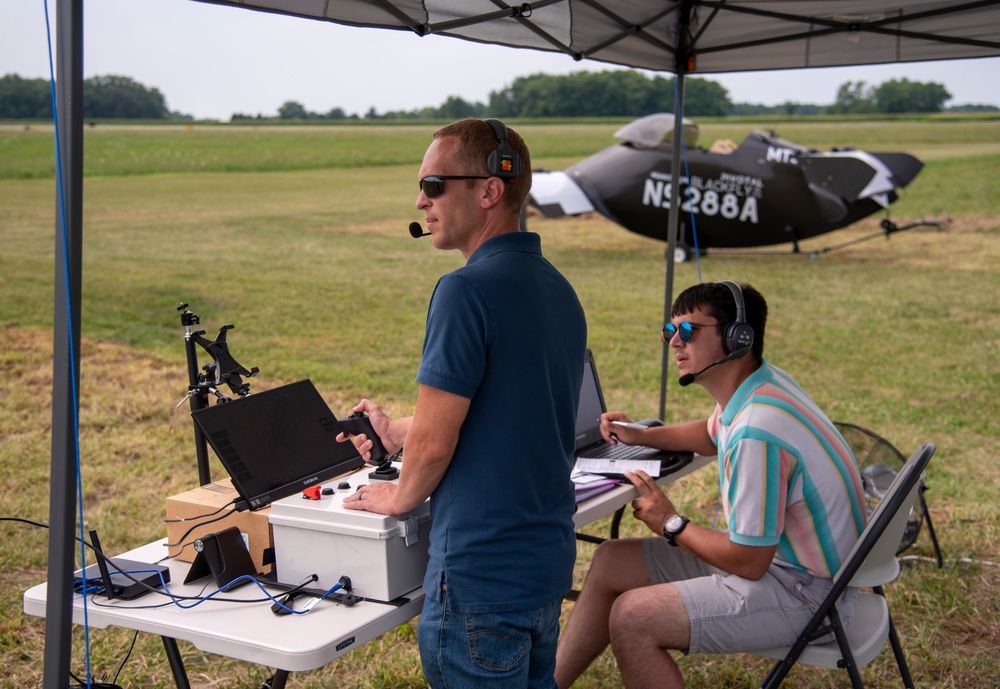
On paper, it reads like a routine cargo run: a cooler goes from point A to point B, crosses a state line, and lands. What makes the mission worth reading twice is everything inside that sentence — the cooler held a manufactured organ, the aircraft was electric, and the trip ran roughly 275 nautical miles across four airports in two states.
The flights, completed July 10, 2026 and publicized by the FAA as a "major milestone in eVTOL technology use," are the first operational missions flown under the agency's eVTOL Integration Pilot Program — eIPP — the initiative the Department of Transportation stood up to gather real operational data before Advanced Air Mobility aircraft try to scale into commercial service. BETA Technologies flew the mission with United Therapeutics Corporation, in partnership with the Pennsylvania Department of Transportation, the Virginia Department of Aviation, and the Maryland Aviation Administration.
One wrinkle worth naming up front: despite the program's title, the aircraft flown was not an eVTOL. BETA's release describes these as the first electric conventional takeoff and landing — CTOL — aircraft flights conducted under eIPP, and Aerospace America identifies the airframe as the ALIA CX300, an electric fixed-wing airplane. The program name is aspirational; the hardware that flew is not vertical-lift.
Per DroneLife's account of the FAA announcement, Administrator Bryan Bedford said the eIPP "gives us a real-world environment to safely test and integrate the next generation of aircraft into our airspace system." BETA's own release quotes FAA Deputy Administrator Chris Rocheleau, who said each eIPP project "will showcase the broad public benefits of this technology."
The route, and what it gives away
The organ — a genetically modified pig heart developed by United Therapeutics, carried purely for research and not intended for a human donor — departed Virginia Tech/Montgomery Executive Airport in Blacksburg, Virginia, and flew via Charlottesville-Albemarle Airport to Frederick Municipal Airport in Maryland and finally to Martin State Airport in Baltimore County. Interstate, multi-airport, roughly 275 nautical miles end to end, per BETA's own release.
The leg structure is the most interesting operational detail, and it is also the one the press materials are least eager to dwell on. A nonstop would have been a cleaner headline. Instead the mission was broken into hops with ground stops at the intermediate fields — a shape consistent with what an electric aircraft can do between charges. BETA notes it has built 123 charging sites to date, which tells you how central that constraint is to the company's own planning. How many airframes flew the mission, and what the charge turnaround looked like at each node, were not reported.
A delivery network for a product that does not exist yet
The commercially significant partner here is not the airframer. It is United Therapeutics.
BETA's release describes a long-standing partnership with United Therapeutics to develop and operate electric CTOL and VTOL aircraft for delivering manufactured organ products once commercially available. That last clause is the entire business case. The stated goals are reducing cost, increasing reliability, and lowering the carbon footprint of large-scale organ delivery. United Therapeutics CEO Martine Rothblatt points to FDA-approved clinical trials for the heart, kidney, and bridge-liver, plus a recent FDA approval of the company's lung device — the pipeline the aircraft are being built against.
Read that as a supply-chain bet rather than an aviation one. Manufactured organs, if they materialize at volume, create a distribution problem with unusual characteristics: high value per unit, brutal time sensitivity, low tonnage, and destinations that are hospitals rather than freight hubs. That is a demand profile conventional air cargo serves badly and charter serves expensively. It is also close to the only demand profile where an aircraft with modest range and modest payload can win on economics rather than on novelty.
Most AAM business plans start with an aircraft and go hunting for cargo. This one starts with a cargo that does not exist at commercial scale yet and builds the aircraft on spec. Whether that is visionary or premature depends entirely on the organ manufacturing timeline — which is the actual risk in the venture, and which no flight test can retire.
Eight programs, 26 states, and one company in seven of them
eIPP is one of eight research projects announced in March 2026, spanning 26 states. The design intent is straightforward: fly real missions in real airspace, collect the operational data, and use it to inform how commercial AAM expands rather than guessing.
The number worth circling is that BETA was selected to participate in seven of the eight launch programs — more than any other electric aircraft developer, by the company's own accounting. That is a striking concentration for a program meant to produce broad, representative data. It may simply reflect who has flyable hardware and a certification posture mature enough to fly missions today rather than in a slide deck. But it does mean the eIPP dataset will be substantially a dataset about BETA aircraft, and regulators reading it later should hold that in mind before generalizing to airframes with different energy, noise, and ground-infrastructure profiles — including the vertical-lift designs the program is nominally named for.
The multistate collaborative structure is the other half of the story. Three separate state aviation authorities — Pennsylvania, Virginia, Maryland — are named partners on a single mission, which reflects how AAM route networks will actually be governed: an aircraft crossing state lines in an afternoon touches multiple sets of aviation authorities, airport sponsors, and ground-infrastructure regimes. The flight was interstate. The coordination was multistate. Those are different problems, and the second one is harder.
Why It Matters
The temptation is to file this as a demo — research organ, controlled route, friendly press. But demos are how infrastructure gets specified, and the specification embedded in this one is unusually legible.
First, the route shape reframes the roadmap. A mission of this length ran as a series of hops rather than a nonstop, which suggests the near-term commercial geometry of electric aviation is a network of short legs with charging at the nodes — not point-to-point long haul. That has capital implications well beyond the airframe: it means airports like Charlottesville and Frederick are not waypoints, they are terminals, and someone has to pay to make them so. The eIPP data will inform where that capital goes.
Second, the payload choice is a market signal. Organ transport is the rare cargo where the customer's willingness to pay is effectively unbounded and the tolerance for delay is effectively zero. If electric aviation cannot make economics work there, the case for it in general freight is considerably weaker. Starting at the top of the value curve is the correct play, and it is also an admission of where the cost structure currently sits.
Third, for anyone tracking the regulatory arc: the FAA is not merely permitting these flights, it is running the program and publicizing the results. An agency that stages the milestone has an institutional stake in the milestone. That is not a criticism — data gathered under an FAA-designed program is more useful to future rulemaking than data gathered ad hoc — but it does mean the announcement is both the news and the marketing, and should be read accordingly. The gap between the program's name and the airplane that actually flew it is a small case in point.
What the mission does not tell us: how the aircraft performed against schedule, what the charge turnaround looked like at each stop, whether the cooler's thermal envelope held across the full route, or what any of it cost. Those are the numbers that decide whether this becomes a network or stays a milestone. eIPP exists to produce them. The interesting reporting starts when they surface.
Sources
- FAA Announces Major Milestone in eVTOL Technology Use — Federal Aviation Administration
- FAA Highlights First Interstate eVTOL Organ Transport Test Under Integration Pilot Program — DroneLife
- BETA Technologies and Multistate Collaborative Complete First Operational Flights of the U.S. DOT and FAA's eVTOL Integration Pilot Program — BETA Technologies
- BETA kicks off its eIPP program with Virginia organ transport flight — Aerospace America (AIAA)
- BETA and collaborative complete first operational flights of eVTOL Integration Pilot Program — Vermont Business Magazine
- Beta Flies Manufactured Organs in First eVTOL Pilot Program Mission — Aviation International News
- DOT and FAA Launch eVTOL Integration Pilot Program — DroneLife