
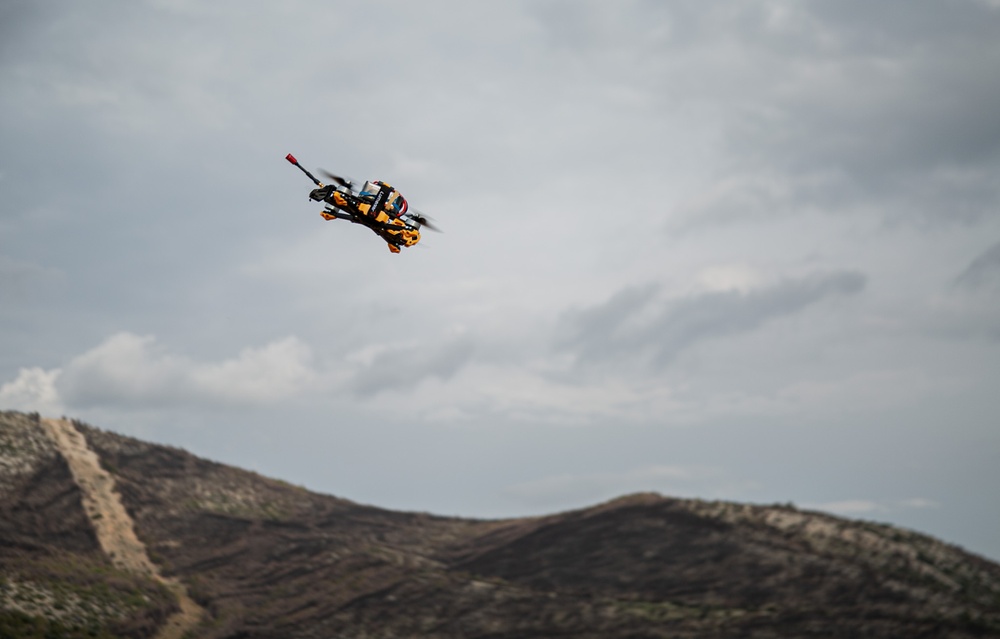
For most of the last decade, first-person-view (FPV) drone footage in motorsport has lived in a familiar slot: the slick promotional flythrough, the empty-track hot lap shot before the cars roll out, the social-media B-roll. On June 28, 2026, at the Austrian Grand Prix held at the Red Bull Ring, Formula 1 moved it somewhere new — into the live race feed itself, as a primary camera tracking wheel-to-wheel racing at speed.
According to DroneXL, the FPV footage was not a brief cutaway or a pre-recorded insert. It aired as a headline camera angle, following a Lewis Hamilton versus Max Verstappen battle on lap 11, and was carried live on Apple TV — F1's exclusive US broadcast partner for the 2026 season — before being replayed as a production highlight. The reaction was immediate enough that fans began demanding the name of the pilot flying the shot, a detail that tells you how far the footage stood out from the conventional helicopter and trackside cameras around it.
Ukrainian outlet dev.ua framed the moment as a first for the series: an FPV drone keeping pace with Formula 1 cars at speeds exceeding 350 km/h during a live broadcast. That framing is the headline draw, and it is worth sitting with. A purpose-built racing drone holding station alongside cars at the top of their speed range is not a casual piece of cinematography — it is a flying camera operating at the edge of what consumer-derived airframes can physically do, piloted in real time, with the output going straight to air.
How did a drone keep up with an F1 car at all?
This is the question most viewers asked, and it has a concrete answer. The drone class involved here is not an off-the-shelf camera platform like the ones used for real-estate flythroughs or wedding videos. It is a high-speed FPV racing airframe, flown manually through goggles by a pilot reacting to the scene in real time rather than following a pre-programmed path. (Notably, F1 did not publicly release the pilot's identity or the specific drone model used in Austria.)
The lineage matters. As DroneXL reports, the FPV team Dutch Drone Gods recorded 310 km/h — roughly 193 mph — during a demonstration lap behind Max Verstappen's car at Silverstone, among the fastest a camera drone has been flown alongside an F1 machine. A drone that can sustain those velocities is what makes shadowing a Formula 1 car through a corner sequence even theoretically possible. Below those speeds, the car simply drives away from the camera.
The distinction between that record-setting Dutch Drone Gods demonstration and what aired in Austria is important. The reason such high-speed footage has not simply been bolted into the standard world feed is not a question of capability. It is a question of where the camera is legally allowed to fly.
The wall the technology keeps hitting
A racetrack on a grand prix weekend is, from an airspace-safety standpoint, close to a worst case for drone operations: tens of thousands of spectators packed into grandstands, and a circuit full of moving race cars. Those are precisely the two scenarios that regulators around the world treat as the highest-risk drone operations — flight over people and flight over moving vehicles.
In the United States, where this footage aired on Apple TV, the governing rule is the Federal Aviation Administration's 14 CFR Part 107, the framework for small unmanned aircraft systems. Part 107's Subpart D — including §107.39 and the related operational categories — sets out the specific conditions under which a small drone may be flown over human beings and over moving vehicles. These are not blanket permissions. They are category-based requirements tied to the airframe, its safety characteristics, and in many cases specific waivers. The practical effect is that a purpose-built FPV chase drone cannot simply lift off and fly over a packed grandstand, or cut across an active racing line, without satisfying those category conditions or holding the appropriate waivers.
That regulatory ceiling is why F1's drone program is so circumscribed. As PickDrones reports, the series runs FPV operations at only about ten races a season, with aviation-authority approvals — the FAA in the US, EASA across Europe, the UK CAA, and CASA in Australia — secured venue by venue. The machines exist and the footage is spectacular, but the operations cannot freely fly over a packed crowd or cross an active racing line. The technology has outrun the rulebook, and the rulebook is the constraint.
What actually changed in Austria
The significance of the Austrian GP broadcast is not that FPV drones suddenly became legal to fly anywhere. It is that the footage graduated from garnish to main course. Treating an FPV shot as a primary camera — putting it in the live cut during a genuine on-track battle between two of the sport's biggest names, then replaying it as a highlight — is an editorial decision that signals confidence in the format. Broadcasters do not hand a marquee Hamilton-Verstappen moment to a camera they consider a gimmick.
That it ran on Apple TV, F1's exclusive 2026 US partner, adds a distribution dimension. A streaming partner building out a flagship motorsport product has obvious incentive to differentiate its coverage, and a high-speed aerial angle no traditional broadcaster can match is exactly the kind of signature feature that does that.
Why It Matters
The Austrian GP broadcast is the clearest evidence yet that high-speed FPV cinematography has crossed from novelty into standard production tooling for elite motorsport. For the commercial drone sector, that is a meaningful proof point: the most demanding live-television environment in the world — fast, unscripted, watched by millions, unforgiving of error — put an FPV airframe in its primary camera rotation and let it carry the story.
But the same broadcast also maps the technology's hard limits. Even the fastest chase drones — like the 310 km/h Dutch Drone Gods machine clocked at Silverstone — are constrained because the operations that would make them most valuable, flying over crowds and across active circuits, run straight into the rules that govern flight over people and moving vehicles. In the US that means Part 107's operational categories; comparable regimes apply elsewhere, which is why F1 secures approvals venue by venue and runs FPV at only a fraction of its calendar. The lesson for anyone building a commercial drone application is the one this footage makes vivid: the binding constraint is rarely the airframe's top speed. It is the regulatory category you can operate in, and the waivers you can secure. The cameras can already keep up with Formula 1. Whether they are allowed to fly where the best shots are is a separate, slower fight.
