
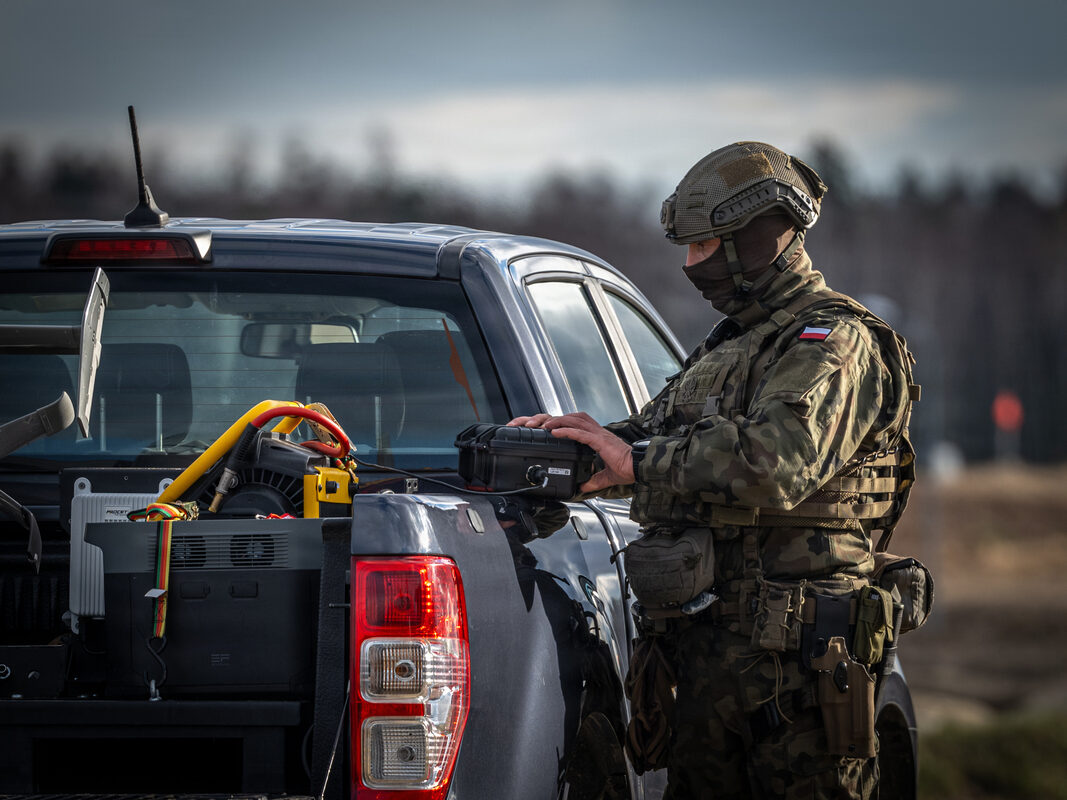
Counter-drone defense is mostly a networking problem. Radars, electro-optical sensors, jammers and weapon stations are only useful if their tracks and commands reach one another, and reach the people deciding what to engage, fast enough to matter. During Spain's ATLAS 26 exercise in October, part of that job was handed to a 5G network built for the military alone.
In a Nov. 24 press release, relayed a day later by Unmanned Airspace, Ericsson says it demonstrated tactical 5G connectivity for counter-drone systems from Oct. 19 to 23 at the Médano del Loro training area in Huelva, in southwestern Spain. The company calls it the first time the Spanish Armed Forces have connected counter-drone systems over a tactical 5G network alone, with that network linking sensors, radars, command posts and effectors. In Ericsson's framing, the wireless link took the place of fixed cabling.
That is a big claim, and so far the "first time" and "alone" parts rest on the vendor's own account. Below is what is known, what Spanish sources confirm independently and what nobody has published yet.
What Ericsson says it deployed
According to the release as relayed, the network ran on the Ericsson Ultra Compact Core, a 5G core designed for defense applications. For ATLAS 26, Ericsson combined 5G core software, a container-as-a-service platform and supporting hardware. In a commercial network the core sits in a data center and handles authentication, session management and routing for every device on the network. A compact, deployable core is meant to reduce dependence on fixed infrastructure.
The network was not run by Ericsson. The release says the 5G Spanish Cyber Defence Centre, part of the Joint Cyberspace Command, operated it. It used frequencies reserved exclusively for military use and isolated from commercial traffic, which the release says is designed to reduce exposure to electromagnetic interference and congestion. Two things follow from that. The armed forces were not renting capacity from a public operator. And whoever runs the network also owns its security posture, which matters a great deal for a system that passes engagement data between sensors and shooters.
What Spanish sources confirm
Spanish reporting backs up the outline of the story, including Ericsson's presence. El Español reported on Oct. 23 that ATLAS 26 validated detection and neutralisation of unmanned aircraft and counter-UAS capabilities. The exercise brought together the Army, Navy and Air Force with state security forces. It was organized by the Maneuver Support Command and directed by the Army Anti-Aircraft Artillery Command.
The same report says 5G technology was tested during the exercise to interconnect counter-UAS defenses and integrate them into command and control and into Integrated Air and Missile Defence (IAMD). It lists collaboration with national companies including Indra Sistemas, Escribano Mechanical Engineering, Sener, Amper and Ericsson, along with the University of Alcalá and the Polytechnic University of Madrid. The Chief of Defence Staff, Adm. Gen. Teodoro Esteban López Calderón, spoke about the exercise's importance for validating UAS and counter-UAS capabilities in the field. The El Español piece names Ericsson only in that list of participants. It does not describe Ericsson's specific role, the 5G core or the "first time" claim.
The Unmanned Airspace account of Ericsson's release fills in more of the setting: ATLAS 26 was a joint exercise involving the Armed Forces, the Guardia Civil and the National Police, and it focused on responses to unmanned aerial threats and wider air defense scenarios.
The defensive kit on the other end
Much of the hardware such a network could carry came from Spanish industry. ASDNews, carrying an Indra release, reported that the ARACNE counter-drone system from Indra and EM&E was integrated into the Spanish Aerospace Operational Command's air defense system during the exercise. The link ran through Indra's COAAAS+ Anti-Aircraft Artillery Operations Centre and, in the release's words, generates a common operational picture and shortens the decision-making cycle.
According to that report, ARACNE's components include Indra NEMUS radars, the C4ARMS command-and-control system, the Brontes jammer, EM&E's OTEOS electro-optical sensor and GUARDIAN remote weapon stations. That spans sensing, identification, command, jamming and weapon-based neutralisation, the same broad chain Ericsson says its network connected.
The available sources do not say that ARACNE's traffic ran over the Ericsson network. Ericsson's release, as relayed, does not name the counter-drone systems it connected, and the ARACNE coverage does not name the transport between its components. Both happened at the same exercise, in the same place, in the same week. How they relate has not been published.
What has not been disclosed
Ericsson's release, as relayed, includes no performance data. It gives no figures for latency, throughput, packet loss, coverage radius, the number of connected nodes, or how the network held up under jamming. That last one matters most. Several of the effectors in counter-drone systems are themselves radio-frequency jammers, and the Brontes jammer was part of ARACNE at ATLAS 26. Whether a 5G network can keep carrying data while friendly electronic attack operates nearby is the obvious engineering question. The public record does not answer it.
The release as relayed also does not explain what "alone" means in practice. It does not say whether backup links were set up and left unused, or whether any part of the chain fell back to cable or legacy radio at any point. "First time" is Ericsson's description, and the El Español report does not repeat it.
Why It Matters
Counter-drone sites have to be put up fast, moved often and reconfigured whenever the threat changes. Fixed cabling between radars, cameras, command posts and weapon stations works against all three. A private 5G network that the military owns, on spectrum reserved for it and run by its own cyber command, promises fast setup and easy relocation without depending on a commercial carrier.
Spanish reporting confirms that 5G was tested at ATLAS 26 to connect counter-UAS defenses and feed them into command and control and the wider IAMD structure. That puts the networking question inside national air defense planning, not just in a vendor demo. The network was also operated by a military cyber unit rather than by the vendor, which suggests the armed forces treat it as part of the weapon system, not something they rent.
The missing numbers are why caution is warranted. Counter-drone engagements are short, crowded and electronically noisy. A tactical network has to be judged on how much delay it adds, how much it drops and how it behaves under interference. Until Ericsson or the Spanish forces publish those figures, ATLAS 26 shows that Spain is testing the approach and that Ericsson says it worked. It does not yet show that 5G can replace cable when the drones are attacking in numbers.
Sources
- Ericsson demonstrates tactical 5G connectivity for counter-drone systems during Spanish exercise (Unmanned Airspace, Nov. 25, 2026)
- El jefe de Estado Mayor de la Defensa subraya la importancia de Atlas 26 para la detección de drones (El Español, Oct. 23, 2026)
- Indra and EM&E's ARACNE System Integrates Into Spain's Air Defence During ATLAS 26 (ASDNews, Oct. 23, 2026)
