
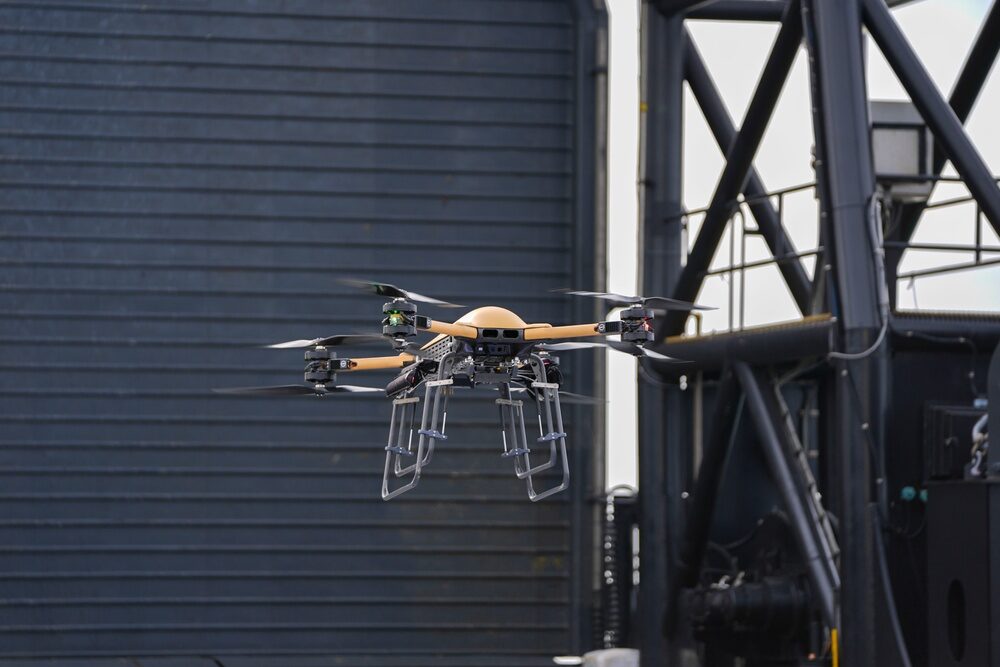
The vertical-lift logistics market has a hole in it, and it is large enough to fly an aircraft through. Below roughly 20 kilograms, the commercial and defense drone market is saturated — dozens of platforms compete for inspection, ISR, and last-mile delivery contracts. Above 500 kilograms, conventional helicopters still dominate, buttressed by decades of operational doctrine and industrial base. In between, in the 150–300 kg band where a meaningful logistics payload could actually move fuel, ammunition, blood products, or field rations to a forward position, almost nothing flies.
"Militaries have identified a gap. There are a lot of drones that can carry 20 kg, and above 500 kg there are helicopters, but there are very few products that can carry 150–300 kg vertically." — Maximilian Oligschläger, CCO, ERC System
That gap framing, articulated by ERC System co-founder and CCO Maximilian Oligschläger, is both the market thesis and the engineering brief for the Victor U250, which the Munich-area startup unveiled at ILA Berlin in June 2026. The timing is deliberate: ILA draws the European defense procurement audience, and the Victor is explicitly pitched at military logistics, offshore and coastal operations, critical infrastructure support, and emergency response, with casualty evacuation flagged as a future application. The day after the unveil, Rheinmetall signed a memorandum of understanding to establish a Victor U250 production facility and supply chain in North Rhine-Westphalia — a signal that one of Europe's largest defense contractors had already done enough diligence to move fast.
A Hybrid Architecture Built for the Gap
The Victor U250 is a lift-and-cruise hybrid-electric eVTOL with a maximum payload of 250 kilograms, a 300 km range, and a cruise speed of 250 km/h, with a wingspan of approximately 8 meters. The propulsion architecture is explicitly designed to separate the hover and cruise regimes rather than compromise both: eight lifting propellers handle vertical takeoff and landing on an electric drivetrain, while a single pusher propeller drives cruise flight. A piston-engine range extender sits atop the electric system, providing the energy density that pure-battery platforms at this payload class cannot yet deliver. It is the same hybrid formula that several crewed eVTOL developers have landed on when endurance and payload density are non-negotiable, applied here to an uncrewed logistics platform.
The logistics integration decisions are worth noting specifically. The Victor's cargo hold accommodates two ISO-standard pallets — the same footprint that moves goods through every port, warehouse, and military supply chain on earth. The aircraft itself fits inside a standard 20-foot ISO shipping container, which means forward deployment does not require specialized ground infrastructure; a container yard is sufficient. ERC also engineered in an aerial drop capability, allowing cargo delivery without landing — relevant both for time-critical military resupply and for offshore platforms where deck space and sea state may preclude a full VTOL approach. Projected operating costs are roughly 70 percent below comparable small helicopters, a figure that would drive adoption in civilian applications if the platform delivers on its performance envelope.
The Victor is certified under Europe's SORA (Specific Operations Risk Assessment) framework rather than the more burdensome full type-certification path, which keeps near-term commercial deployment realistic. The tradeoff is that crewed operations are off the table for the U250, though ERC has a crewed Charlie variant in development for inter-hospital patient transport, targeting certification around 2031 in partnership with DRF Luftrettung.
Romeo: The Demonstrator That Preceded the Product
ERC System was founded in 2020 in Ottobrunn, on the southern edge of Munich's aerospace belt, and emerged publicly in July 2024. Its sole institutional backer is IABG, the German government-linked aerospace and defense test organization, which has committed a "significant double-digit-million-euro sum" — a funding structure that prioritizes technical credibility over valuation velocity. The company has five co-founders: CEO David Löbl, CCO Oligschläger, Christopher Schrop, and two others.
Before the Victor U250 existed as a hardware program, ERC built Romeo — a full-size demonstrator at approximately 2.7 tonnes MTOW and 16 meters wingspan, fully electric, used specifically to validate the lift-and-cruise architecture at scale. Romeo began hover testing near Munich in November 2025 and had accumulated roughly ten flights by the time of the ILA reveal. The aircraft is reportedly the heaviest uncrewed eVTOL currently flying in the EU, which gives ERC a concrete data point about structural loads, propulsion integration, and flight control behavior at the weight class that matters — not a subscale model, not a simulation. When Oligschläger says "customers are approaching us asking when it will be available," the Romeo flight record gives that interest some engineering substance to stand on.
The Romeo-to-Victor development path — build a full-scale demonstrator to retire architecture risk before committing to product hardware — is textbook aerospace risk management and notably different from the approach taken by several eVTOL developers that announced products years before demonstrator flight. Whether ERC's timeline holds will determine whether that discipline translates to execution.
Rheinmetall and the Industrialization Signal
The agreement — announced by Rheinmetall as an MOU, and described by its CEO as a letter of intent — was signed June 10 at ILA, bringing together Rheinmetall CEO Armin Papperger, ERC CCO Oligschläger, NRW Deputy Minister-President Mona Neubaur, and IABG Chairman Prof. Rudolf F. Schwarz. Papperger framed the agreement in industrialization terms: "With today's letter of intent, we are laying the foundation for the industrialization of a forward-looking unmanned aerial system in Germany." That is the language of a production program, not just a technology investment. The MOU calls for a manufacturing facility and supply chain in North Rhine-Westphalia, with hundreds of jobs expected in the region by 2029.
Rheinmetall moving within 24 hours of the product unveil is the most consequential external signal ERC has generated. Rheinmetall's production engineering depth gives it both the capacity to stand up a new platform manufacturing line and the customer relationships — NATO armies, Bundeswehr procurement channels — to accelerate sales cycles. For a startup with a single institutional backer, attaching to Rheinmetall's industrial infrastructure changes the calculus on whether the Victor can reach volume production on schedule or whether it joins the long list of eVTOL programs that stalled between prototype and factory.
ERC's published timeline: first full Victor prototype flight in the second half of 2026, three to four additional prototypes from 2027 onward, first customer deliveries in 2028, and a production rate of 250 aircraft per year by 2032. Those numbers trace a plausible curve — aggressive but not unprecedented for a platform with an architecture already validated at full scale — and the Rheinmetall partnership addresses the industrialization step that has tripped up comparable programs. The 2028 delivery date is roughly two years post-prototype-first-flight, which is thin margin for an uncrewed platform entering defense procurement channels with all their qualification requirements. Oligschläger's own framing — "The European eVTOL industry is not dead" — carries a subtext: the sector has produced enough high-profile failures that every survivor now has to make the case explicitly. Romeo flying, Rheinmetall signing, and a logistics gap that defense customers have named aloud is a stronger starting position than most.
Sources
- The Next Web — ERC System Victor eVTOL cargo drone, ILA Berlin 2026
- Tech.eu — ERC System unveils Victor, a heavy-lift eVTOL designed to close Europe's logistics gap
- Rheinmetall newsroom — Rheinmetall, ERC System, and NRW sign MOU for heavy-lift drones
- Aviation Week — ERC System launches Victor cargo drone for military logistics
