Ukrainian V-BAT operators have been running ISR missions deep into Russian-held territory. The operational conditions are consistent: GPS is gone, GNSS is gone, no communications link is guaranteed. The drones fly anyway — not because the link survived, but because the intelligence moved onboard.
That operational reality frames the central engineering problem in military drone design. GPS satellites broadcast from roughly 20,200 kilometers altitude at effective power levels often compared to detecting a 25-watt bulb from 10,000 miles — a signal trivially overwhelmed by portable jammers operating at 10 to 40 watts that can create blackout zones extending several kilometers. In Ukraine, drones experience GNSS loss within 5 to 10 kilometers of electronic warfare deployments. More capable adversaries don’t just jam: they spoof, mimicking the constellation’s almanac and ephemeris data while introducing gradual errors in position, velocity, and time solutions — errors that build invisibly until the vehicle navigates confidently toward the wrong location.
“The truth of the matter is the vast majority, if not 99% of our military systems, fail when GPS and communications are jammed.” — Brandon Tseng, President, Shield AI
Tseng’s figure isn’t rhetorical. It describes a structural dependency baked into most autonomous systems at the architecture level, with reliable navigation and command links assumed at design time. Remove either, and autonomy collapses into a flight controller holding attitude until recovery or crash. What the past decade of research — and, increasingly, combat — has established is that the answer isn’t a better link. It’s no link at all.
The Physics of Why Cloud AI Cannot Help
The reflex response to any hard compute problem is to offload it upstream. Stream sensor data to a processing cluster, receive output, act on it. For drones in flight, this fails on basic physics before it fails on jamming vulnerability. At 20 meters per second — a conservative cruise for a tactical ISR platform — a 300-millisecond cloud-processing round trip represents 6 meters of flight distance during which the onboard controller has no updated perception of the environment. In a terminal guidance scenario or a cluttered approach corridor, that gap is disqualifying.
Control stability imposes a harder ceiling. Variable link latency above 700 milliseconds makes drone teleoperation practically uncontrollable: PID feedback loops require consistent, low-latency sensor updates to maintain stability, and the margins compress sharply as agility increases. The link also creates an exploitable attack surface. A drone that depends on cloud processing doesn’t degrade gracefully under jamming — it goes blind simultaneously on navigation and perception. Edge compute removes that attack surface by relocating all critical inference to the airframe itself.
“a drone dependent on GPS for stability is not truly autonomous; it is merely automated within a permissive environment.” — Veriprajna technical whitepaper
The Sensor Stack: Fusing IMU and Camera Without Satellites
The algorithmic foundation for GPS-denied navigation is Visual Inertial Odometry (VIO), which fuses high-frequency inertial measurement unit data with camera observations to maintain a continuous position estimate. IMUs run at 200 Hz to 1 kHz, accumulating bias error that drifts quadratically over time. Camera frames arriving at 30 to 60 Hz anchor that drift by matching features against a maintained map of fixed landmarks. Optimization-based approaches — ORB-SLAM3 and VINS-Fusion with loop closure — achieve drift rates as low as 1 to 2 percent of distance traveled, with centimeter-level precision when a drone revisits a known location. Both sensors are passive: they emit nothing, which means they cannot be jammed or detected by the very electronic warfare systems that neutralize GPS.
Loop closure uses visual “Bag of Words” fingerprinting — compressed signatures of scene appearance — to recognize previously visited locations and correct accumulated trajectory error. Semantic segmentation running onboard adds a further layer: masking moving objects — vehicles, people, foliage — so VIO tracks only static landmarks and isn’t pulled off course by dynamic features in the scene.
How aggressively this pipeline can be tightened is illustrated by research published on arxiv in June 2024 (2406.13345). OF VINS-Mono increased VIO throughput from 20 FPS to 50 FPS on a Raspberry Pi Compute Module 4 — a 49.4 percent reduction in end-to-end latency — by pairing VINS-Mono with the VD56G3 image sensor, which carries an integrated ASIC for hardware optical flow. That ASIC reduces the feature-update step from 14.25 milliseconds to 0.339 milliseconds, a 42× speedup, while the complete VIO pipeline consumes 3.79 watts versus a 4.42-watt baseline. A 630-milliwatt reduction sounds modest until multiplied across a battery-critical airframe where every milliwatt-hour extends sortie endurance.
Hardware and Workloads: What Actually Runs Onboard
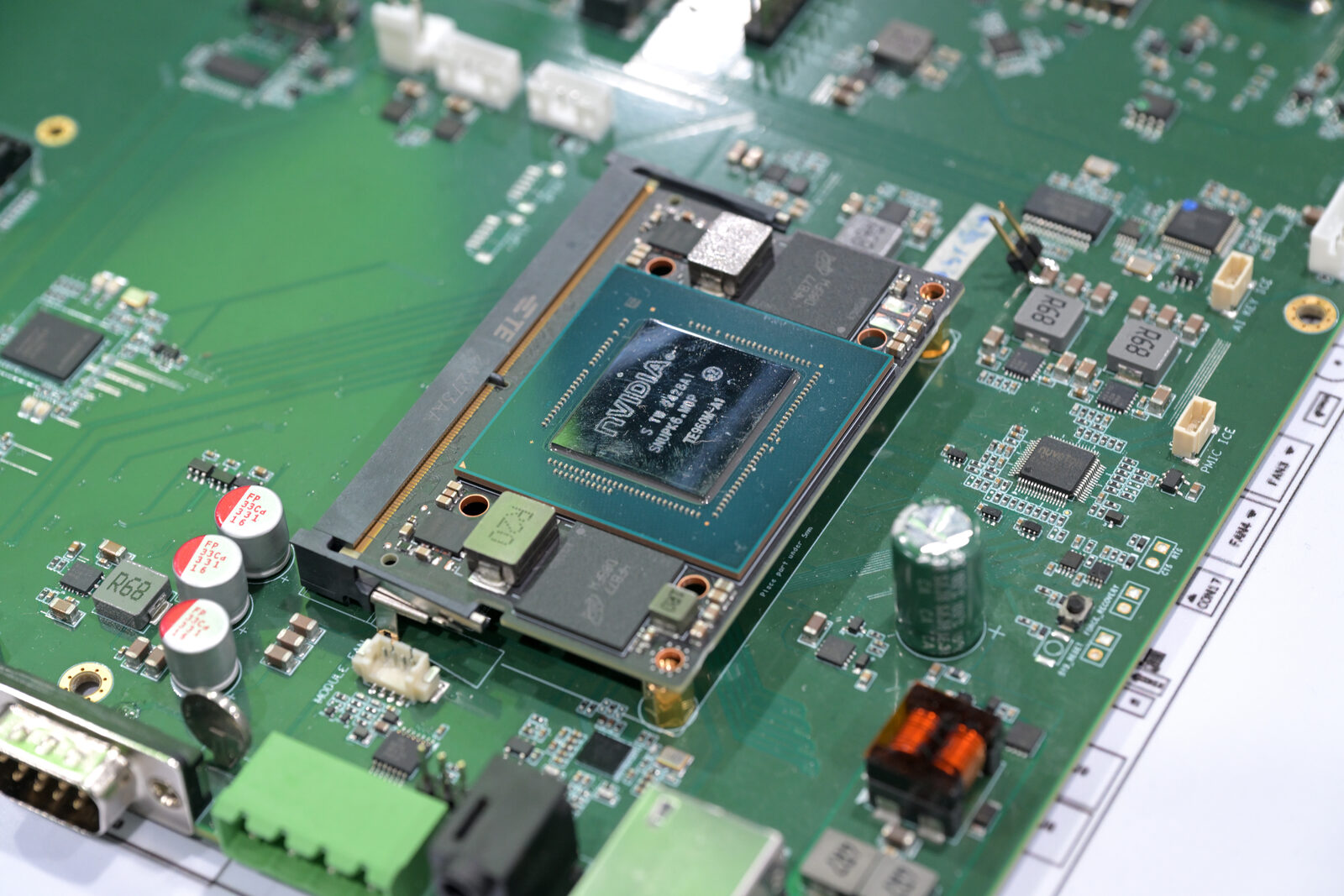
The practical compute tier for tactical drones is the NVIDIA Jetson Orin family, which spans entry-level modules through high-end configurations suited to platforms ranging from tactical micro-drones to larger persistent-surveillance airframes, with each tier trading raw throughput against power draw and physical footprint.
Across these platforms, TensorRT Int8 quantization can double or triple inference throughput versus raw PyTorch execution. Work is typically distributed across compute engines: CUDA cores for deep learning inference, VPI and PVA cores for vision preprocessing, CPU for flight-critical control loops targeting over 50 Hz odometry update rates. The combination of workloads running simultaneously — VIO, object detection, semantic segmentation — without any network call is what makes the capability meaningful in denied environments.
An earlier benchmark that remains instructive: researchers running Modified Tiny YOLO (nine 3×3 convolutional layers, six 2×2 pooling layers) on a Jetson TX2 achieved 77 percent mean average precision tracking a target drone in a GPS-denied, fully autonomous engagement at 8.55 frames per second. The authors were candid about the constraint: performance was limited by the detection algorithm’s 77% accuracy in cluttered environments and a frame rate of 8.55 frames per second. That study was published in 2019. The Orin NX offers roughly an order of magnitude more raw throughput at comparable power draw.
Why It Matters
Shield AI’s Hivemind platform represents the operational proof at scale. The company claims the first fully autonomous AI combat mission in 2018; Hivemind has since been integrated on more than 15 unmanned platforms including the Lockheed X-62 VISTA F-16, General Atomics MQ-20 Avenger, Northrop Grumman Talon IQ, Airbus H145 D3 helicopter, and Shield AI’s own V-BAT and Nova systems. The milestone cadence has compressed: first AI dogfight in 2023, first GPS and communications-denied strategic targeting in 2024, selected as U.S. Air Force mission autonomy provider in 2026. Hivemind navigates via visual odometry and AI-driven object detection, requiring no GPS and no communications link. “Hivemind saved many lives in combat,” an Israeli Yamam operator told Shield AI — one of the few operational attributions from an active user in a named unit.
The government R&D lineage running behind the commercial platforms extends back over a decade. DARPA’s Fast Lightweight Autonomy program (2015–2018) was a significant milestone in developing UAS capable of navigating at speed through unknown, GPS-denied environments using onboard compute alone; three teams competed on a shared hardware platform. The successor Collaborative Operations in Denied Environment program (CODE, 2015–2019) demonstrated six modified Tigershark drones coordinating autonomously above Yuma, Arizona, operating at roughly one-tenth the speed of operational counterparts while demonstrating the core capability: autonomous multi-vehicle coordination when simultaneously cut off from GPS and communications. CODE produced government-owned, airframe-agnostic autonomy software applicable across Navy and Air Force platforms.
The current investment vector is Collaborative Combat Aircraft: the U.S. Air Force allocated at least $392 million in fiscal year 2024 for AI-piloted unmanned wingmen paired with human-crewed fighters, with the XQ-58A Valkyrie completing its first fully AI-guided three-hour sortie near Eglin AFB in July 2023. Col. Tucker Hamilton framed the doctrine: “AI and this autonomy — it’s got to empower the decision-maker.” V-BAT Teams already enable a single operator to command a multi-aircraft wolfpack, with Hivemind handling formation flight and sensor coordination throughout. The deeper shift is in the operator-to-aircraft ratio: autonomous swarms allow crews previously required for a single aircraft to manage dozens of vehicles simultaneously. The math of that inversion — and the fact that it now works reliably in GPS-denied, comms-denied environments where operators describe flying “deep into Russian held territory, always in GPS and GNSS denied environments” — is what makes this more than incremental progress in sensor fusion. It is a fundamental change in how air power can be projected.
Sources
- arxiv.org / IEEE ICRA 2025 Workshop — 25 Years of Aerial Robotics: DARPA Fast Lightweight Autonomy program retrospective (Norton & Yanco)
- arxiv.org — Low Latency Visual Inertial Odometry for Resource-Constrained UAVs (OF VINS-Mono, VD56G3 ASIC evaluation)
- Shield AI — Hivemind Solutions (platform capabilities and deployment record)
- Military Embedded Systems — Shield AI president: up to 99% of military autonomous systems fail in GPS-denied environments
- Veriprajna — GNSS-Denied Navigation for Autonomous Drones (technical whitepaper)
- C4ISRNET — DARPA claims drone autonomy program an undeniable success (CODE program, April 2019)
- PMC/NCBI — Peer-reviewed study: autonomous drone-hunting drone using Jetson TX2 and Tiny YOLO (2019)
- C4ISRNET — AI-enabled Valkyrie drone and the future of the U.S. Air Force fleet (January 2024)