
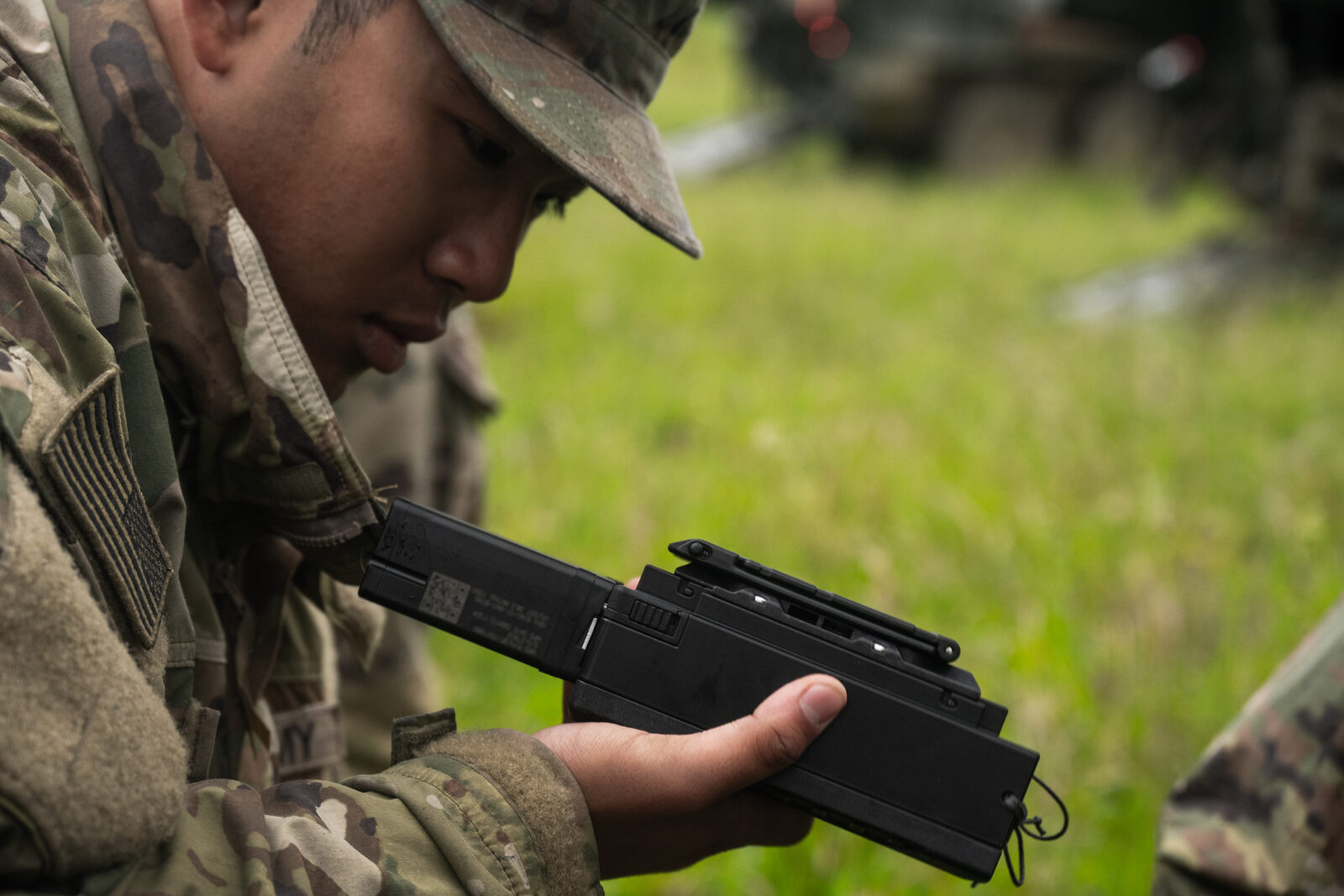
It weighs 3.2 kilograms and fits a single-hand grip, but the DroneGun Mk4 is not a consumer gadget. Launched by DroneShield in April 2023 as a trimmed successor to the rifle-form Tactical variant — 7.3 kg, two batteries, IP54 — the Mk4 is a pistol-shaped counter-UAS device rated IP67 against dust and immersion, operational across -32°C to +55°C, and ready in under three seconds on a NATO-standard quick-release lithium-ion battery sustaining more than an hour of continuous use. Its dimensions sit at 660 mm × 356 mm × 213 mm. DroneShield has not publicly confirmed the Mk4's effective range — CEO Oleg Vornik declined to specify it when speaking to Janes at launch; industry coverage has cited one kilometer, but that figure is unverified by the manufacturer.
The category the Mk4 inhabits — handheld RF disruptors — has become one of the defining tools of contemporary irregular warfare. Unlike kinetic intercept methods that consume projectiles or netting per engagement, RF jammers re-engage without expending ordnance — an asymmetry that has driven mass deployment in Ukraine and produced an acute regulatory paradox in the United States: a tool manufactured for export to allied governments, proven effective on an active battlefront, and almost entirely prohibited by statute for anyone outside a handful of federal agencies.
The Physics of Disconnection
Commercial and consumer drones depend on two independent wireless systems. The first is the command-and-control (C2) link, typically occupying unlicensed ISM bands at 900 MHz, 2.4 GHz, or 5.8 GHz — the same spectrum shared with Wi-Fi and Bluetooth. The second is GNSS positioning: GPS L1 operates at approximately 1.575 GHz and gives the aircraft its spatial context for autonomous flight and return-to-home logic.
DroneShield describes the DroneGun family as targeting "a wide range of ISM (industrial, scientific, medical) bands and GNSS (global navigation satellite services) frequency bands," without publishing a precise band list for the Mk4. The Lithuanian Skywiper EDM4S — the other handheld jammer with documented large-scale operational use — is more explicit in its manufacturer specifications: 900 MHz, 2.4 GHz, 5.8 GHz, and GNSS L1 at 1.5 GHz, with additional customer-specified frequencies available per order.
What happens to the targeted aircraft depends on which links are disrupted and in what combination. Severing only the C2 link typically triggers return-to-home: the drone flies autonomously back to its departure GPS coordinates — useful for locating an operator but not necessarily a termination of threat. Simultaneous disruption of the control link and GNSS eliminates both human guidance and autonomous navigation, producing a controlled on-the-spot descent. DroneShield's documentation states: "When disruption is triggered, UAS targets will respond via vertical on the spot landing or return to its remote controller or starting point." In FPV-attack scenarios there is a compounding secondary effect:
"RF disruption activation will interfere with any live video streaming (FPV) back to the remote controller." — DroneShield product documentation
The drone pilot goes blind at the same moment the aircraft loses control authority. Against an FPV operator guiding a payload-carrying craft visually rather than via waypoints, that dual disruption is the decisive outcome.
From Ukrainian Frontlines to Export Catalogs
The most extensive operational test of handheld RF jamming has played out across Ukraine. Janes reports that thousands of Lithuanian-manufactured Skywiper EDM4S units are operational with Ukrainian armed forces, per Lithuanian developer NT Service, whose export partner SpetsTechnoExport confirmed deployments. The tactical logic is direct: Russian FPV drones are guided via radio control, and severing that link converts a precision weapon into an inert aircraft descending in a field. SpetsTechnoExport's Ivan Sybyriakov described the Skywiper EDM4S as "the best option for the regular soldier," citing its 3–5 km line-of-sight range, 6.5 kg weight, and up to one-hour operating time as a combination that vehicle-mounted or tripod systems cannot offer a dismounted soldier.
A companion variant — the Skywiper Omni at 11.3 kg — provides omnidirectional 500-meter dome coverage without requiring the operator to aim. Ukrainian mobile groups and medical evacuation teams have fielded it specifically because holding a rifle-form device is not always operationally feasible.
DroneShield's Mk4 is positioned for similar dismounted roles. Vornik told Janes the device was "developed in response to end-user feedback, using the 'latest science in waveform design, jamming techniques, and other technologies.'" The heavier Tactical model — 7.3 kg, MIL-STD rail-ready, IP54 — offers more than two hours of aggregate operational time across two batteries, suited for static or vehicle-supported positions. The company's product page makes the US market structure explicit: "DroneShield's disruption capable products are not authorized for (including the offer of) sale, lease, or use in the United States, other than to the United States government" — a disclosure that simultaneously maps the global addressable market by exclusion.
The Statute That Grounds the Jammer at Home
Three provisions of the Communications Act of 1934 form the legal wall. Section 301 requires authorization to transmit on licensed frequencies. Section 302a prohibits devices that interfere with authorized communications. Section 333 — the most direct — forbids "willful interference with licensed radio communications," a prohibition the FCC acknowledged in its April 2026 public notice DA 26-314 now constitutes a genuine statutory barrier even when the target drone is posing an active threat. Civil penalties reach $112,500 per incident; the FCC has levied five-figure civil penalties against individuals for operating a single jammer.
Authorized federal agencies form a short list: the Department of Defense, Department of Homeland Security, Department of Justice (including the FBI), Department of Energy, and the Coast Guard. State and local law enforcement have no independent authority. Per FCC jammer enforcement policy, local law enforcement agencies carry no independent authority to use jamming equipment; federal law enforcement agencies may do so only within specific statutory exceptions. As of January 2025, the agency had issued only eight Counter-UAS experimental licenses — the first ever granted for counter-drone purposes — against 227 general UAS experimental approvals (a 68 percent year-over-year increase in the broader category). Private corporations and individuals carry no exceptions; the prohibition is categorical.
The SAFER SKIES Act, enacted as part of the FY2026 National Defense Authorization Act, is the first meaningful expansion of domestic counter-drone jamming authority since 2018. It extends authorization to state and local law enforcement agencies that complete FBI National Counter-UAS Training Center certification, to correctional facilities, and to agencies responsible for National Special Security Events. The FCC's April 2026 notice — which formally asked how to address Section 333's statutory barrier for operational counter-UAS uses, as distinct from research or experimental licensing — signals the underlying law may face further revision. No timeline has been established.
Why It Matters
The gap between technical capability and legal authorization is sharpest where drone threats are most visible: commercial airports, major sports venues, critical infrastructure operators, and mass-gathering events. Operators at those locations face documented drone incursions with no legal path to the countermeasure that Ukrainian infantry carries by the thousands. The tool is manufactured, commercially sold on the global market, government-export approved, and proven at range and at scale. Under current US law, deploying it without federal authorization carries the same civil penalty structure as running a hotel jammer to block guests' cell service.
The SAFER SKIES Act and the FCC's renewed engagement with Section 333 indicate the framework is adjusting toward operational reality. But certification pipelines, jurisdictional limits, and the fundamental structure of the Communications Act mean the near-term picture remains incremental. Handheld RF disruptors are military hardware deployed everywhere the threat exists — except by the country that manufactures and exports them.
Sources
- Army Technology — DroneGun Mk4 product profile
- DroneShield — Products: Dismounted (DroneGun Mk4 and Tactical)
- Janes — DroneShield launches DroneGun Mk4 (April 2023)
- Janes — Ukraine deploying thousands of Lithuanian C-UAS jammers (2023)
- C4ISRNET — Counter-drone platforms deployed in Ukraine (Nov. 2023)
- Grab The Axe — C-UAS legalities: corporations navigating FAA/FCC rules
- Airsight — Drone jammer legal guide
- DroneXL — FCC DA 26-314 drone spectrum licensing public notice (April 2026)
