
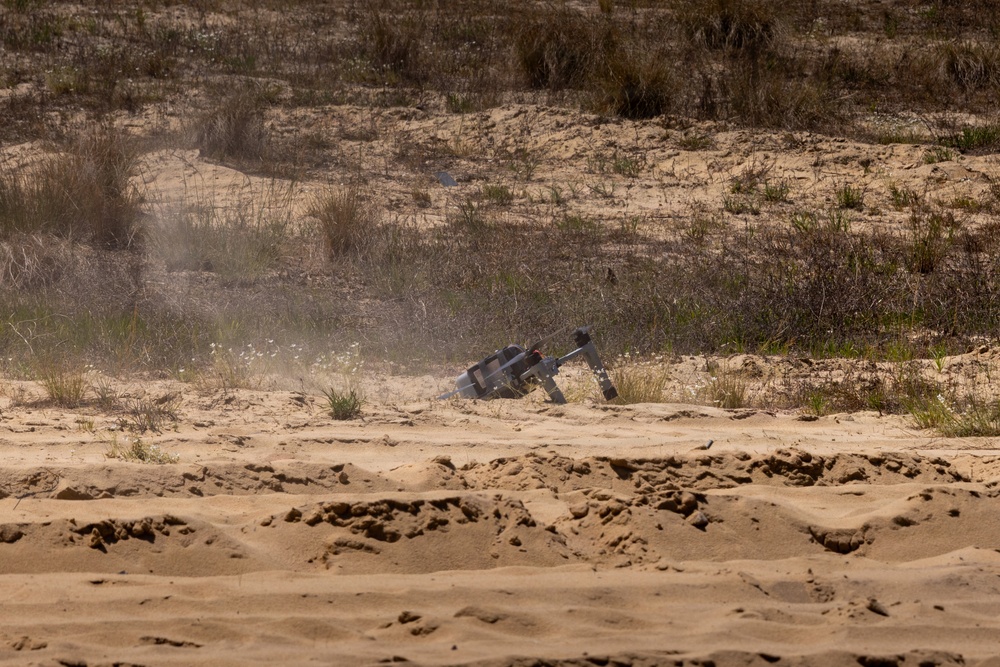
The overnight hours of July 1-2, 2026 delivered a compact lesson in where the air war over Ukraine is heading. Russia threw a massive combined strike at the country — Ukrainian officials counted roughly 570 incoming targets. Air defenses knocked down 524 of them. That is a headline intercept rate most militaries would envy. And yet 25 ballistic missiles and 12 strike drones still got through.
The arithmetic in that single night frames the whole problem. Defenders can be extraordinarily effective and still lose the margin that matters, because the attacker gets to choose the mix — and lately, the speed — of what it sends. Two stories are colliding over Kyiv: a homegrown drone-on-drone kill chain that has the U.S. military taking notes, and a Russian propulsion upgrade that threatens to render that kill chain obsolete before it fully matures.
The interceptor drone: a cheap answer to a cheap threat
For most of the war, the core Russian standoff weapon has been the Shahed-type strike drone — the Iranian-designed loitering munition Russia produces domestically as the "Geran." It is slow, propeller-driven, and loud, and it comes in swarms designed to saturate and exhaust the defenses. Shooting one down with a modern surface-to-air missile technically works, but it is a losing trade: a multi-million-dollar interceptor spent on a comparatively cheap drone. Do that a few hundred times a night and the magazine — and the budget — empties fast.
Ukraine's response has been to fight cheap with cheap. On July 1, C4ISRNET reported on the proliferation of drone-launched-drone tactics and the interceptor techniques Ukrainian units are using against Russian Shaheds — including video that purportedly shows a Ukrainian interceptor drone physically running down a Shahed in flight. The same report documented how far Ukraine has pushed the launch side of the equation, firing FPV and strike drones from the ground, from the air, and from uncrewed surface vessels — the robotic "robo-boats" operating in the Black Sea. The launch platform, in other words, has stopped mattering; what matters is the drone and its job.
The appeal of a propeller interceptor is obvious. It is roughly cost-matched to the target it kills, it does not draw down the precious inventory of guided missiles, and it can be manufactured at scale. C4ISRNET noted that the U.S. military is watching these techniques closely, precisely because mass drone attacks are a problem no Western air-defense architecture has cheaply solved. If a swarm of cheap attack drones can be met by a swarm of similarly priced interceptors, the defender finally has a sustainable answer.
Then Russia changed the engine
The catch, reported by Euronews and Ukrainska Pravda on July 2, is that the propeller interceptor was built to catch a propeller target — and Russia is now flying something faster.
The turbojet-powered Geran-3 reaches speeds of up to 370 km/h, with figures as high as roughly 500 km/h cited. Russia pairs that with a claimed range of about 1,000 km. Against that, Ukraine's interceptor drones top out around 300 km/h. The gap is decisive: a defending drone that cannot close the distance cannot make the intercept. As Ukrainska Pravda put it bluntly, mobile fire groups and anti-drone interceptors can no longer catch the jet drones — which forces defenders back onto missiles.
And that is the entire point of the upgrade. By making the incoming drone too fast for the cheap answer, Russia pushes Ukraine back toward its scarce, expensive surface-to-air missile stocks — the very trade the interceptor drone was invented to avoid. Euronews reported that Russia is explicitly counting on Ukraine's limited SAM inventory. The jet engine is not just a performance spec; it is a deliberate move against the defender's economics.
Nor is the Geran-3 the end of the line. Euronews noted that Russia first used an even newer variant, the Geran-5, in January 2026 — a sign that the propulsion and airframe changes are an ongoing program, not a one-off.
Why propulsion resets the math
It is worth being precise about why speed changes everything here, because it is easy to read "faster drone" as a marginal improvement rather than a structural one.
An interception is a geometry problem. To run down a target, the interceptor needs a speed advantage, or at least parity plus a favorable starting position. Ukraine's drone-on-drone technique worked against Shaheds because a ~300 km/h interceptor can catch a slower propeller drone, given a decent cue and a bit of altitude. Remove the speed advantage — put the target at 370-500 km/h against a 300 km/h chaser — and the intercept envelope collapses. The chaser is now a stern-chase it can never win, and the tactic simply stops functioning against that class of threat.
The defender is then left with the tools that are fast enough: guided missiles. Those work, but they are finite and costly, which returns the exchange to the unfavorable ratio Ukraine spent the last two years engineering its way out of. One propulsion change quietly undoes a hard-won cost advantage.
Why It Matters
This is a live demonstration of how quickly an air-defense advantage can be neutralized without a single new missile being fired at the defender. The interceptor drone was a genuinely important innovation — a cheap, scalable, cost-matched answer to mass drone attack, and one the U.S. military is studying as a template for its own problem set. Russia's counter was not a better warhead or a bigger swarm. It was a faster engine, chosen specifically to push the target speed past the interceptor's reach and thereby drag the defender back onto its most limited and expensive resource.
For any military planning against drone saturation — the Pentagon very much included — the July 1-2 barrage is a cautionary data point. A 92 percent intercept rate still let 37 weapons through, and the leakers included the fast, hard-to-catch threats. Cheap interceptors are necessary but not sufficient, because the attacker can move the goalposts with propulsion. The counter to jet-powered drones will have to be faster interceptors, better early cueing, or layered defenses that do not collapse when one layer is outrun — and it will have to arrive on the same relentless timeline the threat is evolving on. The drone-vs-drone kill chain is real, but so is the arms race around it, and right now the propulsion curve is bending in Russia's favor.