
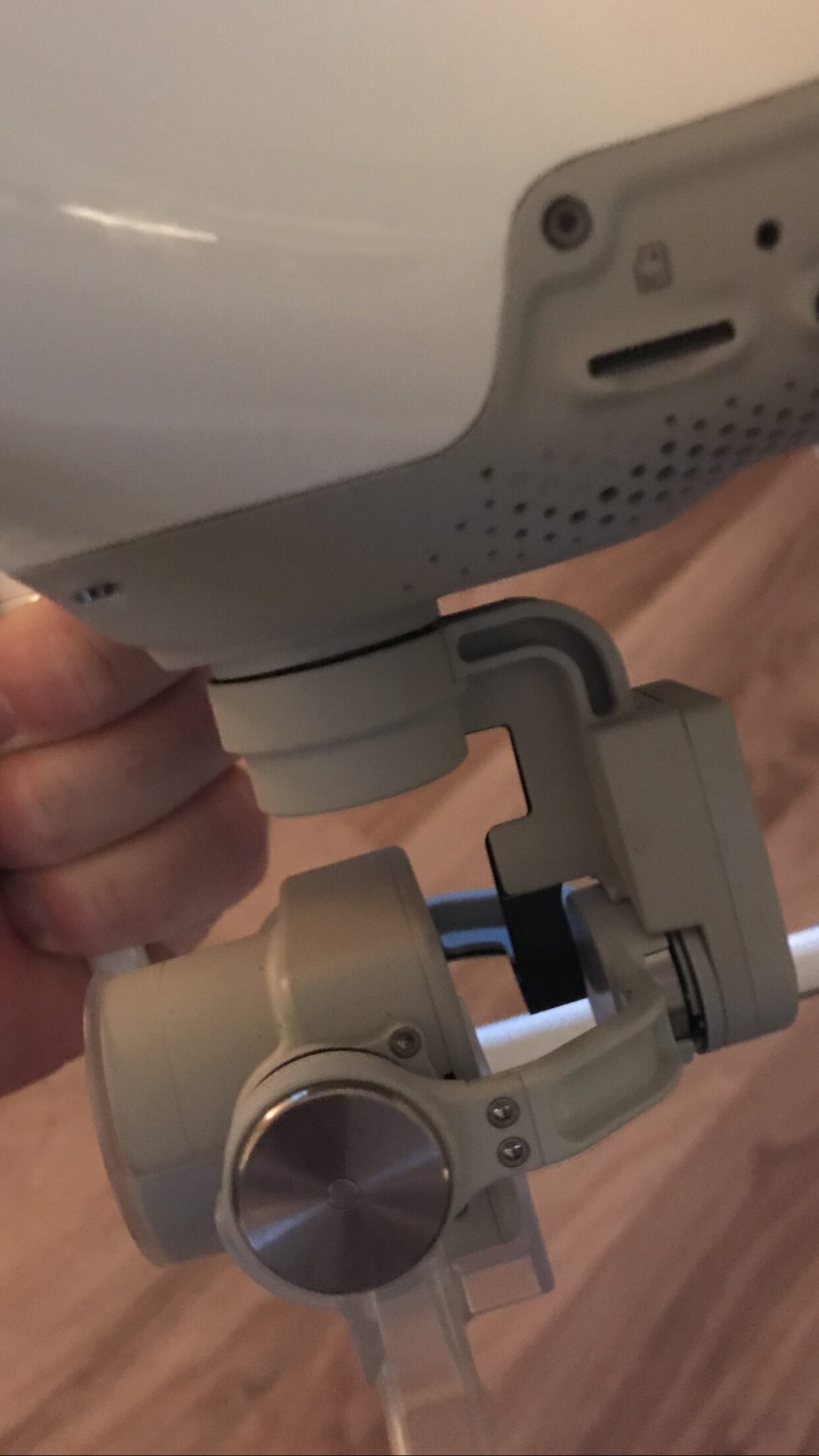
When a drone banks hard into a crosswind, every vibration, oscillation, and attitude change travels directly to any camera bolted to the airframe. What the sensor records isn't the scene below — it's the aircraft's own motion, smeared across every frame. The brushless gimbal exists to break that mechanical coupling: to hold a camera's line of sight fixed in space regardless of what the platform does. It's a conceptually clean objective that conceals several interlocking layers of control theory, precision mechanics, and embedded signal processing. The same physics scales from a 41.3-gram nano-UAV test rig at Delft University of Technology to a 19-kilogram military targeting ball providing persistent ISR coverage.
Three Axes, Three Motors, One Constraint
A camera in flight can be disturbed rotationally along three axes: pitch (nose tilting up or down), roll (the side-to-side lean of a banking turn), and yaw (left-right rotation around the vertical axis). A two-axis gimbal addresses pitch and roll — the most visible disturbances — but leaves the sensor exposed to yaw-axis motion. That gap produces the "jello effect" and rolling shutter distortion characteristic of CMOS sensors under lateral vibration. A three-axis gimbal adds a third brushless motor, closing the vulnerability at the cost of additional mass and power draw.
Physical travel ranges are dictated by how aerial cameras actually work. Pitch typically spans -90° (straight down for nadir surveys) to +15° (slightly above horizon). Roll stays within ±15°. Yaw can sweep a full 360° for continuous panoramic coverage. Before corrective motors engage, an anti-vibration isolation layer handles the frequencies the control loop can't track fast enough: carbon fiber arms and rubber ball dampers mechanically filter high-frequency propeller noise before it reaches the gimbal frame.
The choice of brushless motors over conventional brushed DC servos isn't incidental. Brushless motors use permanent magnets around the rotor perimeter and a stationary wound stator — no brushes, no commutator, no contact wear. The result is quieter operation, higher efficiency, and substantially longer service life. What made consumer brushless camera gimbals viable as a product class was the convergence, around 2012, of miniaturized MEMS inertial sensors and embedded microcontrollers with sufficient headroom to run real-time attitude control loops. Before that convergence, the components either didn't exist at usable price points or consumed too much power and volume.
IMU, Control Loop, and the Filter War
The gyroscopes and accelerometers inside the gimbal's inertial measurement unit (IMU) are MEMS devices — microscale silicon structures that flex and oscillate under g-forces and angular rates, functioning as inertial sensors at the microscale. A research-grade device like the ADIS16405 covers ±300°/s in gyroscope range, ±18g in acceleration, and ±3.5 gauss in magnetometer sensitivity. The IMU samples the platform's motion state and feeds it to the gimbal control unit, which generates corrective commands dispatched to all three motors many times per second. As one technical analysis of drone stabilization puts it, "Advanced algorithms, including stabilization, motor control, object tracking, and sensor fusion algorithms, process data and ensure the gimbal responds accurately and in real-time."
The complication: raw gyroscope output drifts over time, and raw accelerometer output is noisy under vibration. Neither signal alone reconstructs the gimbal's true orientation reliably. Sensor fusion combines them — and the choice of fusion algorithm carries measurable consequences.
Researchers at the University of Waterloo (Koksal, Jalalmaab, and Fidan) ran a direct comparison at 200 Hz between a Kalman filter and a complementary filter on a quadrotor stabilization platform. The complementary filter is architecturally simple: it passes low-frequency components from the accelerometer and high-frequency components from the gyroscope through complementary frequency windows and sums them. The Kalman filter is more computationally expensive — it maintains a probabilistic state estimate and corrects it against each new measurement while explicitly accounting for process and sensor noise covariances. The Waterloo team found that the "Kalman filter based approach provides less mean-square estimation error": 0.0012 rad roll MSE versus 0.0027 rad for the complementary approach at the same sampling rate. Running an adaptive linear-quadratic tracking (LQT) controller, they held attitude tracking error within ±0.1 radians, with parameter adaptation converging to nominal inertia in approximately 40 seconds.
At Delft University of Technology, the "Open Gimbal" three-degree-of-freedom test platform achieved attitude estimation error within 2° on all axes using a wireless, batteryless IMU subsystem powered by RF energy harvesting and communicating via backscatter up to 4.5 meters. The entire platform weighs 41.3 grams; the sensor PCB — using an LSM303AGRTR three-axis accelerometer and magnetometer, sampling at 10 Hz — accounts for 1.7 grams, roughly 2% of a typical nano-UAV's total mass. At that scale, every milligram is a legitimate design constraint.
Mechanical gimbal stabilization remains the most precise correction path: the camera frame physically rotates against the disturbance. Electronic image stabilization (EIS) takes a software approach, cropping and warping the image plane to remove apparent motion after the fact. EIS adds no moving parts or mass overhead, but it costs field of view (you're working with a cropped region of the sensor) and is generally less precise than the mechanical approach. Most professional drone platforms combine both: the gimbal handles large, low-frequency disturbances while EIS cleans residual micro-jitter that the motors can't resolve.
When Smooth Footage Becomes a Geo-Locked Aimpoint
Consumer camera gimbals and military electro-optical/infrared (EO/IR) targeting turrets share their fundamental physics. Beyond that, they diverge sharply in requirements and consequences.
"Optical sensors such as IR, radar and camera are often mounted on moving platforms" for surveillance, navigation, and data collection tasks. — Agasti, Hazarika, Bhikkaji (IIT Madras / NIT Kurukshetra)
IIT Madras researchers analyzing inertially stabilized platforms (ISPs) identified three primary disturbance sources: platform body motion, cross-coupling between gimbal axes, and gimbal mass unbalance. Their control framework separates two distinct objectives — stabilization (driving angular rates to zero to hold the line of sight fixed in inertial space) and tracking (slewing the sensor toward a desired target trajectory). To handle the nonlinear gimbal dynamics analytically, they applied feedback linearization, converting the system to a Linear Time-Invariant (LTI) form that admits exponentially converging control laws for both objectives simultaneously.
The hardware that results from these requirements looks nothing like a consumer payload. SPI Corp's M2-D achieves four-axis stabilization — yaw, pitch, roll, and vertical — in a 53-millimeter diameter, 160-gram package drawing under 10 watts. It integrates an LWIR uncooled thermal imager (7–14 µm) at up to 1280 HD resolution alongside an EO camera channel with up to 80× optical zoom, a field of view spanning from 30° wide to 1° telephoto, and angular slew rates up to 105°/s. With advanced targeting modules, human detection extends to approximately 10 kilometers; vehicle detection reaches approximately 20 kilometers.
At the heavier end of the military spectrum, the Global Falcon packs six sensor channels — MWIR thermal with continuous zoom, color HDTV, laser rangefinder, laser pointer, laser illuminator, and a low-light HDTV channel — into a 300-millimeter ball weighing under 19 kilograms, with ball-up and ball-down mounting for aerial, maritime, and ground vehicle installations. Onboard digital processing includes automatic target tracking, moving target detection, image blending, scene hold, and haze reduction. The shift from three axes to four reflects a fundamentally different success criterion: not visually smooth footage, but a geo-locked aimpoint stable enough to designate a target.
Why It Matters
The performance gap between a 1.7-gram sensor PCB and a 19-kilogram ISR turret is real, but the underlying closed-loop inertial stabilization problem is the same in both. As MEMS sensors shrink, control algorithms improve, and brushless motor efficiency increases, capabilities historically confined to large military platforms migrate steadily into commercial and Group 1 sUAS. That convergence has direct operational implications across ISR, border surveillance, infrastructure inspection, search and rescue, and agricultural remote sensing — any domain where stable, geospatially accurate imagery is the mission-critical output. For operators, acquisition professionals, and counter-UAS practitioners, understanding where a given platform sits on that continuum — and what physics governs its imaging fidelity — is increasingly a baseline professional requirement, not a specialist concern.
Sources
- arXiv / IEEE Sensors Letters — Delft University of Technology, "Open Gimbal" 3-DoF wireless batteryless IMU platform (2023)
- arXiv preprint — IIT Madras / NIT Kurukshetra, feedback linearization control for inertially stabilized platforms (2023)
- MDPI Sensors / PubMed Central — University of Waterloo, Kalman vs. complementary filter for UAV attitude control (2019)
- AAI-Drones — Understanding Drone Gimbal Stabilization
- DroneZon — Drone Gimbal Design, Components, Parts & Technology Overview
- DroneFlyers — Understanding Brushless Camera Gimbals
- SPI Corp / X20.org — M2-D Mini Gyro-Stabilized EO/IR UAV Turret Ball
- SPI Corp / X20.org — Global Falcon Multi-Sensor EO/IR Gyro-Stabilized 4-Axis Gimbal
