
On June 1, 2025 — Russia’s Military Transport Aviation Day, chosen deliberately — 117 small drones launched from wooden cabins loaded onto cargo trucks struck four Russian strategic air bases simultaneously, hitting targets as far apart as Murmansk and Irkutsk. When the strikes concluded, more than 40 aircraft had been destroyed or damaged: Tu-95MS strategic bombers, Tu-22M3 supersonic bombers, Tu-160 variable-sweep aircraft, and A-50 AWACS planes worth roughly $350 million each, of which Russia operates fewer than ten. CSIS estimated the operation — Operation Spider Web — eliminated approximately 34 percent of Russia’s strategic cruise missile delivery capability. Each drone cost between $600 and $1,000. Each ran ArduPilot.
When Chris Anderson, ArduPilot’s original creator, saw the reports, he posted one sentence that contained approximately all the irony a sentence can hold:
“That’s ArduPilot, launched from my basement 18 years ago. Crazy.”
That observation frames the question worth understanding: what exactly is a drone flight controller, and why does it matter that this software — originally a hobbyist autopilot — can guide a precision strike on a hardened military airfield?
The Brain in the Machine
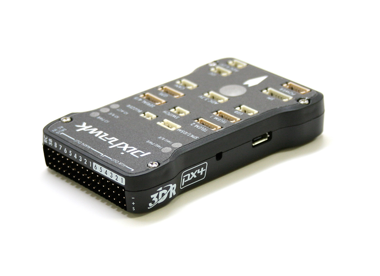
A flight controller (FC) is the embedded computer that keeps a multirotor or fixed-wing UAV from falling out of the sky. This sounds modest. It is not. Any multirotor design is aerodynamically unstable by default; without continuous active correction, it tumbles. The FC’s job is to read raw sensor data at rates reaching tens of thousands of samples per second, fuse those readings into a real-time estimate of the vehicle’s attitude and position, compute the corrections needed to hold or change course, and dispatch updated commands to the motors — all within a few milliseconds, continuously, for the entire flight.
The sensor suite covers several physical phenomena simultaneously. A three-axis accelerometer measures linear forces; a three-axis gyroscope measures rotational rate; a barometric altimeter tracks pressure altitude; a magnetometer provides heading reference against Earth’s magnetic field; and a GPS receiver supplies geographic position. No single sensor is authoritative — gyroscopes drift, magnetometers suffer magnetic interference, GPS signals drop under jamming or terrain — so the FC runs a Kalman filter that continuously reconciles disagreeing measurements into a single trusted state estimate, weighting each source by its known noise profile.
The gyroscope sample rate is a telling detail. The MPU6000, common in older boards, samples at 8 kHz. The ICM-42688-P, which has become the de facto industry standard as of 2025, reaches 32 kHz. SPI bus connections are preferred over I2C precisely because they sustain the bandwidth those update rates demand.
From State Estimate to Motor Commands
Getting from “here is what the vehicle is doing” to “here is how fast each motor should spin” happens through what Circuit Cellar describes as “nested PID control loops for controlling 3D attitude, and velocity and Kalman filters for sensor fusion.” The innermost loop operates on angular rate — comparing where the gyroscope says the vehicle is rotating against where it should be, issuing corrections within fractions of a millisecond. An outer loop operates on attitude (the actual angle), and a still-outer position loop uses GPS to hold or change geographic coordinates. Each loop’s proportional, integral, and derivative terms are tuned to the vehicle’s physical characteristics.
FC outputs translate to motor speed through Electronic Speed Controllers. ESCs receive pulse-width modulation signals from the flight controller — or the digital DSHOT protocol on modern hardware — and respond by switching field-effect transistors to apply tri-phase voltage to brushless motor windings in timed sequence. Above that mechanical layer sits the communication stack: MAVLink, the standard telemetry and command protocol linking FCs to ground stations, carries just 14 bytes of frame overhead in version 2.0 and supports up to 255 concurrent systems on a single link, efficient enough for both tactical networks and consumer mission planning software.
An Ecosystem Built in Basements
The hardware beneath all of this has evolved almost entirely around STMicroelectronics’ STM32 microcontroller family, and the trajectory of that evolution maps directly to what firmware can do. The F1 ran at 72 MHz with 128 KB of RAM; the F3 doubled RAM to 256 KB; the F4 pushed clock speed to 168 MHz and RAM to 512 KB or 1 MB; the F7 hit 216 MHz; the current H7 reaches 480 MHz with 1–2 MB of RAM. Betaflight — the dominant firmware for FPV racing applications, descended from Baseflight via Cleanflight (2014) and forked in 2015 — has deprecated F1 and F3 support entirely. The firmware has simply outgrown what those chips can hold.
The Pixhawk standard charts a different course. The original Pixhawk 1, built around the STM32F427 Cortex-M4F, offered a capable autopilot for around $75. The current flagship, the Pixhawk 6X-RT, runs NXP’s i.MX RT1176 — a step beyond the STM32 line altogether. PX4 Autopilot supports a wide range of hardware boards from vendors including CubePilot, Holybro, ARK Electronics, CUAV, and mRo. AT32 chips from Artery Technology are emerging as a cost-competitive STM32 alternative in price-sensitive designs.
Both ArduPilot and PX4 span an unusually broad vehicle class from a single codebase: multirotors, fixed-wing, VTOL, helicopters, ground rovers, boats, and submarines. Ground control software — Mission Planner, APM Planner 2.0, MAVProxy, QGroundControl — speaks MAVLink and runs on Windows, Linux, macOS, Android, and iOS. Flight modes range from fully manual through GPS-hold and return-to-home up to fully autonomous 3D waypoint missions with onboard failsafes for RC loss, GPS degradation, and low battery.
Why It Matters
Operation Spider Web was engineered explicitly around ArduPilot’s autonomous navigation capability. Each vehicle carried a compact onboard computer (reportedly a Raspberry Pi), a webcam, and an LTE modem. ArduPilot’s pre-programmed 3D waypoint navigation minimized reliance on active RF control signals — a deliberate operational security measure that compressed the electronic signature the drones projected against Russian electronic warfare systems. Machine vision models embedded on the companion computers identified structural weak points on target aircraft: underwing missile pylons, fuel tank seams. The Security Service of Ukraine claimed responsibility. The operation required 18 months of planning.
This same architecture — open-source autopilot, consumer companion computer, cellular command link — is now being scaled for autonomous swarm operations in research settings. Work presented at the 12th IEEE International Conference on Mechatronics and Robotics Engineering in March 2026 paired Pixhawk 6X flight controllers with Jetson Orin NX 16GB companion computers for counter-UAS swarm drone operations, exploiting PX4’s Offboard mode, which enables external control via commands from the companion computer. ROS 1 reached end-of-life in 2025; ROS 2 is now the standard middleware layer tying PX4 autopilots to higher-order autonomy and swarm coordination logic.
The implication is direct: the software stack running competitive FPV racing drones and commercial delivery UAVs is being integrated into AI-driven, GPS-waypoint-navigating swarms for both offensive strike and counter-drone applications. A flight controller is not a commodity component. It is the load-bearing technical layer between the concept of autonomous flight and its physical execution — and it has been freely available, extensively documented, and continuously improved by a global open-source community for nearly two decades.
Sources
- arXiv / IEEE ICMRE 2026 — Flight Controller and Companion Computer Integration for Autonomous UAV Swarms
- PX4 Official Documentation — Flight Controller Hardware
- CSIS — How Ukraine’s Spider Web Operation Redefines Asymmetric Warfare
- 404 Media — Ukraine’s Massive Drone Attack Was Powered by Open-Source Software
- Circuit Cellar — Intro to ArduPilot and PX4, Part 1
- Oscar Liang FPV — Everything About Flight Controllers