
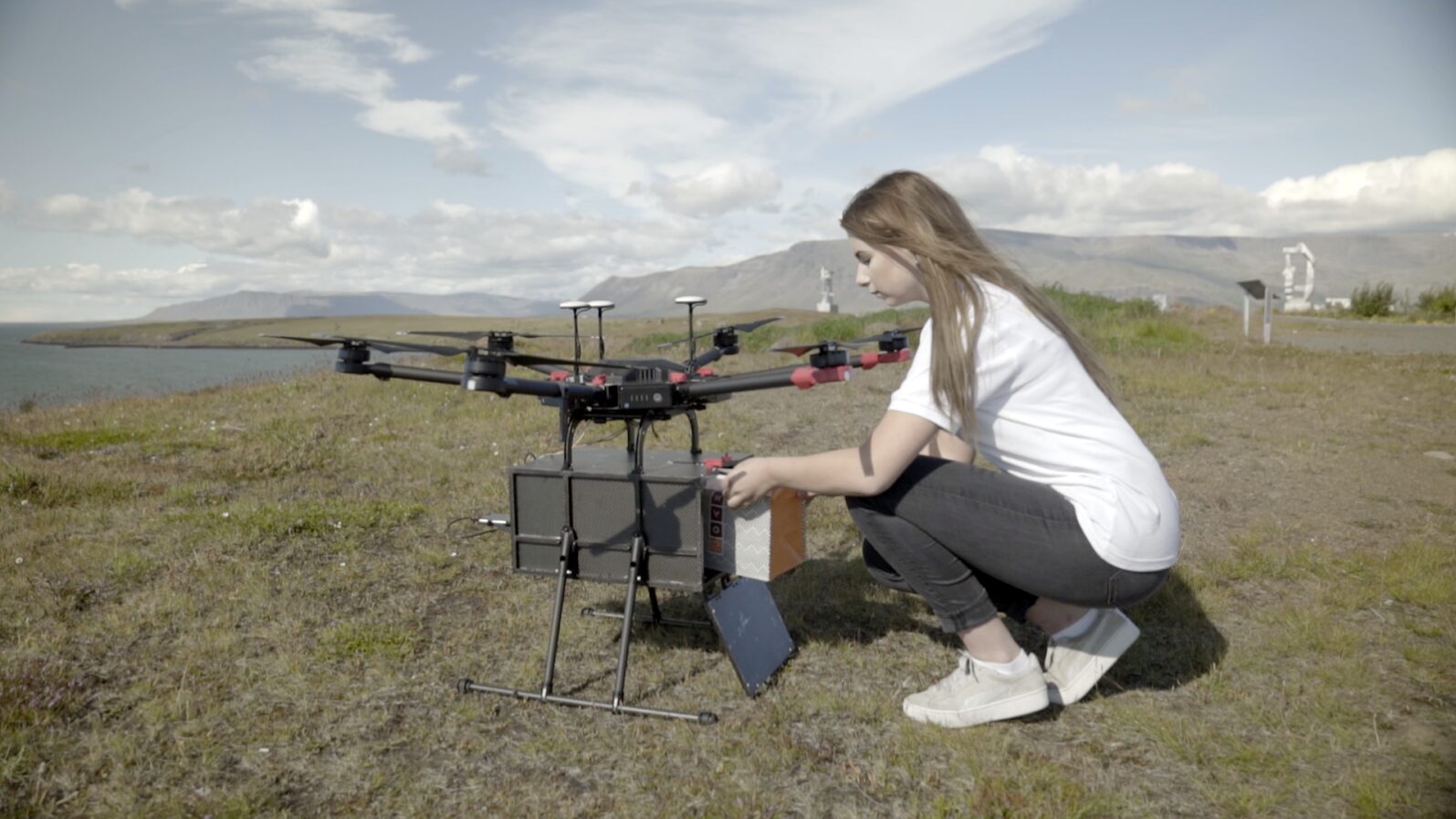
Zipline's Platform 2 hovers at 300 feet above a residential backyard in Mesquite, Texas, lowers a package on a tether, and climbs away — no human pilot watching from below. Wing has completed over 400,000 deliveries across three continents. China's Meituan runs more than 600 drone routes across 12 cities with 28,000 daily flights.
And yet the industry's core regulatory question — who can fly autonomously over populated areas without a visual observer — remains unanswered in most jurisdictions. The FAA's proposed Part 108 rulemaking (August 2025) could define the next decade of US drone commerce. Europe's U-space framework entered into force January 2023, but 27 member states are implementing at different speeds. China bypassed the deliberation through centralized coordination. The gap between operational capability and legal authorization is purely a governance problem.
Why Visual Line of Sight Was Always a Workaround
Every major aviation system inherited rules built for manned aircraft. When consumer drones proliferated after 2015, regulators defaulted to requiring a visual observer who can see the drone at all times. For a delivery network covering a metropolitan area, this is prohibitive — you cannot staff a human observer between every distribution hub and every customer backyard.
BVLOS is the technical prerequisite for scalable delivery. Achieving it legally requires demonstrating autonomous aircraft detection, remote identity broadcast, air traffic management integration, and mathematically bounded collision and ground-injury probability. No country had a mature framework for any of this before approximately 2021. What operators encountered instead was the waiver — a case-by-case FAA petition or national permit, authorizing one company to fly one route in one defined airspace block for a defined period.
The United States: Part 107 Waivers to Part 108
Through mid-2024, the primary US mechanism was the Part 107 waiver: evaluated individually, granted with site-specific conditions, typically requiring six to twelve months and $5,000–$10,000 in compliance preparation. By that point the FAA had issued over 100 BVLOS waivers — each new delivery city requiring its own. The system produced real operations: Zipline holds waivers authorizing package delivery across multiple US cities; Amazon Prime Air operates in Texas and Arizona after a brief 2025 sensor-related halt; Wing runs Walmart routes in Dallas-Fort Worth. What the system cannot do is support a hub-and-spoke metropolitan network.
On August 7, 2025, the FAA published an NPRM creating 14 CFR Part 108, "Normalizing Unmanned Aircraft Systems Beyond Visual Line of Sight Operations." Over 3,000 public comments closed in two rounds; final rule publication was projected for early 2026 but had not been issued as of mid-2026; implementation is anticipated late 2026 or early 2027.
Part 108 replaces individual waivers with Permitted Operations (streamlined self-certification) and Certificated Operations (organizational certificates) across five population density categories. Category 5 — dense urban zones within half a mile of 2,500 or more people — mandates automated detect-and-avoid for non-cooperative aircraft. For package delivery, Permitted Operations cover fleets up to 100 aircraft, maximum 55-pound payload. Technical requirements include ADS-B receivers on 1090 MHz and 978 MHz, Remote ID, UTM integration, redundant propulsion, 87-knot speed cap, and 25-foot wingspan limit.
The Drone Service Providers Alliance argued that case-by-case area approvals "effectively becomes another waiver system" — perpetuating the inefficiencies Part 108 was designed to eliminate.
Other objections: no grandfathering for operators with proven Part 107 BVLOS safety records; prohibiting drones from broadcasting ADS-B Out creates visibility gaps for low-altitude manned aircraft; a streamlined airworthiness process applies only to manufacturers in bilateral-agreement countries, effectively excluding most DJI products in commercial service.
Europe: U-Space Live, Implementation Fragmented
Three EU regulations entered into force January 26, 2023: Regulation (EU) 2021/664 (U-Space Service Provider certification), 2021/665 (member state designation of U-space airspace), and 2021/666 (manned aviation in U-space). Within designated U-space airspace, operators must subscribe to four mandatory services: UAS Flight Authorisation (conflict-free departure clearance), Geo-awareness (real-time airspace constraints), Network Identification (live position data for all UAS), and Traffic Information (manned aircraft positions). This stack enables BVLOS by replacing the human visual observer with electronic conspicuity and centralized flight authorization. The European Commission described the rollout as an important step toward creating the trusted, safe enabling environment needed for a competitive EU drone services market.
Full U-space implementation targets 2030. Individual member states must separately designate U-space zones and certify service providers — a company operating across multiple EU states faces different designations, different providers, and different national timelines.
China at Scale; Australia, UK, and Beyond
China is the country where drone delivery has achieved the most extensive daily urban logistics integration. The CAAC's 2024 Interim Regulations established urban corridors below 120 meters for BVLOS, mandatory smart landing pads, and a national real-time UTM coordination system. Meituan averages 22-minute delivery times across 12 cities; combined daily flights from Meituan, JD Logistics, and SF Express exceed 28,000; no fatal incidents in certified operations have been reported since 2021. The structural difference: the CAAC coordinated airspace designation, UTM, and certification as a single national program — faster deployment at the cost of due-process protections embedded in Western rulemaking.
Australia's CASA launched a broad-area BVLOS trial program in 2025 where qualified operators can self-assess operational areas, significantly cutting approval timelines. The UK is developing its own post-Brexit framework with 2024–2025 medical transport BVLOS innovation zone trials. Singapore's regulatory sandboxes run approvals in two to six months. In Rwanda, a 2023 Wharton School study found a 51% reduction in postpartum hemorrhage deaths tied to Zipline's blood delivery network; by March 2025 the company had logged 1.4 million deliveries and 100 million miles across the US and Africa.
Four technical problems remain unsolved across every jurisdiction: detect-and-avoid for non-cooperative aircraft at sub-500 feet (hardware from companies including Iris Automation and Fortem Technologies still maturing); UTM integration with legacy ATC at real-time scale; ground risk bounding to the 10⁻⁵ per-flight-hour probability threshold required by Part 108 Category 5 and EASA's SORA; and C2 link reliability above 99.999% in dense urban spectrum environments.
Drone delivery works at significant scale in 2026. The open question is whether legal frameworks can move fast enough for commercial networks to reach route density that makes unit economics viable. Part 108, U-space, and China's 2024 regulations converge on the same technical answer: replace the human observer with certified digital infrastructure. The divergence is in how fast, how uniformly, and who absorbs the coordination costs.
Sources
- FAA Newsroom — Part 108 BVLOS NPRM announcement
- Federal Register NPRM 2025-14992 — Normalizing UAS Beyond Visual Line of Sight Operations
- EASA — U-Space domain
- EASA press release — AMC/GM for U-space Regulation, December 20, 2022
- European Commission — U-space rules entry into force, January 26, 2023
- EASA press release — Regulatory framework for drone service deliveries
- Pilot Institute — Part 108 Explained
- DLA Piper — FAA proposed Part 108 BVLOS rule industry response, October 2025
- UAVHQ — FAA Part 108 Complete Guide BVLOS 2026
- Walmart Newsroom — Drone delivery expansion, June 5, 2025
- Loyalty Drones — How Drone Delivery Is Taking Flight in 2025
- SparkCo.ai — Autonomous Drone Delivery Regulatory Approval Worldwide
- Alibaba Electronics — China Drone Delivery Real World Status
- CASA Australia — Broad Area BVLOS Operations (TMI 2025-03)
