On May 29, 2026, Walmart recorded its one-millionth drone delivery — a milestone that arrived in under three years and, in the final quarter alone, accounted for 40 percent of the total. Average order-to-door time: 23 minutes. Fastest single delivery: 4 minutes and 44 seconds. The technology demonstrably works. And yet, at roughly the same moment, Amazon Prime Air was spending an estimated $63 per delivery to hand off packages to customers who could have paid $4.99 for the same item. Those two facts coexist, and understanding the gap between them is the whole story of drone delivery economics in 2026.
The Cost Anatomy: Still Worse Than the Van It Replaces
A McKinsey analysis published in January 2023 put the direct cost of a drone delivery at roughly $13.50 — and pegged labor at approximately 95 percent of that figure. That single statistic explains almost everything. The model in widest deployment today requires one operator per drone per flight, which means personnel costs scale linearly with volume. By contrast, industry benchmarks put ground van delivery at roughly $9–11 per package, and Amazon's ground logistics operation was already estimated at under $5.50 per package in 2022. On a pure cost-per-drop basis, drones are currently worse than the thing they are meant to disrupt.
Amazon's own trajectory makes the problem concrete. Widely circulated industry estimates — unconfirmed by Amazon — put Prime Air at approximately $484 per delivery in 2022, falling to around $63 by 2024–25. If accurate, that is real progress, but the endpoint still involves spending $63 to deliver an order the customer paid $4.99–9.99 to receive. DroneUp, which operates a separate drone delivery network, was running at approximately $30 per delivery as of 2026 with a stated target below $7, per eMarketer. The gap between current reality and commercial viability is not rounding error.
Beyond labor, three structural cost drivers compound the problem. Hub infrastructure is expensive: industry estimates put a small drone pad at $200,000–$400,000 to build and $600,000–$900,000 per year to operate; a full hub runs $6–7 million in capital with $15–17 million in annual operating costs. Payload caps are severe — Amazon's MK30 handles 5 pounds, Zipline's P2 manages 8 pounds, and some Wing craft carry roughly 2.5 pounds, meaning only about half of typical Walmart items qualify by weight alone, per eMarketer. And weather imposes hard blackout windows: Amazon's fleet shuts down above 104°F, creating significant service gaps across Arizona and Texas in summer months.
The One-to-Many Unlock: Where the Math Starts to Work
The McKinsey analysis that produced the $13.50 baseline also modeled what happens when the operator-to-drone ratio improves. At 1:20 — one operator supervising twenty simultaneous flights — the per-delivery cost falls to approximately $1.50–$2.00. Barclays research published in April 2026 offered similar math: early-market autonomous delivery at $5–7 per order, with a long-term target near $1 and savings of $3–4 per drop today, scaling to $8–9 at full automation. Zipline CEO Keller Rinaudo Cliffton has publicly named $1 per delivery as the company's target cost at scale — though consumer drone delivery, as he would be first to acknowledge, remains venture-subsidized today.
The obstacle between current 1:1 ratios and a 1:20 world is regulatory, not aeronautical. Beyond Visual Line of Sight (BVLOS) operations — the prerequisite for unsupervised one-to-many flight — remain tightly controlled in the United States. The FAA's BEYOND program data illustrates the constraint starkly: fewer than 763 of more than 44,000 BVLOS flights logged in the program — roughly 2 percent — flew without a visual observer present, according to the DOT Office of Inspector General's June 2025 review of the program. Approximately 190 BVLOS waivers had been issued in total through October 2024, and only four operators hold full BVLOS authorization: Wing, Zipline, Amazon Prime Air, and Flytrex.
The FAA published a Part 108 Notice of Proposed Rulemaking on August 7, 2025 (docket FAA-2025-1908), with comments closing October 6, 2025. As of June 2026, the final rule remains pending. Part 108 would replace the waiver-by-waiver system with a permit and certificate structure enabling one-to-many operations at scale — the single regulatory change that most directly unlocks the cost model. The FAA Reauthorization Act of 2024, Section 930, mandated a rule-based BVLOS framework; the FAA missed its statutory deadline. As Lisa Ellman, CEO of the Commercial Drone Alliance, put it: Outdated regulations and regulatory paralysis threaten America's security and aviation leadership.
Four Business Models, Four Bets
The operators currently running at scale have placed structurally different bets on which version of the economics pencils out first.
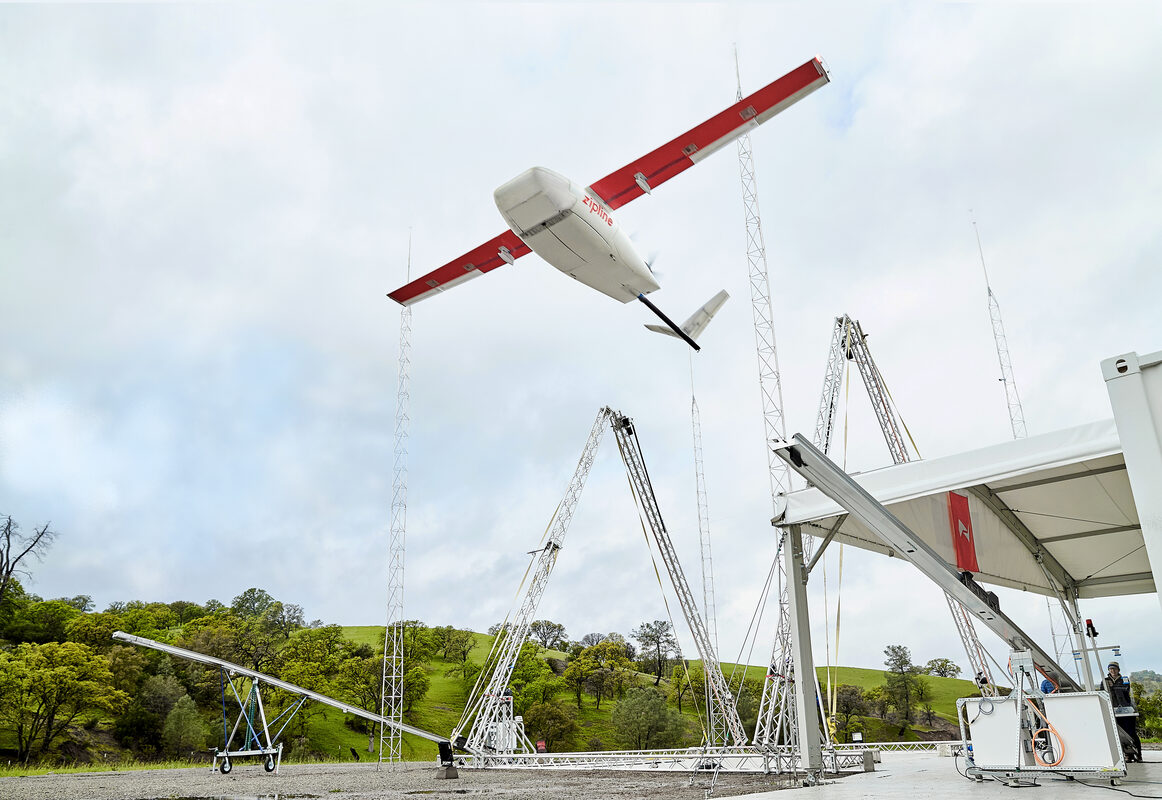
Zipline has the most validated unit economics in the world, but almost entirely in a context — medical supply delivery in sub-Saharan Africa — where the alternative is hours-long ground transport, not a next-day van. Founded in 2014, the company had logged more than 130 million autonomous miles and 2 million deliveries by January 2026, with zero serious injuries. Its P1 platform handles 4-pound payloads over 120-mile round trips for healthcare applications; the consumer-facing P2 covers 10-mile radius at 8 pounds for restaurant and retail delivery. The company has documented a 56 percent decrease in maternal mortality and a 66 percent decrease in missed malaria treatment opportunities at supported facilities — outcomes that justify pricing structures not available to a company trying to undercut DoorDash on pad thai. Zipline's January 2026 $600 million raise — with investors including Fidelity, Baillie Gifford, Valor, and Tiger Global — pushed its valuation to $7.6 billion, up from $4.2 billion in 2023. Its US expansion — DFW, Arkansas, Houston, Phoenix, and Seattle announced — is a genuine consumer bet, but one backed by a margin structure built in a different market.
Wing (Alphabet) has been running commercial deliveries since 2019 and is executing the most aggressive geographic expansion in the US market. The company had logged 450,000-plus deliveries by 2026 across a network that grew from 18 DFW Walmart stores in fall 2023 to 270-plus locations by early 2027, covering Atlanta, Charlotte, Houston, Orlando, and Tampa. DFW average delivery time is under 19 minutes. Crucially, Wing's data shows top-quartile DFW customers ordering three times per week — a habit-formation signal that matters enormously for unit economics, since fixed hub costs amortize against volume. Wing CEO Adam Woodworth framed the ambition in everyday terms: We've spent years building our technology to ensure that when you realize you're out of eggs or need over-the-counter medicine, the solution is just a few taps away, seamlessly integrated into existing store operations.
Wing's hybrid hover/fixed-wing aircraft cruise at 65 mph and cover approximately 75 percent of the DFW population from existing hub locations.
Amazon Prime Air is the most expensive moonshot in the sector. The MK30 — 83-pound MTOW, 5-pound payload, 73 mph, 7.5-mile service radius — is FAA type-certified. Amazon logged roughly 16,000 total deliveries as of February 2026 across Texas, Michigan, Arizona, Florida, and Kansas, against a stated target of 30 million reachable customers by end of 2026 and 500 million packages annually by 2030. The program paused early 2025 over altitude-sensor failures and has seen subsequent incidents including a crane collision and an apartment-building crash. The MK30 carries an estimated build cost of approximately $146,000 per unit, per industry analyses. Amazon's leadership frames speed as the driving force of its logistics strategy — but parcel consultant Satish Jindel has observed that more than 90% of customers don't need their package on scheduled delivery day.
That tension between Amazon's strategic premise and actual consumer behavior is the Prime Air question in miniature.
DoorDash/Flytrex occupy the narrowest, arguably most defensible niche: food delivery, where time-value is real and the competitive baseline is a 45-minute ground courier, not a $5 Amazon shipment. DoorDash commercially launched in DFW in June 2025 after a 1,000-delivery pilot. Flytrex's next-generation aircraft handles 8.8 pounds — enough for two large pizzas, a capability demonstrated with Little Caesars in April 2026. The food delivery wedge sidesteps payload caps (a pizza box clears almost any current aircraft) and the speed premium is unambiguous.
Bull Case, Bear Case
The bull case rests on three interlocking claims. First, the cost curve is real: Amazon's $484-to-$63 trajectory and Zipline's documented scaling prove the math moves in the right direction. Second, habit formation compounds: Wing's three-orders-per-week heavy users generate the volume that amortizes hub costs, and Walmart's 40-percent-of-total Q1 FY27 figure suggests adoption accelerates once a service crosses a convenience threshold. Third, the addressable market is genuinely large — Barclays estimates drone delivery could generate a $16 billion annual profit pool by 2035 even at roughly 10 percent penetration of global food delivery,. Zipline also claims a 97 percent carbon reduction versus gasoline cars, which may matter for regulatory goodwill.
The bear case is equally grounded. Consumer trust in the US is genuinely weak: 57 percent of US adults report little or no trust in drone delivery, and only 11 percent support drone operations near their homes, per eMarketer — compared to 92 percent willingness in India and over 80 percent in China, Brazil, and Saudi Arabia. Noise remains the top community complaint, with drone operations running approximately 50–70 dB (comparable to a leaf blower). Payload caps exclude roughly half of typical retail items. Heat shutdowns create predictable service gaps in the highest-density summer markets. And the BVLOS regulatory framework that unlocks the entire cost model remains unfinalized two years after Congress mandated it.
The honest summary: drone delivery's unit economics are solvable on paper, and a handful of operators are closing on viable cost structures in specific niches. What the sector cannot engineer around, at least in 2026, is the regulatory floor on autonomous operations and the capital intensity of hub infrastructure. The aircraft are ready. The rulebook is not.
Sources
- DOT Office of Inspector General — FAA BVLOS Drone Operations Final Report (June 30, 2025)
- Walmart Newsroom — Walmart Celebrates 1 Million Drone Deliveries (May 29, 2026)
- Zipline Fact Sheet (2026)
- Wing Newsroom — Wing and Walmart Expand Drone Delivery Coast to Coast (Jan 11, 2026)
- DroneDJ — Drone Delivery Cost Analysis (McKinsey, Jan 2023)
- TechCrunch — Zipline Charts Expansion With $600M in New Funding (Jan 21, 2026)
- DroneXL — Drone Delivery $16B Profit Pool (Barclays Research, April 18, 2026)
- FreightWaves — Amazon to Scale Up Drone Delivery (2025–26)
- eMarketer — FAQ on Drone Delivery: What Retailers Need to Know (2026)
- DroneLife — Progress in BVLOS Rulemaking (May 2025)