
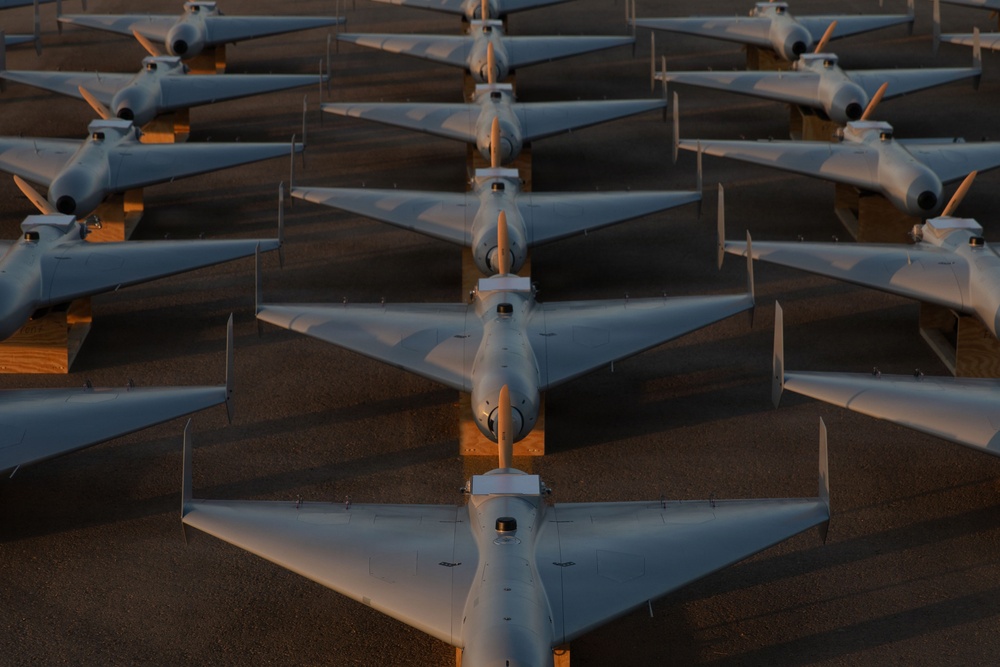
A nearly intact Russian jet-powered Geran-4 has now been photographed, opened up and itemized on camera. The result is a parts list that reads less like a sovereign weapons program and more like a well-run assembly line for imported hardware. Its most consequential component is not a chip. It is a Chinese turbojet of the kind sold to model-aircraft builders.
The teardown comes from Schemes, the investigative unit of RFE/RL's Ukrainian service, working with specialists who study the wreckage of kamikaze drones after mass attacks on the Kyiv region. The specialists are not named in the reporting we reviewed. Schemes published its report on Sept. 19, and an English-language video followed on Sept. 25, according to DroneXL, which summarized the findings on Sept. 28.
What was inside
The Geran-4, also called "Seeker," is the jet-powered successor in the Shahed family. The examined drone was assembled at the Alabuga special economic zone in Tatarstan. According to the Radio Svoboda report by Valeriia Yehoshyna, the drone combines a jet engine, a mesh modem intended to keep the datalink uninterrupted, a camera with optical and digital zoom, a protected 16-channel antenna that complicates Ukrainian electronic warfare, GSM-based navigation and a warhead of up to 90 kg. Most of the foreign parts are Chinese, the report says, but some are Western. The report puts the point bluntly: "What is Russian in this drone is the assembly."
DroneXL's summary of the same material adds detail on each subsystem.
- Engine: a Chinese TJ-2000-class turbojet rated for 30 hours of running time.
- Datalink: a Chinese mesh modem with a stated range of 186 miles (300 km).
- Cellular: two GSM modems carrying SIM cards from Ukraine, Russia and several EU countries. The video adds Belarus, and the Ukrainian-language report mentions Kazakhstan.
- Antenna: a 16-channel controlled-reception pattern antenna (CRPA), up from a 12-element unit on the Geran-3.
- Camera: 10x optical and 32x digital zoom, with a cover stamped "Mini-buterbrod."
- Electronics: Texas Instruments parts on the flight computer's boards, which give the DroneXL headline its Western angle.
One detail is almost domestic. A slip of paper inside the airframe, signed by a local technician at Alabuga, recorded a test run of the engine, according to the Schemes report. It is the sort of quality-control artifact that suggests a production line with acceptance testing, not a workshop.
The engine is the expensive part
The turbojet is where the teardown gets interesting economically. The specialists told Schemes that TJ-2000-class engines are listed at $20,000 to $25,000 in China and about $65,000 in Ukraine, based on classified-ad sites. DroneXL adds that Ukraine's military intelligence directorate (HUR) puts Russia's cost at $35,000 to $40,000 per engine and says Russia has no domestic replacement.
Ukrainian defense intelligence had already described the engine options in May. In a May 25 release covered by Janes on May 27, HUR published a 3D model of the Geran-4 and said the engine is either a Telefly LX-WP-160, rated at 160 kgf (1,600 N), or a Telefly TF-TJ2000A, rated at 200 kgf (1,960 N). The same release gave the airframe as 3.5 m long with a 3 m wingspan, carrying a 50 kg or 90 kg warhead, with a range of up to 450 km. Janes is background here, since it predates the Schemes work by four months, and we have not independently matched the engine on the downed drone to either Telefly model.
A hobby-grade turbojet is cheap next to a missile engine, and it is still a substantial line item on a one-way attack drone. It is also a single-source part. DroneXL notes that a transceiver has a dozen substitutes, while an engine of this thrust class, rated for a defined service life, is harder to swap. That is the angle we take from the reporting: on the evidence in this teardown, the choke point looks like the Chinese engine, not the Western semiconductors. This is our reading of the published material, not a finding stated by Schemes or HUR, though HUR's statement that Russia lacks a domestic replacement points the same way.
Performance claims do not line up
Performance figures differ depending on who is speaking, and they should be attributed separately. The Schemes specialists, as relayed by DroneXL, describe a ceiling of up to 26,000 ft (about 8 km), a speed of up to 450 to 500 km/h (280 to 310 mph) and a route from Crimea to Lutsk of more than 435 miles (700 km). HUR's May figures, as reported by Janes, are a top speed of up to 500 km/h, an altitude of up to 5,000 m (16,500 ft) and a range of up to 450 km. The speed figures are broadly compatible. The altitude figures are not: 5,000 m from Ukrainian intelligence against roughly 8 km from the wreckage specialists. We cannot reconcile them from the sources at hand.
Zelensky's 55 percent claim
The teardown arrived days before a headline number from Kyiv. In his Sept. 26 evening address, President Volodymyr Zelensky said Russia launched more than 2,730 jet-powered Shaheds in September and that more than 1,500 were intercepted or electronically suppressed, about 55 percent, according to UNITED24 Media. He said the interception rate for conventional propeller Shaheds now exceeds 90 percent. He also said several prototype interceptors have been developed, some already used by units in combat, and that Ukraine is expanding interceptor production.
This is a Ukrainian government figure. We have read it only through UNITED24 Media and DroneXL, which relays the same address, and it has not been independently confirmed. It also lumps "intercepted" with "electronically suppressed," which are different outcomes for the people on the ground. Still, the gap between the two rates is what the teardown would lead you to expect. UNITED24 notes the jet variants travel at higher speeds, reducing the time available for air defenses, and the specialists put the jet's ceiling far above the propeller variants. The 16-channel CRPA is described as complicating electronic warfare.
Zelensky also said Ukrainian military intelligence obtained Russian internal 2027 production documents, which, as UNITED24 reports his account, show Russia intending to spend about $12 billion next year on jet-powered drones and loitering munitions. We have no further detail on those documents. Separately, DroneXL cites a HUR statement to Militarnyi on Aug. 12 that Russia builds about 3,000 Geran-4 and Geran-5 drones a month. We could not read the Militarnyi piece, so that number stays attributed to DroneXL's account.
Why It Matters
The teardown puts hard components behind a claim that had been mostly rhetorical: that Russia's long-range drone campaign runs on imported parts. The Chinese mesh modem, the Chinese turbojet and the Texas Instruments chips each point to a different supply relationship, and the SIM cards from several countries show how much of the navigation and connectivity stack rides on ordinary commercial infrastructure.
For sanctions policy, the lesson is about where leverage may exist. If HUR is right that Russia has no domestic substitute, then engine supply is a more meaningful pressure point than the long list of electronic parts, for which DroneXL says substitutes are plentiful. For air defense, the 55 percent versus 90 percent split, if it holds, suggests the new jets are a harder target and that Ukraine is leaning on interceptor drones and electronic suppression to close the gap. And for Russia, a production line that moves from a 12-element to a 16-channel antenna between generations is one that iterates quickly.
Several questions remain open. The specialists are unnamed. The ceiling numbers conflict. The interception figure is one side's claim. But the physical evidence, a drone on a table with its guts labeled, is hard to argue with, and it says the assembly is Russian while much of what matters inside is not.
Sources
- Journalists disassembled a jet Geran: how Russia upgrades the drones attacking Kyiv (RFE/RL Schemes / Radio Svoboda)
- Russia's Geran-4 Runs On A $25,000 Hobby Jet, Texas Instruments Chips (DroneXL)
- Ukraine Now Neutralizes 55% of Russia's Jet-Powered Shahed Drones, Zelenskyy Says (UNITED24 Media)
- Ukraine's defence intelligence reveals Russia's jet-powered Geran-4 OWA UAV components (Janes, May 2026, background)