
Title 14 CFR 91.113 requires every aircraft to see and avoid other traffic. For an unmanned system flying beyond visual line of sight, there are no eyes in the cockpit — detect-and-avoid (DAA) technology is the industry's attempt to satisfy the same legal obligation through sensors, algorithms, and communications links instead of vision. The stakes are not abstract: the U.S. commercial drone fleet was forecast to exceed one million aircraft by the end of 2025. As of December of that year, the FAA had approved just over 1,000 BVLOS waivers. The numbers are only going one direction.
Cooperative and Non-Cooperative: The Foundational Split
Every DAA architecture starts with the same question: does the conflicting traffic announce itself? Aircraft that broadcast position data via ADS-B Out, transponders, or TCAS are cooperative targets. Aircraft that don't are not. The distinction matters because the sensor requirements, processing pipelines, and performance standards differ substantially between the two cases.
ADS-B In is currently the dominant DAA mechanism in practice. A 2026 GAO audit found that most approved BVLOS waivers rely on ADS-B In, with stakeholders calling it "currently the most effective technology for drones to detect and avoid aircraft that are broadcasting their position data" — a qualification that contains its own critique. ADS-B cannot see non-broadcasting aircraft: military jets running dark, gliders, balloons, and unequipped general aviation. The GAO documented three failure modes: inability to detect non-broadcasting traffic, frequency saturation at high aircraft densities, and terrain masking that degrades reception below 500 feet AGL. Remote ID, fully enforceable since 2024, broadcasts drone position over Wi-Fi and Bluetooth but was not designed for manned aircraft to detect drones and lacks the latency and intent data required for tactical collision avoidance. Traffic Awareness Beacon System (TABS) exists as a cooperative option on paper — but per the GAO's 2026 report, no manufacturer has yet produced compliant hardware.
The non-cooperative gap is real: approximately 15% of U.S. airspace operations involve aircraft that do not broadcast position. Bridging it requires active sensing. Radar systems achieve 3–3.5 km detection range with 120° azimuth and 45° elevation per panel in all weather. Electro-optical and infrared sensors reach roughly 2.1 km airborne or 2.8 km ground-based, but are constrained to daylight. Acoustic sensors offer 360° coverage and 2–10 km variable range at low power, but cannot detect balloons, gliders, or skydivers and degrade in noise. No single modality closes the gap; sensor fusion is the field's direction.
"Casia G sees the entire sky, with uniform probability and resolution, 10 times per second — without distractions or breaks." — Jon Damush, CEO, Iris Automation
Airborne and Ground-Based Architectures
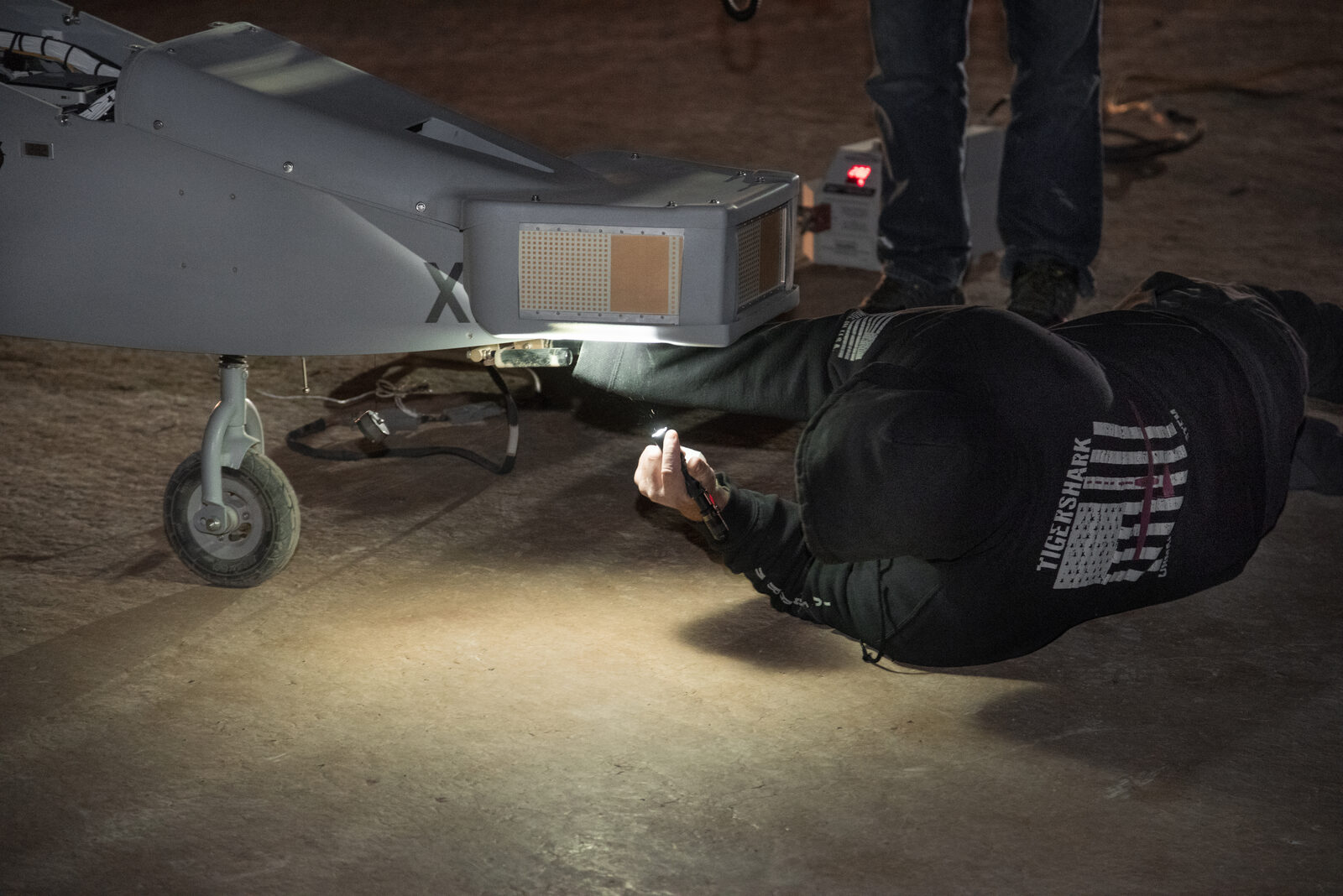
Airborne DAA integrates sensors onto the UAS itself for self-contained conflict detection. General Atomics Aeronautical Systems (GA-ASI) operates the most mature example: the MQ-9 DAA system pairs a Due Regard Radar (DRR) — a two-panel Active Electronically Scanned Array (AESA) — with TCAS II and ADS-B. The system has logged over 3,000 operational hours deployed on U.S. Customs and Border Protection MQ-9s since a 2016 test that used a Cessna C-210 and UH-60 Black Hawk as intruder aircraft, described at the time as "the first integration and evaluation of DRR on an operational UAS." The Naval Air Systems Command awarded GA-ASI a $30.9 million contract for a follow-on MQ-9A DAA radar targeted for completion in April 2026.
Ground-based DAA instruments the operating corridor rather than every aircraft. Iris Automation's Casia G uses AI computer vision with a full 360° optical field of view, 10 Hz update rate, and 2 km detection radius per node, expandable via networked nodes. It supported a BVLOS waiver for the City of Reno. The architecture suits defined corridor operations but carries a structural limitation: terrain masking, buildings, and vegetation interrupt line-of-sight reception below 500 feet AGL. Former Department of Interior aviation director Mark L. Bathrick identified four failure modes for ground-based sensor-centric DAA in Class G airspace: coverage degradation from clutter, non-cooperative traffic gaps, intent blindness (detecting presence without trajectory intent), and alert fatigue that causes operators to inhibit systems. "Situational awareness alone does not scale," he wrote.
The Standards Landscape
RTCA DO-365 targets large UAS in Class D, E, and G airspace with transit through Class B and C. Its DAA Well Clear (DWC) volume triggers when horizontal, vertical, and time-based thresholds defined in RTCA DO-365 are simultaneously breached. Three alerting tiers — Preventive, Corrective, and Warning — protect a progressively tighter Hazard Alert Zone. Compliant hardware under DO-365B requires four components: an ACAS Xu computer with interrogator, an ADS-B transponder, a non-cooperative traffic sensor such as certified radar, and a command-and-control link. FAA adopted TSO-C211 (DAA) and TSO-C212 (Air-to-Air Radar) as the certification basis in 2017. RTCA released DO-365C Change 1 and DO-366B in March 2025, the latter adding a new radar class with reduced delay times, customizable range requirements, and improved clutter management.
ASTM F3442/F3442M-23 targets smaller UAS — maximum dimension at or under 25 feet, airspeeds below 100 knots — in lower-risk Class G and E environments. Its well-clear geometry is tighter: a hockey-puck zone of 2,000 feet horizontal and 250 feet vertical separation. The standard is architecture-agnostic, specifying performance thresholds without mandating sensor configurations. Scope is limited to UAS-to-manned-aircraft avoidance; UA-to-UA conflicts, terrain, and obstacles are explicitly excluded.
The sub-55-lb category is next. MITRE Corporation and MIT Lincoln Laboratory are developing ACAS for small drones; RTCA DO-396 covers ACAS sXu logic for that class, with ACAS Xr covering rotorcraft UAS. The FAA's May 2023 NPRM (Docket FAA-2023-1256) evaluates four standards for BVLOS DAA compliance: ASTM F3442/F3442M-23, RTCA DO-381 for ground-based surveillance, DO-365C for airborne DAA, and DO-396 for small-drone ACAS.
A 2026 GAO report (GAO-26-107648) made clear how much planning remains. FAA officials acknowledged that ADS-B limitations "would require the development of some other electronic conspicuity technology for drones" — a concession that the mechanism underpinning most existing waivers is insufficient at NAS scale. The GAO found the FAA's information-centric NAS plan, targeting 2035 initial capabilities, lacks clear federal versus nonfederal roles, technical milestones beyond 2026, and cost estimates. The department concurred with GAO's recommendation to establish those specifics. Concurrence is not a roadmap.
Sources
- GA-ASI — Detect and Avoid System (MQ-9 DAA technical overview)
- General Atomics / CBP — GA-ASI and CBP Successfully Test Airborne Detect and Avoid System Aboard Guardian UAS (2016)
- GAO — GAO-26-107648: Transforming Aviation: FAA Planning Efforts Should Address How Drones Will Communicate with and Avoid Other Aircraft (2026)
- Sagetech Avionics — Detect and Avoid Systems Now Ready for Takeoff with DO-365B (2021)
- Sagetech Avionics — DAA Requirements Explained According to Airspace and ACAS Classifications
- DroneLife / Iris Automation — Iris Automation Casia G Ground-Based Detect and Avoid Technology (2022)
- Unmanned Airspace — RTCA Updates UAS DAA Safety Standards (2025)
- Unmanned Airspace — FAA Plans Major Overhaul of Detect and Avoid Regulations to Extend BVLOS Operations (2023)
- FlytBase — Detect and Avoid Technology Overview
- Commercial UAV News — Low-Altitude Air Domain Awareness, Coordination, and Collision Avoidance (Mark L. Bathrick, 2026)
- Military Aerospace Electronics — General Atomics Aeronautical Systems Unmanned Detect and Avoid Radar
- DroneLife — Universal Conspicuity, Drones, ADS-B, and Remote ID (2026)