
In 2023, Dedrone logged 4,046 drone flights across 374 major sporting events at 59 stadiums worldwide that violated temporary flight restrictions. That figure represented a nearly 20 percent year-over-year rise from 2022, and NFL regular-season incursions had nearly doubled over two seasons — from roughly 1,300 in 2021-22 to approximately 2,500 in 2022-23. The problem is not that these drones are invisible. They are not. The problem is that the systems capable of detecting them reliably, at scale, fused across multiple sensing modalities, are surprisingly hard to build — and even harder to act on legally.
Dedrone, now a division of Axon Enterprise after a deal that closed October 2, 2024, has spent a decade building that detection infrastructure. Understanding what it does — and, critically, what it cannot do — is essential for anyone tracking the counter-UAS landscape.
A Decade Building the Detection Layer
Dedrone was co-founded by Jörg Lamprecht in the early 2010s. The company eventually moved its headquarters to the Washington, D.C. metropolitan area as the U.S. government emerged as its dominant customer base. By the time Axon announced a definitive acquisition agreement on May 6, 2024, Dedrone served hundreds of commercial, government, and military customers globally. Financial terms were not disclosed.
The Axon rationale was strategic, not defensive. Axon — best known for the Taser and body-worn camera ecosystems — was already building Drones as First Responders programs under its DedroneBeyond BVLOS platform. Acquiring Dedrone folded in the detection infrastructure those programs depend on. As Axon founder and CEO Rick Smith described the logic at announcement:
“By combining Axon’s 30-year legacy of innovation with Dedrone’s cutting-edge airspace security solutions, we aim to revolutionize public safety once again.”
DroneDNA: The RF Signature Library
Most commercial drones — including the entire DJI product line — communicate on radio frequencies: a control uplink from the pilot, a telemetry and video downlink from the aircraft. These transmissions produce detectable, fingerprint-like RF signatures that are largely unique to each drone model and firmware variant. Dedrone built its competitive moat around cataloguing those signatures at scale.
DroneDNA is the company’s proprietary, continuously updated cloud database of RF signatures for approximately 600 individual drone models from more than 150 manufacturers. The analogy to antivirus signature files is accurate: just as endpoint security depends on a maintained library of known malware patterns, Dedrone’s detection capability depends on an up-to-date library of known RF profiles. A drone that appears on an operator’s scope can be classified — model, manufacturer, communication protocol — within seconds of appearing on scope.
The RF sensor hardware spans five models: the RF-160, RF-310, RF-360, RF-560, and RF-900. The RF-560 and RF-900 are the long-range sensors in the lineup. Sensors localize threats via two methods. A single sensor can determine bearing through Angle of Arrival (AOA), giving operators a directional vector toward the drone. Multiple sensors networked together enable Time Difference of Arrival (TDOA) triangulation, which resolves both drone position and pilot location — the latter being operationally critical for any potential law enforcement or military response. Critically, all RF sensing is passive: no transmissions, no jamming, no spectrum interference. This has direct legal significance.
Sensor Fusion and the DedroneTracker.AI Platform
RF detection alone has documented limits. It cannot track a drone through an RF-denied or encrypted-link environment, cannot confirm payload type, and struggles in dense urban RF environments without additional context. Dedrone’s answer is DedroneTracker.AI, its AI/ML-powered command-and-control software that aggregates inputs from RF sensors, radar, cameras, and acoustic sensors through a single sensor fusion engine.
Third-party integrations extend the platform’s reach. DedroneTracker.AI connects to certified technology partners via open API. Radar extends detection range beyond passive RF; optical cameras confirm visual identification and payload; acoustics provide redundancy when RF is jammed or absent. Operators receive a unified picture rather than four separate data streams requiring manual correlation.
Deployment tiers map to threat environment. DedroneFixedSite anchors the system at a permanent facility. DedroneTrailer+ provides mobile rapid-deployment capability. DedronePortable handles temporary or austere deployments. DedroneCity scales to citywide mesh coverage — the Las Vegas deployment built in coordination with federal and local public safety agencies is described as the largest citywide airspace security infrastructure in the world, and was operational for Super Bowl LVIII coverage.
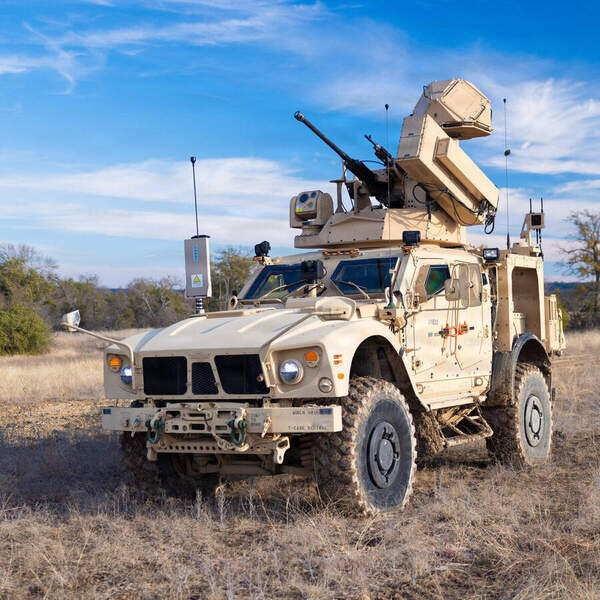
The military customer record illustrates the operational value of persistent detection. A 56-day pilot at an Eastern U.S. military base uncovered 95 instances of UAS activity that had gone entirely undetected prior to the system’s deployment. The platform was subsequently expanded to multiple U.S. bases. A $400,000 Pentagon Defense Innovation Unit contract followed in 2018, the same year C4ISRNET reported that version 3.5 of Dedrone’s software could simultaneously track up to five drones at ranges out to one mile. The company also worked with a NATO military partner on swarm-detection alignment. Dedrone co-founder Jörg Lamprecht characterized the military relationship directly:
“Our partnership is an opportunity to work directly with military installations and inform leaders on how to protect military airspace against rogue drones.”
Today Dedrone’s customer base spans six G7 governments and extends across critical infrastructure sites, airports, and correctional facilities — where drone-smuggled contraband has become a well-documented operational problem. Ukraine’s Ministry of Defense is a confirmed battlefield customer. The platform holds DHS Safety Act Designation status and CPNI-rated product certification.
The Legal Wall Between Seeing and Acting
Understanding Dedrone’s commercial model requires understanding a fundamental legal division in U.S. counter-UAS law — one that shapes every deployment the company makes.
Detection — passive RF sensing, radar, optical observation, acoustic monitoring — carries no federal restriction. Any private operator can deploy Dedrone hardware. Mitigation is a different legal territory entirely. Jamming drone communications violates 47 U.S.C. §§ 301, 302a(b), and 333 (the Communications Act) for unlicensed operators. Physically destroying a drone implicates 18 U.S.C. § 32, which carries up to 20 years for aircraft destruction, and 49 U.S.C. § 46502 for aircraft piracy. These are federal felony statutes, and they apply regardless of the drone operator’s intent.
Counter-UAS authority — defined to include detection, tracking, disruption, seizure, and use of force — is granted under 6 U.S.C. § 210G (the Preventing Emerging Threats Act of 2018) exclusively to the Secretary of Homeland Security, the Attorney General, and authorized DOJ and DHS personnel at designated “covered facilities.” State and local law enforcement are currently excluded from independent mitigation deployment and must operate under federal deputization to take any action beyond observation.
This statutory structure explains a striking data point: between 2018 and 2023, the FBI received 121,000 requests for counter-drone units at stadiums and critical infrastructure. Only 6 percent were fulfilled. The constraint is not detection technology — Dedrone and comparable platforms can detect, classify, and localize at scale. The bottleneck is legal authority and federal resource allocation.
Dedrone’s business model is shaped precisely by this wall: sell detection broadly to airports, prisons, stadiums, military bases, and municipalities. Sell mitigation only to the federally authorized operators who can legally employ it.
Why It Matters
Dedrone sits at the intersection of two curves moving in opposite directions. Drone proliferation continues accelerating — 4,046 stadium TFR violations in a single year is a data point from a market that did not meaningfully exist a decade ago. Legal and institutional capacity to respond, however, remains constrained to a narrow slice of government operators, and the gap between what detection systems can see and what anyone can legally do about it is the defining friction in the commercial C-UAS market.
A decade of DroneDNA accumulation creates a data moat that is genuinely difficult to replicate. A competitor entering the RF-detection market today starts without the signature library, without the historical incident data, and without the federal certifications Dedrone has earned through sustained government deployment. Those certifications — DHS Safety Act Designation, CPNI-rated status — matter to federal procurement officers in ways that are not easily short-circuited by a technically equivalent product.
The Axon acquisition signals where capital expects the market to develop. An end-to-end drone solution — from authorized BVLOS first-responder operations to airspace threat detection — positions the combined entity as both the infrastructure layer for DFR programs and the sensor layer for security. As Dedrone CEO Aaditya Devarakonda framed it, the goal is ensuring “not only the safety of our communities but also the security of nations around the world.”
What remains unresolved is the legislative piece. Until Congress expands mitigation authority to state and local law enforcement, the distance between what Dedrone can detect and what anyone other than a narrow set of federal operators can do about it will remain the central tension in the C-UAS market — and the reason the stadium TFR violation count keeps climbing.
Sources
- C4ISRNET — Dedicated drone tracker can now detect swarming robots (2018)
- PR Newswire / Axon — Axon to Acquire Dedrone (May 2024)
- Axon Corporate Blog — Axon Completes Acquisition of Dedrone (October 2024)
- Dedrone — U.S. Department of Defense Customer Page
- Dedrone — RF Sensors Product Overview
- Dedrone — Ahead of Super Bowl LVIII, Drone Incursions at Stadiums Are on the Rise (January 2024)
- Dedrone — Federal Government and Military Industry Page
- Rupprecht Law — Drone Jammer Legal Problems (attorney analysis)