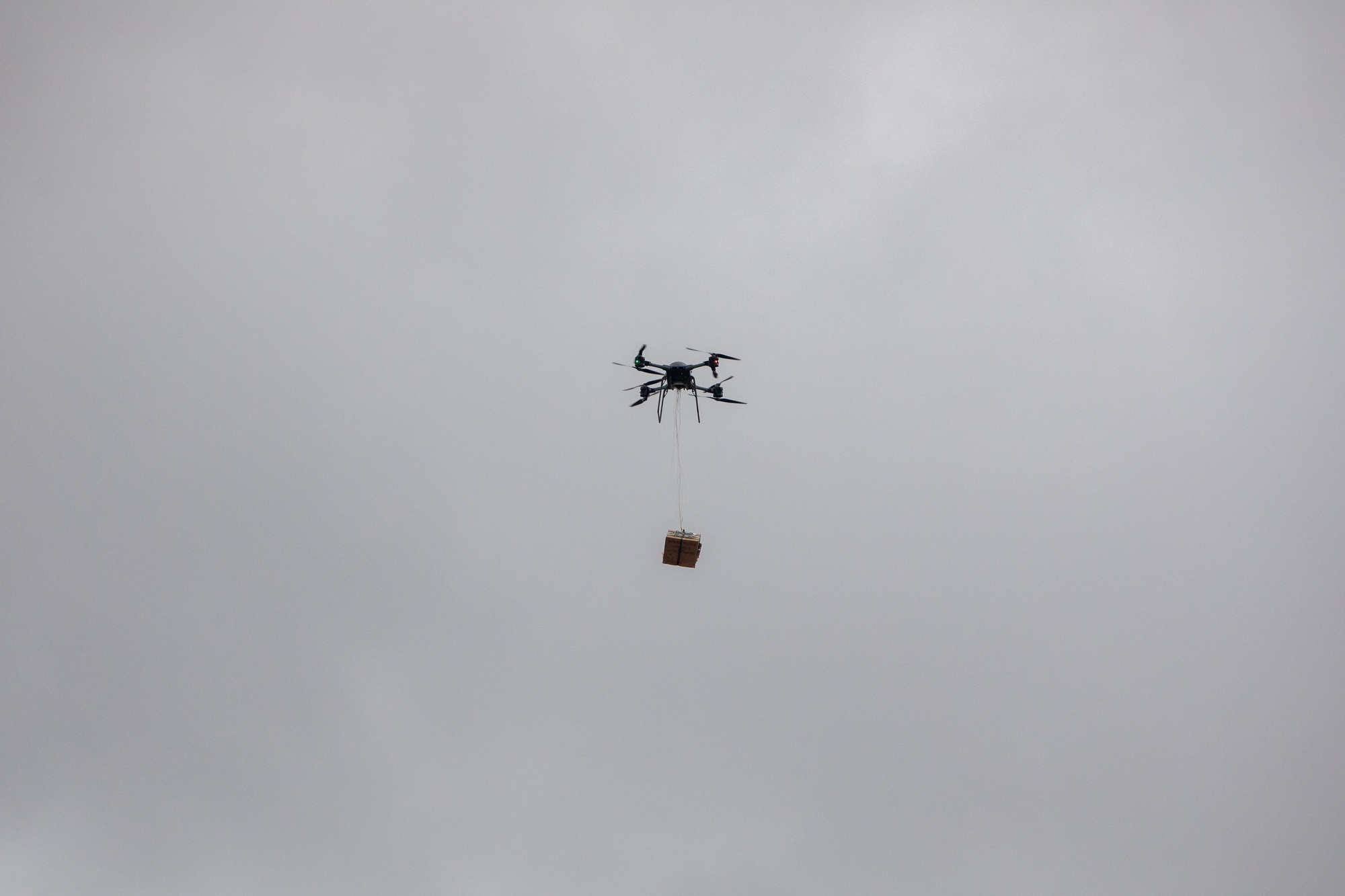
On July 1, 2026, BayCare — the largest not-for-profit academic health system in West Central Florida — announced it will partner with autonomous logistics company Zipline to build a health-care drone-delivery network. The plan is not a pilot or a demonstration. It is infrastructure: a standing aerial link designed to move lab samples, medications and critical supplies between BayCare facilities and, eventually, directly to patients' homes.
The service is slated to go live in late 2027, beginning in the St. Petersburg area. When it does, it will offer what the two organizations describe as on-demand delivery — a courier network that flies rather than drives, dispatched by software instead of a dispatcher.
What BayCare and Zipline Actually Announced
Strip away the launch-day framing and the deal comes down to a concrete set of commitments. BayCare and Zipline will construct a delivery network across West Central Florida. Its payloads are the everyday cargo of clinical operations: diagnostic lab samples that need to reach a central lab quickly, medications that need to reach a pharmacy or a bedside, and the "critical supplies" that hospitals routinely shuttle between sites when one facility runs short and another has stock.
Two delivery modes are on the table. The first is facility-to-facility — the connective tissue of a multi-hospital system, where samples and supplies move constantly between locations. The second, and the more ambitious, is delivery straight to patients' homes. That second mode is where drone logistics starts to reshape the patient experience rather than just the back office: a prescription or a home-care supply arriving by air, on demand, without a patient leaving the house or a courier knocking on the door.
The rollout is deliberately staged. Rather than blanketing the region at once, the network starts in St. Petersburg and expands from there. That is a sensible posture for a system standing up new aviation operations from scratch, and it mirrors how Zipline has scaled elsewhere: prove the corridor, then extend it.
Why Zipline, and Why Now
BayCare is not betting on an unproven vendor. Zipline is one of the most established names in autonomous delivery, and its recent trajectory in U.S. health care has been steep. The company already counts Advocate Health, Mayo Clinic and Cleveland Clinic among its partners. Its work with Advocate Health has been billed as the "nation's largest" hospital drone-delivery program — a signal that the model is moving past novelty and into scaled operations at major health systems.
The scale numbers behind Zipline are what make a deal like BayCare's plausible on a 2027 timeline. The company operates across four continents, serves more than 5,000 hospitals and health facilities, and — by its own accounting — completes a delivery roughly every 20 seconds. That cadence matters. A drone network for health care is only useful if it is reliable and continuous; a service that flies once an hour cannot replace a courier van. A platform already clearing a delivery every 20 seconds worldwide is operating at the tempo hospital logistics demands.
For BayCare, partnering with an operator that has already threaded the regulatory and operational needles at Mayo and Cleveland Clinic de-risks the build considerably. The health system supplies the clinical network and the demand; Zipline supplies the aircraft, the autonomy stack, and — critically — the aviation authority to fly them.
The Regulatory Backbone: FAA Part 135 and BVLOS
The part of this story that is easy to overlook is also the part that makes it possible at all. A drone that can only fly where an operator can physically see it is a toy for logistics purposes. To run a real delivery network — one that spans a metro area and connects hospitals miles apart — an operator has to fly beyond visual line of sight, or BVLOS. And in the United States, commercial BVLOS package delivery runs on a specific legal foundation: FAA Part 135 air-carrier certification.
Part 135 is the same category of certification that governs on-demand and commuter air carriers. The Federal Aviation Administration's package-delivery guidance describes Part 135 certification as the only path for small drones to carry the property of another for compensation beyond visual line of sight. Zipline holds that authority — it received a Part 119 air-carrier certificate as a standard Part 135 operator in June 2022. So do Wing and Amazon, along with several other operators the FAA lists as approved for Part 135 package delivery, including UPS Flight Forward, Causey Aviation, DroneUp and Drone Express.
That certification is the regulatory backbone of the BayCare network. Without it, none of the facility-to-facility routing or home delivery described in the announcement is legal at scale. With it, Zipline can fly the corridors between BayCare's sites and out to patients' homes as a certificated air carrier — not as an experimental operation running on a waiver, but as a business with the FAA credential that mainstream logistics requires.
Questions the Announcement Leaves Open
How many facilities, and how fast? The announcement names St. Petersburg as the starting point and describes a network spanning West Central Florida, but it does not spell out the full facility count or the pace of expansion beyond the first area. Staged rollouts are the norm in this space, and the specifics will likely firm up as the 2027 launch approaches.
What does "to patients' homes" mean in practice? Home delivery is the headline capability, but the eligibility, the payload limits, and the sequencing relative to facility-to-facility service are not detailed. It is common for operators to establish inter-facility routes first — where the endpoints are controlled and predictable — before extending to residential delivery.
Why late 2027? The roughly 18-month runway from announcement to launch reflects the reality of standing up an aviation operation: site preparation, integration with clinical workflows, and the operational build-out that a certificated network requires. It is a timeline that reads as operational, not promotional.
Why It Matters
The BayCare deal is a data point, and a telling one, about where drone delivery in the U.S. actually is. For years, autonomous delivery has lived in the gap between splashy demonstrations and durable operations. Announcements like this one — a large regional health system committing to a multi-site network with a defined launch window, built on an existing operator's certificated air-carrier authority — are the signal that the technology is crossing into mainstream logistics.
Health care is a natural proving ground. The cargo is high-value and time-sensitive, the endpoints are fixed and institutional, and the payoff for speed is measured in patient outcomes rather than convenience. When a lab sample or a medication can move by air in minutes instead of sitting in a courier queue, the value case for BVLOS delivery stops being theoretical.
It also underscores how much the regulatory framework, not just the hardware, gates this market. The reason Zipline can sign a network deal with BayCare — and previously with Mayo Clinic, Cleveland Clinic and Advocate Health — is that it holds FAA Part 135 authority to fly beyond visual line of sight. That certification is the difference between a science project and a business. As more health systems follow BayCare's lead, the constraint on scaling U.S. drone delivery is shifting from "can it fly?" to "who else can earn the authority to fly it commercially?" The BayCare network, launching in St. Petersburg in late 2027, is one more concrete answer to the first question — and a bet that the model is ready for prime time.